
Ibanez AEG70 Acoustic-Electric Guitar
As an Amazon Associate I earn from qualifying purchases.
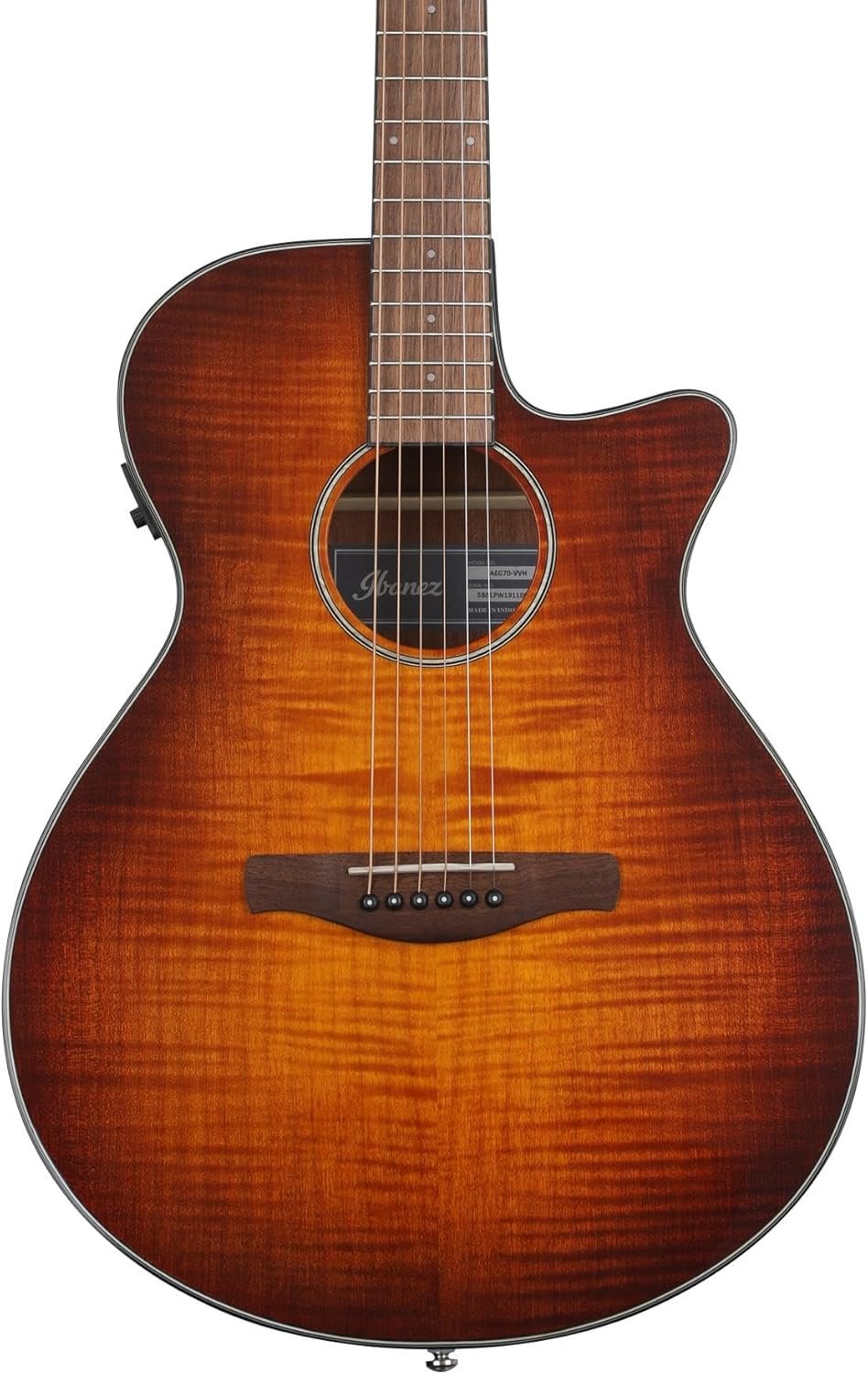
The Ibanez AEG70 Acoustic-Electric Guitar takes a different approach from a large traditional acoustic. Its slim AEG body, cutaway shape and comfortable neck are designed for players who want an acoustic guitar that feels manageable whether they are sitting at home, standing with a strap or plugging into an amplifier.
A flamed maple top gives the guitar its distinctive appearance, while sapele is used for the back and sides. Ibanez pairs this with a Comfort Grip Nyatoh neck, rosewood fingerboard and rosewood bridge. The result is an acoustic-electric that looks noticeably more contemporary than a conventional dreadnought while still retaining familiar steel-string controls and playing dimensions.
Why the slim AEG body matters
The body is one of the main reasons to consider the AEG70.
Ibanez lists the maximum body depth at 3 3/4 inches, with a body width of 15 inches. That relatively slim profile brings the guitar closer to the player and can feel less bulky under the picking arm than a deeper traditional acoustic.
That can make a noticeable difference during longer practice sessions, particularly for players who find large-bodied acoustics cumbersome when seated.
The cutaway also gives the fretting hand more room when moving higher up the neck. You may not spend all your time playing lead lines at the upper frets on an acoustic guitar, but having that access makes the instrument less restrictive when you do.
Visually, the flamed maple top gives the AEG70 considerably more character than a plain acoustic top. Importantly, Ibanez describes this simply as a flamed maple top — it should not be confused with a solid maple top.
What it feels like to play
The AEG70 uses a 25-inch scale length, a 43 mm nut width and a 400 mm fingerboard radius. The Nyatoh neck is 20 mm thick at the first fret and 21 mm at the seventh, according to Ibanez.
Those dimensions help explain why the AEG series can appeal to players coming from electric guitar.
The body is relatively slim, the neck is not excessively chunky, and the 25-inch scale is a little shorter than the 25.5-inch scale found on many steel-string acoustics and electric guitars.
The Comfort Grip neck also has a satin finish, rather than the heavily glossy feel sometimes found on acoustic necks. That gives the fretting hand a smoother surface to move along and suits the modern character of the guitar.
There are 20 frets, with a rosewood fingerboard and simple white dot position markers.
Nothing about the neck is particularly complicated. It is designed to make the guitar approachable and comfortable rather than to recreate the substantial feel of an old-fashioned large-bodied acoustic.
Flamed maple and sapele construction
The AEG70 uses a combination of flamed maple for the top and sapele for the back and sides.
Ibanez describes the maple top as contributing a bright, tight character, while the sapele back and sides are intended to provide warm mids alongside a brighter overall response.
The visual effect is just as important.
The flamed figuring gives the front of the guitar depth under the gloss finish, while the relatively restrained rosette and cutaway body keep the design modern rather than overly decorative.
The rosewood bridge and fingerboard add a darker contrast against the body.
Chrome die-cast tuning machines with an 18:1 gear ratio are fitted at the headstock, and Ibanez uses its Advantage bridge pins at the other end of the strings.
The Advantage pins have a shaped end intended to make them easier to grip during string changes and to stop them being pushed unnecessarily deep into the bridge.
Built for plugged-in playing
The AEG70 is an acoustic-electric rather than an acoustic guitar with electronics added almost as an afterthought.
Under the saddle sits an Ibanez T-bar II pickup, connected to the AEQ-TTS preamp mounted in the side of the guitar.
The control system is deliberately simple.
There is a Volume control, a Shape control and a built-in tuner with its own LCD display.
Leaving the Shape control around its centre position provides the more natural starting point. Turning it in one direction shifts the response towards a fuller, heavier sound, while moving the other way produces a brighter character.
That single control avoids covering the side of the guitar with a bank of sliders and EQ knobs.
For somebody playing live, that simplicity can be useful. You can make a broad tonal adjustment quickly without navigating menus or remembering several control positions.
The built-in tuner is equally practical. It means basic tuning can be checked without attaching a separate clip-on tuner every time the guitar is plugged in.
The electronics are powered by a 9V battery, and the guitar uses a standard quarter-inch output.
Useful at home and on stage
Unplugged, the AEG70 can be used like any other steel-string acoustic for practice, songwriting and casual playing.
Its slimmer body is particularly attractive where comfort and convenience matter more than producing the sheer acoustic volume of a large dreadnought.
Plug it in, however, and the guitar becomes much more flexible.
The onboard pickup allows it to feed an acoustic amplifier, suitable PA system, audio interface or other appropriate equipment without positioning a microphone in front of the soundhole.
That can make recording simpler as well.
A microphone can certainly capture a richer sense of the guitar in the room, but an undersaddle pickup gives you a clean direct signal without having to worry about microphone placement, background noise or the player moving away from the mic.
For live work, a direct output also makes the setup far more predictable than trying to microphone an acoustic guitar in a noisy room.
The drawbacks
The slim body that makes the AEG70 comfortable also creates its first compromise.
This is not a large-bodied acoustic designed primarily to produce maximum unplugged volume and deep low-frequency projection.
If your priority is sitting in a room with no amplification and getting the fullest possible traditional acoustic sound, a deeper dreadnought or similarly substantial body may suit you better.
The AEG70 makes more sense when comfort, plugged-in flexibility and easy handling are important parts of the decision.
The flamed maple top is also not described by Ibanez as solid wood.
That distinction is worth making because acoustic-guitar listings and older descriptions can sometimes blur the difference between a particular wood species and solid-wood construction.
Players specifically shopping for a solid-top acoustic should therefore not assume the attractive flamed maple appearance means solid maple.
The electronics are deliberately straightforward, which can be either an advantage or a limitation.
The AEQ-TTS preamp gives you volume, the Shape control and a tuner. It does not provide separate bass, middle and treble controls.
If you prefer detailed onboard EQ adjustments while performing, the simple two-knob arrangement may feel restrictive.
You can of course shape the sound at an acoustic amplifier, mixer or external preamp, but that means making those changes elsewhere in the signal chain.
An undersaddle pickup also sounds different from hearing the guitar acoustically in the room.
The T-bar II is useful for producing a consistent direct signal, but players seeking a highly natural microphone-like recorded sound may still prefer using a good external microphone or combining different recording methods.
The guitar also relies on a 9V battery for its onboard electronics.
That is completely normal for this type of acoustic-electric, but it means keeping an eye on battery condition if the guitar is being used for performances. A flat battery shortly before playing is easily avoided by keeping a spare in the case, but it is still another maintenance item that a purely acoustic guitar does not have.
The shallow body can also feel unfamiliar if you are accustomed to a large traditional acoustic.
Some players enjoy having less guitar pressing against their chest and picking arm. Others specifically like the physical presence of a big dreadnought and may find the AEG70 almost too streamlined.
The glossy body finish is another matter of personal preference.
It highlights the flamed maple nicely and gives the instrument a polished appearance, but glossy surfaces tend to show fingerprints more readily than satin finishes and may require wiping down if you like the guitar to remain looking pristine.
The cutaway is useful for upper-fret access, but players who spend virtually all their time strumming open chords may receive little practical benefit from it.
Likewise, the pickup and preamp add most value when the guitar is going to be amplified or recorded directly.
If you know the instrument will only ever be played acoustically at home, a simpler non-electro-acoustic design could give you fewer components that you never use.
The AEG70 is therefore best viewed for what it actually is: a slim, modern acoustic-electric with an emphasis on comfort and versatility rather than a replacement for every style of traditional acoustic guitar.
Who it suits best
The Ibanez AEG70 should particularly appeal to guitarists who find conventional acoustics physically bulky.
Electric guitar players moving into acoustic playing may also appreciate the relatively slim body, manageable 25-inch scale and comfortable neck profile.
It makes sense for singers who want an acoustic-electric they can plug directly into live equipment, home players who want one guitar for both unplugged practice and recording, and musicians who appreciate a modern-looking instrument rather than a very traditional acoustic design.
The simple preamp also suits players who would rather make quick adjustments than work with several small EQ controls while playing.
Is it worth the guitar space?
The Ibanez AEG70 has a clear purpose.
It combines a slim AEG body and cutaway with a flamed maple top, sapele back and sides, comfortable Nyatoh neck and straightforward onboard electronics. The T-bar II pickup and AEQ-TTS preamp make plugging in uncomplicated, while the built-in tuner removes one more piece of equipment from the basic setup.
Its shallow body will not provide the same unplugged experience as a large traditional acoustic, and players wanting detailed onboard EQ or specifically seeking solid-top construction should take those limitations into account.
But for someone who wants an acoustic-electric that feels comfortable against the body, looks distinctive and can move easily between home practice, recording and amplified playing, the AEG70 offers a particularly practical combination.
Explore more acoustic guitars in our Acoustic Guitars section.
As an Amazon Associate I earn from qualifying purchases.