
Audio-Technica ATH-M50x Professional Monitor Headphones
As an Amazon Associate I earn from qualifying purchases.
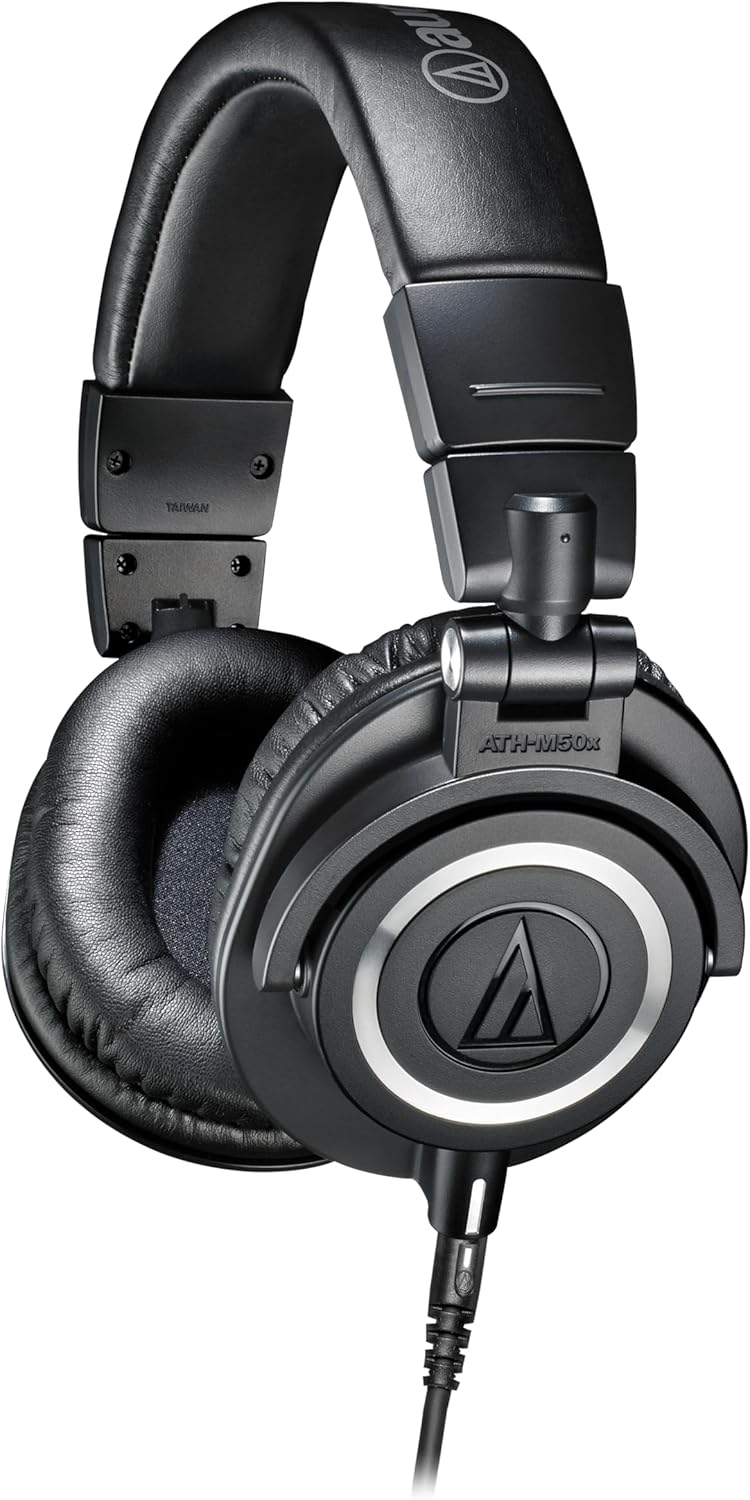
The Audio-Technica ATH-M50x Professional Monitor Headphones have become a familiar sight in home studios, rehearsal spaces and recording setups because they combine a closed-back design with straightforward wired operation and enough isolation to make them useful while recording.
For a guitarist, that makes them particularly practical.
They can be connected to an audio interface, headphone amplifier, modelling unit or suitable guitar processor for quiet practice, recording and checking tracks without filling the room with sound.
They are not wireless lifestyle headphones and they do not try to be. The ATH-M50x are built around a simple idea: plug them in, hear the signal directly, and get on with recording or playing.
Why they work for guitar recording
The ATH-M50x use 45 mm dynamic drivers with neodymium magnets and copper-clad aluminium voice coils. Audio-Technica specifies a frequency response of 15 Hz to 28,000 Hz and an impedance of 38 ohms.
For home recording, the closed-back construction is especially useful.
If you are recording an acoustic guitar or vocals with a microphone, open-back headphones can allow more of the backing track or click to leak into the microphone.
The ATH-M50x earcups are designed to fit around the ears and provide useful acoustic isolation from the room.
That helps keep headphone spill under control while still allowing you to hear the backing track clearly.
Electric guitar players can benefit in a different way.
Connect the headphones to an audio interface or modeller and you can practise or record without using a loud amplifier in the room.
That is particularly useful late at night or in a home where turning up a guitar amp is not practical.
What they feel like to wear
The ATH-M50x are an over-ear design rather than small on-ear headphones.
The padded earcups surround the ears, and the headband is padded across the top.
Audio-Technica lists the headphones at approximately 285 g without the cable, so they have a solid feel without being especially heavy for full-size studio headphones.
The earcups can swivel through 90 degrees, which makes it possible to move one side away from the ear for quick one-ear monitoring.
They also fold inward for storage.
That makes them easier to put into a bag or studio drawer than a completely rigid pair of headphones.
The construction feels more substantial than lightweight consumer headphones, which makes sense given that they are intended to cope with regular studio and monitoring use.
Three detachable cables
One of the most practical parts of the ATH-M50x package is the detachable cable system.
Audio-Technica includes three different cables:
- a 1.2 m to 3 m coiled cable
- a 3 m straight cable
- a 1.2 m straight cable.
This gives you some choice depending on how the headphones are being used.
The short cable makes sense when sitting close to an audio interface or portable device.
The longer straight cable gives more freedom when moving around a recording room.
The coiled cable is useful when you want extra reach without having several metres of loose cable lying permanently across the floor.
Because the cables detach, a damaged cable does not automatically mean replacing the entire pair of headphones.
A screw-on 6.3 mm adaptor is also included for equipment using the larger professional headphone socket.
Useful with guitar modelling equipment
The ATH-M50x can work particularly well with modern guitar equipment.
Headphone amps, desktop modelling units, multi-effects processors and audio interfaces often provide dedicated headphone outputs.
Plugging a pair of closed-back headphones directly into that equipment allows you to hear amp modelling, cabinet simulation, delay, reverb and other effects without needing a physical guitar speaker running in the room.
This can be useful for practising.
It can also help when creating tones for direct recording.
You can work on a guitar sound without disturbing anyone else, then record the same modelled signal directly into the computer.
Because the ATH-M50x are wired, there is no Bluetooth delay between playing the string and hearing the result.
For guitar practice, that matters.
Even a small amount of wireless latency can make playing feel disconnected from the instrument.
Good for tracking as well as listening
Closed-back headphones are particularly useful while tracking, which simply means recording the performance.
Imagine recording acoustic guitar with a microphone while listening to a click track.
You need to hear the click clearly, but you do not want the microphone picking it up from the headphones.
The circumaural closed-back design helps reduce that problem.
The same applies when recording vocals over a guitar arrangement.
The backing track remains close to the ears rather than being projected into the room.
That makes the ATH-M50x more naturally suited to recording sessions than many open-back designs.
They can also be useful when checking a mix or editing tracks, although it is worth understanding that headphones should ideally be one part of the monitoring process rather than the only reference used.
Listening to guitar detail
For guitarists, headphones can reveal details that are easy to miss through room speakers.
String noise, pick attack, fret movement, excessive gain, unwanted hiss and poorly timed delay repeats can all become much more obvious when the sound is delivered directly to the ears.
That can be useful when recording.
A guitar tone that sounds impressive at first may become tiring when listened to closely.
Too much low end can make rhythm parts muddy.
Too much treble can make distorted sounds harsh.
Too much reverb can push the guitar backwards in a mix.
Using headphones gives you another perspective before committing to the sound.
The ATH-M50x can also expose small performance problems that might otherwise be hidden by the acoustics of the room.
That is not always flattering, but it can be useful.
No batteries, pairing or software
One of the strengths of the ATH-M50x is how little setup they require.
There is no rechargeable battery.
There is no Bluetooth pairing.
There is no mobile app.
There are no firmware updates.
Plug the cable into the headphones, connect the other end to the equipment, and they work.
For a home studio, that simplicity can be valuable.
You may already have recording software, an interface, plug-ins, pedals and modelling equipment demanding attention.
The headphones themselves do not need to become another piece of technology to manage.
The 38-ohm impedance also means they are designed to work with a wide range of normal headphone outputs rather than requiring an unusually powerful specialist headphone amplifier.
The drawbacks
The first drawback is comfort.
The ATH-M50x provide useful isolation partly because the earcups sit firmly around the ears.
Some people can wear them for hours without difficulty.
Others may find the clamping pressure or enclosed feeling tiring during very long sessions.
Closed-back headphones also retain more heat around the ears than open-back designs.
During a short guitar practice session that may not matter.
After several hours of recording or editing, warm earcups can become noticeable.
The synthetic earpad and headband material will also wear over time.
Audio-Technica’s own documentation notes that the pads and headband can deteriorate through use and storage.
Replacement pads are therefore something long-term owners may eventually need to consider.
Another limitation is that the ATH-M50x are not specifically marketed as completely flat reference headphones.
Audio-Technica describes them as providing extended clarity and strong, accurate bass reproduction rather than claiming an entirely neutral frequency response.
That matters when mixing.
They can certainly be used to edit recordings, balance tracks and make tonal decisions, but I would not rely on any single pair of headphones as the final judge of a mix.
A good habit is to check finished work through several systems: headphones, monitors, ordinary speakers and perhaps even a phone or car system.
If a mix only sounds right through one pair of headphones, there may still be work to do.
The closed-back design also creates a different listening experience from open-back studio headphones.
Open-back models can often feel more spacious because sound is allowed to interact more freely with the surrounding air.
The ATH-M50x trade some of that openness for isolation.
For tracking guitar and vocals, that trade-off is useful.
For long analytical mixing sessions, some people may prefer an open-back design.
The cable connection is another point to consider.
These are wired headphones.
If you want to walk around the house listening from your phone without a cable, the ATH-M50x are not designed for that.
Audio-Technica does make Bluetooth versions in the wider M50x family, but the standard ATH-M50x covered here are conventional wired headphones.
For recording guitar, I actually prefer that.
A cable avoids wireless latency and charging.
But for general casual listening, some users may prefer the convenience of wireless headphones.
The detachable cable is proprietary at the headphone end rather than a simple cable you can necessarily replace with any random 3.5 mm lead.
That means it is sensible to look after the included cables or obtain a compatible replacement if one is lost.
At 285 g before the cable is attached, the ATH-M50x are also not ultralight headphones.
The weight is perfectly reasonable for studio equipment, but somebody accustomed to very light consumer headphones may notice the difference.
Another limitation is that there is no built-in microphone for calls or gaming.
These are monitoring headphones, not a communications headset.
If you need to speak during online sessions, voice chat or remote lessons, a separate microphone is needed.
There is no active noise cancellation either.
The isolation comes from the physical closed-back design and earcup seal.
That is useful in a studio because it requires no electronics, but it will not cancel low-frequency travel noise in the way modern active-noise-cancelling headphones can.
The swivelling earcups are useful, but the folding hinges also introduce moving parts.
As with any foldable headphone design, repeatedly throwing them loose into a bag is not ideal.
A soft carrying pouch is supplied, but it does not provide the protection of a hard case.
If they are going to travel regularly with other heavy equipment, a more protective case may be worthwhile.
There is also the question of whether you really need studio-style headphones.
If all you want is casual music listening from a phone, there are simpler and more convenient options.
The ATH-M50x make the most sense when the wired connection, isolation, detachable cables and monitoring design are actually useful.
For a guitarist recording at home, those features are much easier to justify.
Who they suit best
The Audio-Technica ATH-M50x are particularly well suited to guitarists recording at home.
They work naturally with audio interfaces, modelling devices and headphone amplifiers.
The closed-back construction makes them useful while recording acoustic guitar or vocals with a microphone because it helps reduce sound leaking back into the recording.
Electric guitar players can use them for silent practice with a modeller or interface.
Songwriters can record demos late at night without running monitor speakers.
They should also suit musicians who want one pair of headphones that can handle both recording and ordinary music listening without requiring batteries or wireless setup.
Are they worth the studio space?
The ATH-M50x have remained useful because they solve several ordinary recording problems without making the solution complicated.
The 45 mm drivers, closed-back earcups, 38-ohm impedance, swivelling design and three detachable cables make them practical around a home studio.
They are particularly well suited to tracking guitar and vocals, practising through modelling equipment, editing recordings and listening without disturbing the room around you.
They are not weightless, wireless or actively noise-cancelling, and I would not treat them as the only monitoring reference needed for serious mixing.
But for a guitarist who wants a dependable pair of wired closed-back headphones that can move easily between practice, recording and everyday listening, the ATH-M50x remain a very practical piece of studio gear.
Explore more useful equipment in our Guitar Gear section.
As an Amazon Associate I earn from qualifying purchases.