
Fender Frontman 10G Guitar Amp
As an Amazon Associate I earn from qualifying purchases.
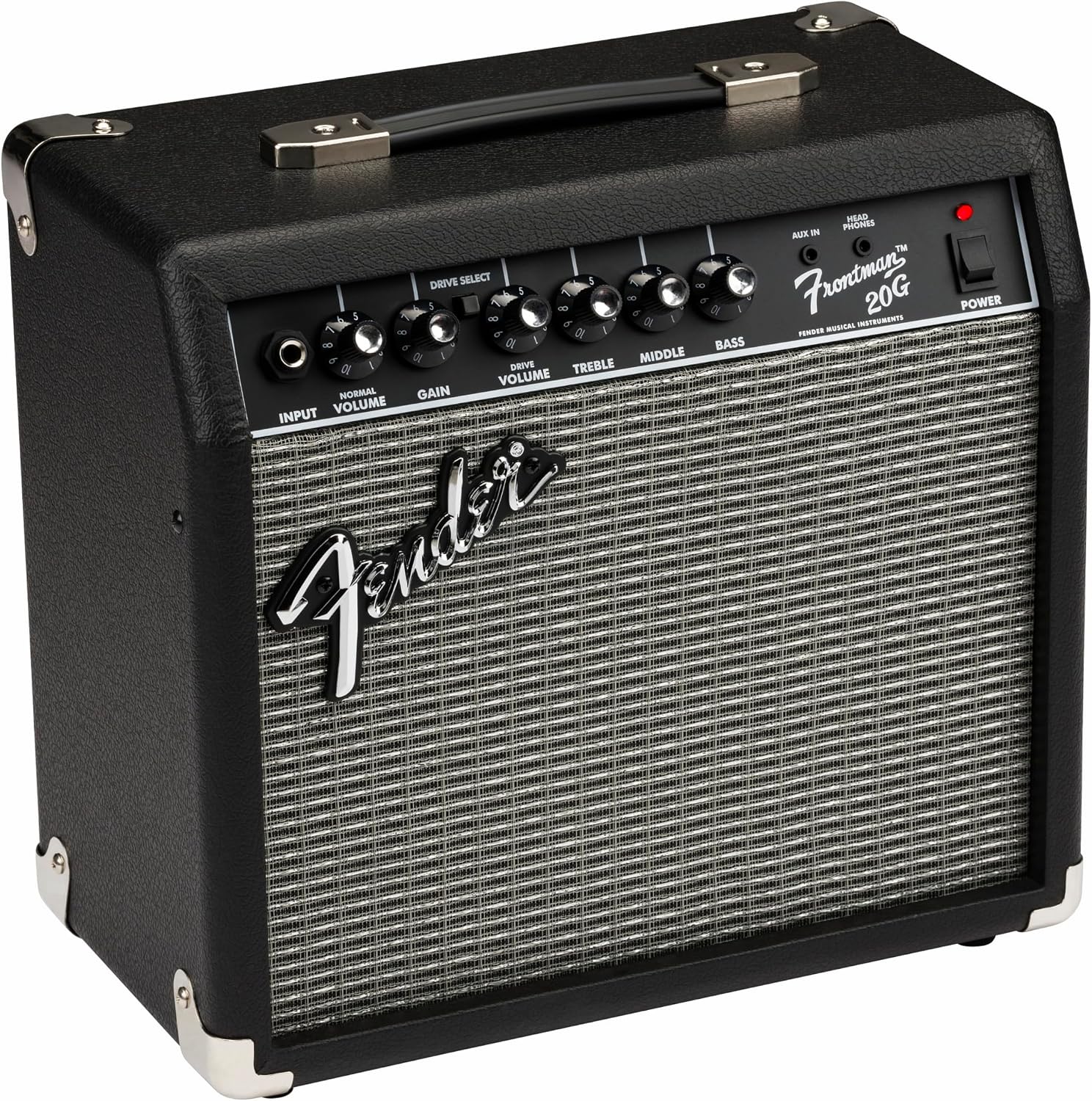
The Fender Frontman 10G Guitar Amp is built for the simplest kind of electric-guitar practice: plug in, turn a few familiar controls and start playing.
Its 10-watt solid-state amplifier drives a single 6-inch Fender Special Design speaker, while the front panel keeps everything straightforward with gain, volume, treble and bass controls. A separate overdrive switch adds a dirtier sound without requiring a pedal.
For bedroom practice, lessons or keeping a small amp beside the guitar ready to use, that simplicity is a large part of the appeal.
Why it works for home guitar practice
The Frontman 10G does not ask you to learn menus, presets or an app before you can get a usable sound.
Plug the guitar into the quarter-inch input, set the volume, adjust treble and bass, and you are ready to play.
For clean tones, the controls can be kept fairly restrained. Press the overdrive switch and the gain control becomes much more prominent, allowing the amp to move from mild breakup into a more saturated distorted sound. Fender specifically positions the Frontman 10G as an easy-to-use practice amplifier for newer players.
That makes it particularly useful when the aim is actually learning the guitar rather than spending half the practice session adjusting equipment.
What it feels like to use
Physically, the Frontman 10G is compact and fairly light.
Fender lists it at around 8.5 lb, with a cabinet approximately 10.25 inches wide, 11 inches high and 5.75 inches deep. It is small enough to sit beside a desk, under a shelf or in the corner of a bedroom without dominating the space.
The cabinet has black textured vinyl, silver grille cloth and familiar Fender-style controls across the front.
It feels more like a miniature traditional guitar combo than a piece of computer equipment. There is a proper carry handle on top, physical knobs beneath your fingers and a simple red power light rather than a bright screen.
That tactile simplicity is pleasant. Gain feels like gain, volume feels like volume, and there is little chance of getting lost in settings.
Clean and overdriven sounds
The Frontman 10G has one main channel, but the overdrive switch gives it two noticeably different personalities.
Leave the overdrive off and the amp can provide the clearer sound you would expect for chords, basic rhythm practice and cleaner guitar parts.
Switch overdrive on and the gain control pushes the sound into distortion. Fender describes the range as moving from tube-style overdrive towards heavier saturation.
The separate treble and bass controls let you shape the broad character of either sound.
This is not the same as having a full three-band EQ or several amplifier models, but for a small practice amp it gives enough adjustment to hear how different settings interact with the pickups and controls on the guitar.
That can actually be useful for a newer player. Rather than scrolling through dozens of sounds, you learn what gain, bass and treble physically do.
Headphone practice
One of the most useful features for a bedroom setup is the headphone output.
Plugging in headphones allows you to practise without the main speaker filling the room, which is handy late at night or when other people are nearby. Fender includes a dedicated 1/8-inch headphone output on the front panel.
That means the Frontman 10G can remain the centre of a small practice setup even when playing aloud is not practical.
There is also a 1/8-inch auxiliary input.
A phone, tablet or another suitable audio source can be connected so you can play along with backing tracks, lessons or songs through the amplifier.
For somebody learning guitar from online lessons or practising songs by ear, that is arguably more useful than another bank of built-in effects.
A small closed-back cabinet
Fender uses a closed-back cabinet around the 6-inch speaker.
In a practice amp this helps keep the enclosure compact and gives the small speaker a firmer, more contained character.
The cabinet is made from medium-density fibreboard rather than being a lightweight hollow plastic shell. Fender lists seven-ply 3/4-inch MDF construction.
You still feel the physical limitations of a 6-inch speaker, of course, but the amp itself feels like a proper little combo rather than a novelty desktop speaker.
The drawbacks
The first limitation is the 6-inch speaker.
It keeps the cabinet compact, but a speaker this size cannot move air like a 10-inch or 12-inch guitar speaker. The Frontman 10G can sound perfectly useful at practice levels, but it will not give you the same fullness, low-end weight or physical push as a larger combo.
That matters particularly if you like heavily distorted sounds.
At modest volume, the overdrive can be fun and useful for practice. Push the amp hard and the small speaker naturally starts to sound more compressed and boxy than a larger amplifier.
The 10-watt output also defines where the Frontman belongs.
It is a practice amplifier, not a rehearsal amp for competing with an acoustic drum kit. A quiet rehearsal or informal jam may be possible depending on the other instruments, but that is not the job it is built around.
There are no built-in delay, reverb, chorus or modulation effects either.
You get clean and overdriven sounds, plus bass and treble control. If you want ambience or more elaborate tones, you will need separate pedals or a different amplifier.
That simplicity is refreshing when learning, but it also means the Frontman can feel limited once your tastes become more specific.
There is only one guitar input and one basic channel.
You cannot save different sounds and recall them later. If you find a clean setting you like and then change everything for an overdriven tone, you will need to turn the knobs back manually.
The overdrive itself is straightforward rather than subtle.
Players who become particular about distortion may eventually prefer a dedicated overdrive or distortion pedal, where gain character, EQ and response can be chosen more carefully.
The tone controls are limited to treble and bass.
There is no dedicated midrange control, so you cannot shape the middle frequencies independently. On a larger or more sophisticated amplifier, that extra control can make quite a difference to how the guitar sits in a room or recording.
The auxiliary input is useful, but it is a simple wired connection.
There is no Bluetooth audio, so playing a backing track means physically connecting the source device with the appropriate cable.
Likewise, there is no USB recording output.
If you want to record the Frontman 10G directly into a computer, you will need another method such as a microphone and audio interface. Modern modelling practice amps sometimes include USB audio, but the Frontman deliberately keeps things much more traditional.
The headphone output is valuable, although the listening experience will naturally depend on the headphones being used.
Cheap or uncomfortable headphones can make extended practice tiring, and the sound through headphones will not feel exactly like hearing the physical speaker in the room.
The Frontman 10G also runs from mains power rather than an internal rechargeable battery.
That is not a problem when it lives permanently in a bedroom or practice corner, but it is less flexible than a battery-powered desktop amp if you like moving around the house or practising outdoors.
The small cabinet is easy to carry, yet it still needs a power socket.
Another consideration is how quickly a progressing player may outgrow it.
A beginner learning open chords, barre chords and simple riffs may find the Frontman 10G does everything required. As playing develops, you might start wanting a larger speaker, better overdrive, reverb, several channels or enough volume for rehearsals.
That does not make the Frontman a poor choice. It simply means it has a clearly defined job rather than trying to be a long-term answer for every situation.
And finally, the compact format is useful only if you genuinely need a compact amplifier.
If there is room for a larger combo and you already know you want to rehearse with other musicians, buying bigger from the beginning may make more sense.
Who it suits best
The Fender Frontman 10G makes most sense for a beginner, casual home player or guitarist who wants a small amplifier permanently available for practice.
It suits bedrooms, spare rooms and small home practice areas particularly well because it takes up little floor space and can be carried easily.
The simple controls are also useful for somebody still learning how amplifiers work.
You can hear what changing gain, bass and treble actually does without being distracted by dozens of presets.
More experienced players might also find it useful as a small secondary amp that stays ready for quick practice when switching on the main rig feels unnecessary.
Is it worth the bedroom space?
The Fender Frontman 10G succeeds by keeping things uncomplicated.
Its 10-watt output and 6-inch speaker are modest, but that is precisely why the amp works in a bedroom or small practice space. The physical controls are easy to understand, the overdrive switch gives you a second basic flavour, and headphone and auxiliary connections make quiet practice and playing along with music straightforward.
It is not a replacement for a larger rehearsal amplifier, and players wanting built-in effects, Bluetooth or USB recording will need something more sophisticated.
But for keeping an electric guitar within reach and being able to plug in and practise without turning the room into a studio, the Frontman 10G has a very clear purpose.
Explore more guitar amps in our Amplifiers section.
As an Amazon Associate I earn from qualifying purchases.