
When Your Tone Travels Seventy-Five Feet
Amazon Associate Disclaimer: As an Amazon Associate, we may earn from qualifying purchases. This comes at no extra cost to you and helps support our website.
The Creative Space Between You and Your Amp
There’s a certain electricity in the air when you’re plugged into your amp and you take a step back. The sound changes, the room breathes, and suddenly you’re not just playing a guitar—you’re interacting with a space. Now, imagine having the freedom to walk across a stage, into a control room, or around your entire studio without that familiar tension of a short leash pulling you back. That’s the kind of creative horizon a 75 ft guitar cable begins to sketch out.
Rethinking Your Relationship with Length
For most of us, a guitar cable is an afterthought. It’s the necessary tether that connects our instrument to the amplifier. We uncoil it, plug it in, and try not to trip over it. But when you start thinking about a cable that stretches to 75 feet, it stops being just a utility. It becomes a tool for reimagining your entire setup.
The fundamental challenge with any long instrument cable is maintaining the integrity of your signal. As a cable gets longer, it naturally accumulates more capacitance. This can interact with your pickups, especially passive ones, and subtly roll off the high-end frequencies, potentially making your tone sound darker or “woolly”. It’s the reason many guitarists instinctively avoid long cable runs. The physics of it are simple: the longer the journey, the more potential for the signal to lose its sparkle.
However, the product details for this 75 ft option point to a different approach. The use of a 20 AWG oxygen-free copper conductor is a significant factor here. Compared to the more common 22 AWG wire, a thicker 20 AWG conductor offers lower resistance. This is crucial for a cable of this length, as it helps to ensure that more of your guitar’s original signal makes the journey from your fingers to the speaker.
The Science of a Clean, Long Run
Beyond the conductor itself, the construction of the cable plays a massive role in how it performs. The mention of a five-layer shielding system, which includes an aluminum foil layer and a dense OFC braided shield, is designed to tackle one of the biggest enemies of a long cable run: noise. In a world filled with electromagnetic interference from lighting, power supplies, and other gear, a long, unshielded cable can act like an antenna, picking up all sorts of unwanted hum and buzz. The goal here is to provide a “noiseless experience”, allowing the natural tone of your guitar to come through without being masked by interference.
New Sounds from a New Perspective
Let’s set the technical specs aside for a moment and think about what this length actually does for your music. It fundamentally changes the relationship between you, your instrument, and your amplifier.
The Stage as Your Canvas: On a larger stage, a 75 ft cable is liberation. You’re no longer confined to a small patch of floor near your amp. You can walk to the front of the stage and engage with the audience during a solo, move to interact with other band members, or use the entire performance space as part of your act. It’s about physical expression being directly tied to your sound.
The Studio as a Playground: The recording studio is where this kind of cable can really shine. One of the classic recording dilemmas is placing an amplifier in a live-sounding room while the guitarist is in the control room. With a 75 ft cable, that challenge becomes a creative opportunity. You can mic up your amp in a hallway for a natural reverb, place it in a tiled bathroom for a unique ambience, or keep it in the live room while you listen to the playback in the control room to fine-tune your tone. You can even run the cable out to an isolation box in another room to get a cranked amp sound without deafening everyone in the studio.
The Home Studio Evolution: Even in a modest home setup, the extra length can be transformative. Ever wanted to sit on your sofa while you track a part, or stand in the middle of the room to get a better sense of your sound in the mix? This kind of cable allows you to position your amp exactly where it sounds best in the room, rather than being forced to place it right next to you.
Built for the Journey
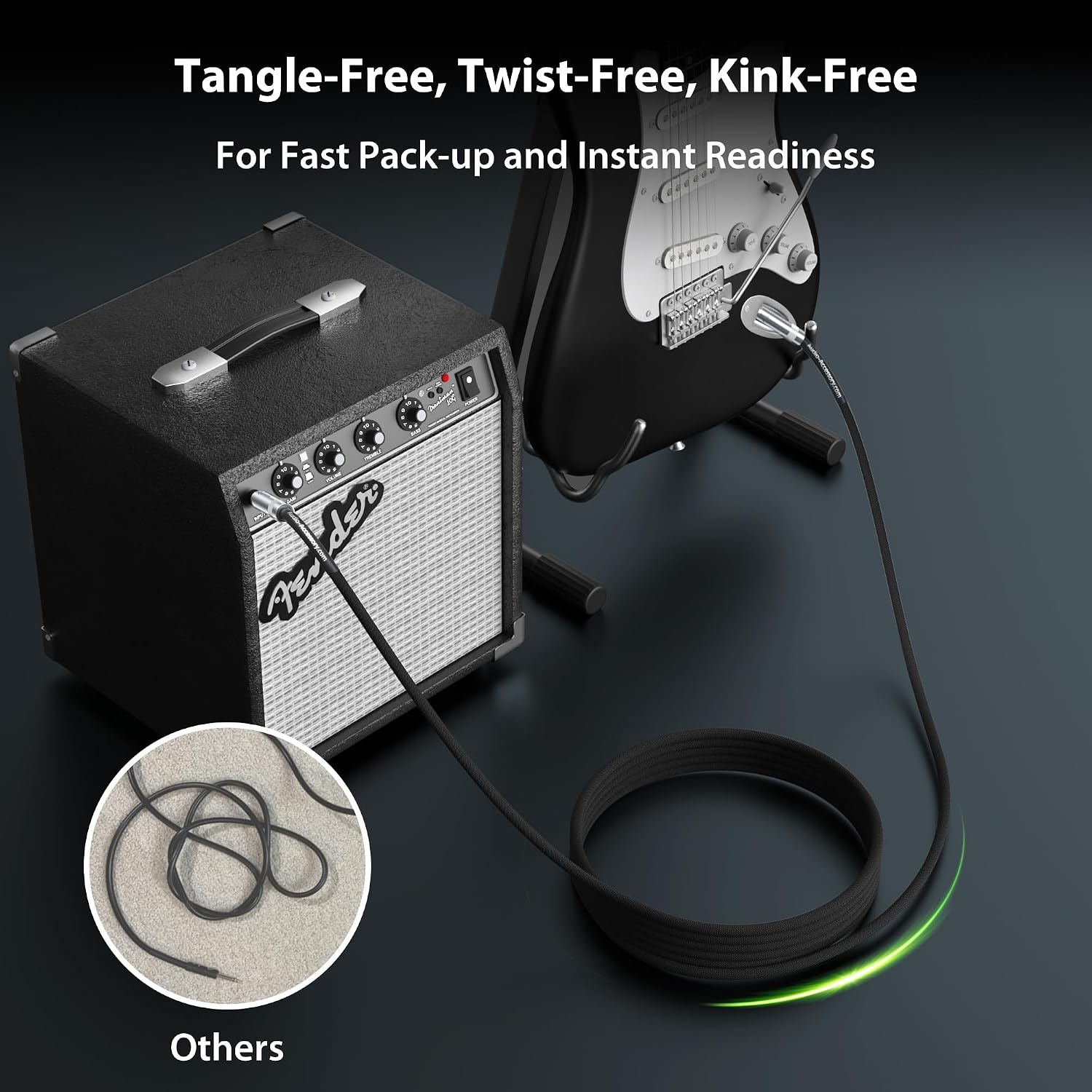
Of course, a cable this long needs to be durable. You don’t want it to be a fragile, kink-prone liability. The nylon braided exterior and Kevlar reinforcement are key here. This isn’t just about making it look tough; it’s about creating a cable that can withstand the rigors of coiling, uncoiling, and being stepped on.
A cable that kinks easily is a constant source of frustration. The anti-kinking design of the nylon braiding suggests it will coil and uncoil smoothly, saving you time and annoyance during setup and teardown. The Kevlar reinforcement speaks to its longevity, theoretically making it many times more durable than a standard cable. The 360° heat-shrink protection on the solder joints is a detail that shows an understanding of where cables often fail first: right at the connection point.
A Final Note on the Connection
The right-angle to straight connector design is a practical choice for a cable of this length. The right-angle end is perfect for plugging into your guitar, keeping the cable profile low and reducing stress on the jack, especially if you like to move around. The straight end is standard for most amplifiers and pedals.
The Long and Short of It
A 75 ft guitar cable is an invitation to rethink your space. It’s a tool that can unlock new stage presence, solve tricky recording challenges, and simply make playing more comfortable and inspiring by removing the physical limitations of a shorter cable. It’s about the freedom to place your amp where it sounds best and position yourself where you feel most creative, without the signal degradation that has historically made such long runs a compromise. For the guitarist who is curious about the intersection of technology and expression, it represents a new frontier of sonic and spatial exploration.
As an Amazon Associate I earn from qualifying purchases.
Take a closer look