
Line 6 POD Express Guitar Effects Processor
As an Amazon Associate I earn from qualifying purchases.
The Line 6 POD Express Guitar is built for players who want a lot of sound-shaping without carrying a full pedalboard or learning a complicated multi-effects unit. It puts amp models, cabinet sounds, effects, presets and headphone-friendly practice into a compact floor unit that can sit neatly in front of an amp, beside a desk or inside a gig bag.
What makes it appealing is the balance between depth and simplicity. You can move from clean tones to driven sounds, add modulation, delay or reverb, and save combinations you actually use without disappearing into pages of menus. It can also work as a USB audio interface and run from batteries, so it makes sense for home practice, recording ideas and portable setups where space matters.
What Makes the POD Express Easy to Use?
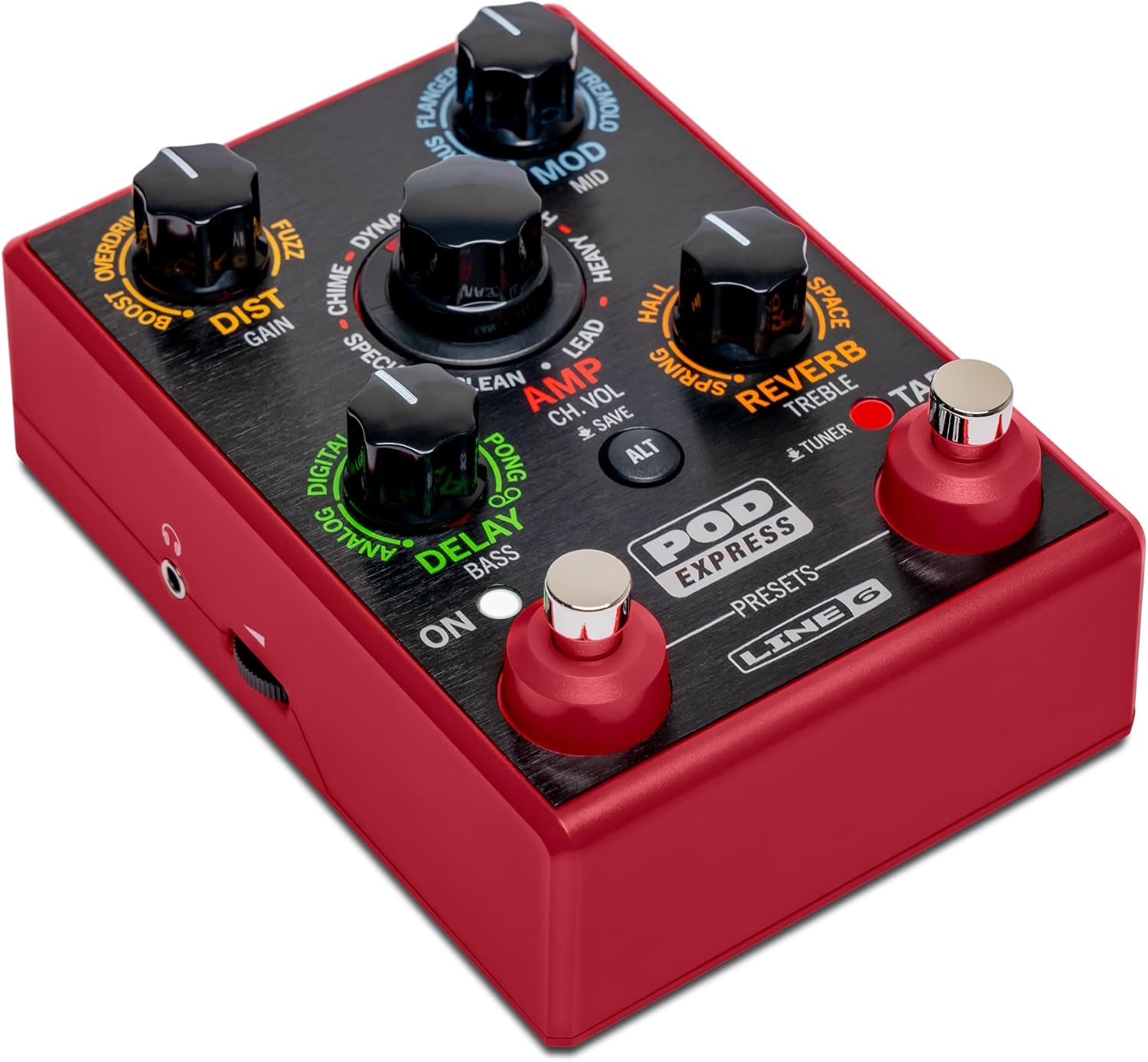
The appeal of the POD Express is that it keeps the controls visible and immediate. Instead of relying on a deep menu system, the main amp and effect choices are handled through dedicated knobs, so you can make useful changes while you are actually playing rather than stopping to scroll through screens.
That makes it a good fit for players who like multi-effects flexibility but do not want something that feels like a computer on the floor. You can start with a clean amp sound, add drive, modulation, delay or reverb, then save the combination as a preset once you find something worth keeping.
The controls have enough resistance to feel deliberate rather than loose, and the compact metal-style housing keeps the unit planted reasonably well underfoot without making it awkward to carry.
What Sounds Can You Get from the POD Express?
The POD Express gives you enough range to cover most everyday guitar sounds without turning the unit into a maze of options. The amp models let you move from cleaner, more open tones through to crunch and higher-gain sounds, while the built-in effects add the movement, space and texture you would normally get from several separate pedals.
For practice, that means you can keep a few very different sounds ready without rebuilding your setup each time. One preset can be clean and spacious, another can carry more drive, and another can be shaped for heavier playing. The real benefit is not simply having lots of sounds available, but being able to reach them quickly.
Can You Use the POD Express for Headphone Practice and Recording?
Yes — and that is one of the reasons the POD Express makes so much sense for home players. Headphone practice lets you use the amp models and effects without needing to run through a speaker, which is useful for late-night sessions or anywhere volume needs to stay under control.
The USB connection also lets the unit work as a straightforward audio interface for recording guitar into a computer. That makes it handy for capturing ideas, practising with software or putting together simple home recordings without adding another piece of equipment to the desk.
It is not trying to replace a full studio interface or an elaborate recording rig. The attraction is having practice sounds, effects and basic recording duties handled by the same compact box.
How Portable Is the POD Express?
Portability is one of the POD Express’s strongest practical advantages. The footprint is small enough to fit into a gig bag or backpack far more easily than a conventional multi-effects board, and battery operation means you are not always tied to a power supply when you want to practise or sketch out ideas somewhere different.
That makes it particularly useful for players who move between rooms, practise away from their main setup or want a lightweight backup rig. You still get proper footswitch control and enough physical weight for it to feel planted underfoot, but without the bulk of a large modeller or a board full of individual pedals.
The Drawbacks
The POD Express is deliberately simpler than a larger multi-effects processor, and that simplicity will not suit everyone. There is no large display showing signal chains, parameter names or detailed preset information. Instead, the unit relies on its knobs, coloured LED ring and secondary functions. Once you understand the layout it keeps the pedal compact, but players coming from a screen-based modeller may initially find it less obvious when making deeper adjustments.
Its modelling library is also intentionally focused rather than enormous. You get seven amp models, seven cabinet models and 17 effects, including a looper. That is plenty for building a useful collection of everyday sounds, but players who enjoy scrolling through dozens of amps, speaker combinations and obscure effects may eventually want something larger. The POD Express works best when you value quickly finding a handful of sounds you actually use rather than collecting hundreds of options.
Foot control is another compromise. There are two onboard footswitches, which handle useful jobs such as effects, presets, tap tempo and the tuner, but a more complicated live setup can quickly ask more of them. Line 6 does allow optional expression pedals or extra footswitches to be connected, although that adds another piece of equipment and chips away at the simplicity that makes the POD Express attractive in the first place.
Battery power is convenient, but it uses three AA batteries rather than an internal rechargeable battery. A 9-volt power supply can be used instead, but it is optional. For occasional portable practice this is easy enough to live with; for somebody using the unit every day, keeping spare batteries around or adding a suitable power supply is more sensible.
Finally, this is a compact processor rather than an all-in-one guitar amp. For headphone practice it can work by itself, but if you want to hear it in the room you still need an amplifier, powered speaker or another suitable output setup. Players wanting one box with its own speaker may find a modelling practice amp more convenient.
None of those points makes the POD Express poorly designed. They are simply the trade-offs that allow it to remain small, portable and relatively straightforward. The important question is whether you want focused flexibility or the deeper control of a much larger modeller.
Who the POD Express Suits Best
The POD Express is a strong fit for guitarists who want a compact way to cover several sounds without building a large pedalboard. It suits home players who practise through headphones, guitarists who like to record ideas straight into a computer, and anyone who wants a lightweight effects setup that can travel easily.
It also makes sense for players who enjoy experimenting but do not want to spend half the session programming menus. The controls are immediate enough for quick changes, while the presets let you keep useful sounds ready once you have found them.
If you need a huge library of models, detailed routing or extensive live foot control, a larger processor will give you more room to grow. But if your priority is portability, simplicity and a practical collection of guitar sounds in one small unit, the POD Express fits that brief very neatly.
Is the Line 6 POD Express Worth Adding to Your Setup?
The POD Express makes the most sense when you want more sounds without more clutter. It gives you amp models, effects, presets, headphone practice and USB recording in a unit small enough to disappear into a bag when you are finished.
There are more powerful processors with deeper editing, bigger displays and far more models, but they also bring more size and complexity. The POD Express takes the opposite approach: keep the useful choices close at hand and make it easy to get from plugging in to actually playing.
For a guitarist who wants a compact practice companion, a simple recording tool or a portable alternative to carrying several pedals, it is a very convincing little box. The limitations are real, but so is the convenience.
Explore more ways to shape your sound in our Effects section.
As an Amazon Associate I earn from qualifying purchases.