
Yamaha Pacifica 112V
As an Amazon Associate I earn from qualifying purchases.
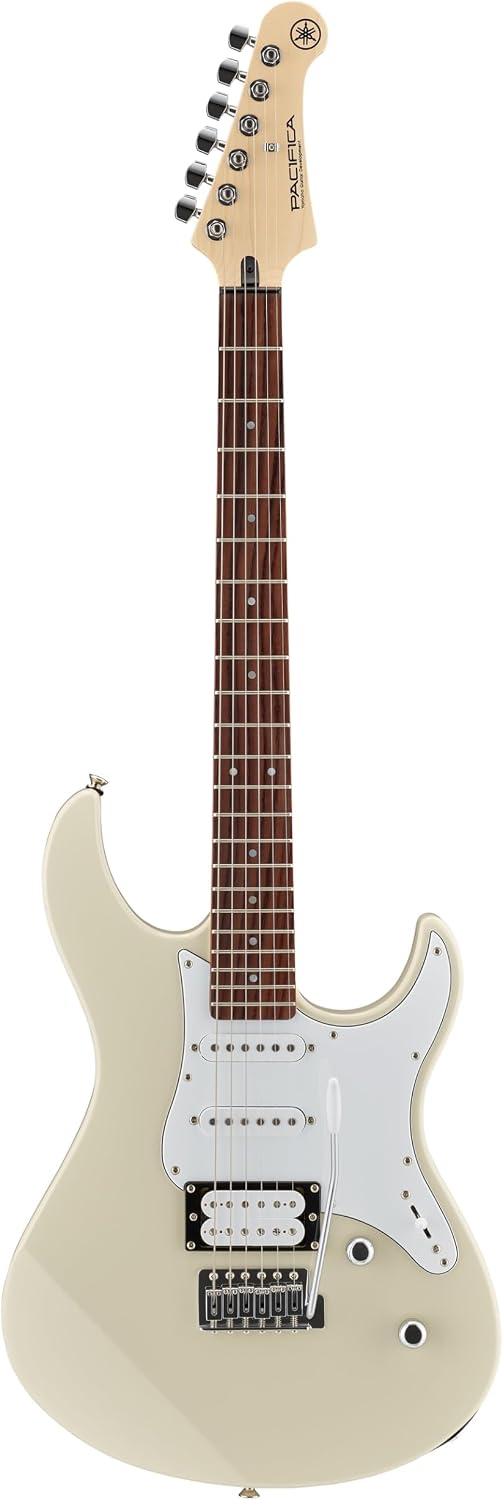
The Yamaha Pacifica 112V is an electric guitar built around versatility rather than one very narrow musical identity. Its familiar double-cutaway shape is paired with an alder body, maple neck, rosewood fingerboard and an HSS pickup layout — a bridge humbucker alongside two single-coils. Yamaha then adds a push-pull coil split and vintage-style vibrato, giving the 112V a useful range of sounds without making the controls complicated.
The Vintage White finish keeps the appearance fairly restrained. Against the darker rosewood fingerboard and contrasting pickguard, it has the sort of classic electric-guitar look that should age more gracefully than something built around a short-lived visual trend.
Why it works as an everyday electric guitar
The Pacifica idea has always been centred on flexibility, and the 112V demonstrates that clearly.
Yamaha uses an alder body with a bolt-on maple neck and rosewood fingerboard, a combination that feels familiar rather than experimental. The body is contoured rather than slab-sided, so there is shaping around the areas that meet your forearm and torso.
That matters on a guitar you may sit with for long practice sessions. The edges do not have the hard, square feel of some simpler body designs, while the double cutaways leave plenty of visual and physical space around the upper frets.
The control arrangement is equally straightforward. A five-position pickup selector moves between the three pickups and their combined positions, while the push-pull function on the tone control splits the bridge humbucker. Yamaha describes this as providing additional single-coil tonal options rather than forcing the player to choose permanently between a humbucker or single-coil bridge sound.
For someone buying one electric guitar to cover plenty of musical ground, that simplicity makes more sense than filling the instrument with switches that rarely get used.
What it feels like to play
The Pacifica 112V uses a 25½-inch scale length, so the basic string feel follows the longer-scale side of familiar electric-guitar design. With the same strings and tuning, that generally means a little more tension under the fingers than a shorter-scale instrument.
The maple neck has a satin polyurethane finish rather than a heavily glossy coating. That should give the back of the neck a smoother, less sticky feel under the palm, particularly once your hand becomes warm during longer playing sessions.
The rosewood fingerboard gives the front of the neck a darker, softer-looking surface against the pale maple. Yamaha uses 22 frets, which is enough for conventional lead and rhythm playing without pushing the design towards an extended modern fretboard.
Nothing about this layout demands a specialised technique. That is part of the attraction. Someone moving from an acoustic guitar, buying a first serious electric, or simply wanting a comfortable second instrument should find the basic proportions recognisable.
HSS pickups give it useful range
The pickup arrangement is one of the strongest reasons to look at the 112V.
Yamaha fits Alnico V pickups in an HSS configuration: two single-coils and one bridge humbucker. The five-way selector gives access to the individual pickups and the familiar in-between combinations.
The neck and middle single-coils give the guitar access to cleaner, lighter and more open electric-guitar textures, while the bridge humbucker provides a fuller option when a thicker sound is wanted.
Then there is the push-pull coil split.
Pulling the tone control splits the bridge humbucker, letting it operate more like a single-coil pickup. Yamaha specifically includes this feature to broaden the available tonal options.
It does not turn one guitar into several completely different instruments, and it would be wrong to pretend that it does. What it does provide is a practical extra choice without adding another visible switch to the body.
That is particularly useful for someone who has not yet decided whether they prefer humbuckers or single-coils. The Pacifica lets you spend time with both approaches.
Vintage-style vibrato without unnecessary complication
The PAC112V uses Yamaha’s vintage-style vibrato bridge with block saddles. Yamaha describes the design as offering smooth vibrato action while the heavier block saddles are intended to contribute to sustain and stability.
A vibrato bridge opens up another part of electric-guitar playing. Gentle pitch movement, chord shimmer and more expressive single-note work are all possible without needing an external effect.
Just as importantly, you do not have to use it.
A player who prefers to leave the arm alone can simply treat the Pacifica like a conventional electric guitar. It is an additional tool rather than something that dictates how the instrument must be played.
The bridge is also a more familiar design than the locking tremolo systems found on some harder-edged guitars. That makes ordinary string changes and adjustments less intimidating for someone still learning how an electric guitar is put together.
A guitar that can grow with the player
One of the appealing things about the 112V is that its specification does not assume the owner will always play the same music.
A new guitarist might begin with clean chords and simple rhythm parts, then move towards blues, rock, effects-heavy sounds or more driven lead playing. The HSS layout means the guitar does not immediately push the player towards only one of those directions.
It also makes sense as a second guitar for someone whose main instrument is more specialised. A guitarist who normally plays a two-humbucker instrument, for example, may appreciate having access to the Pacifica’s single-coil positions without buying something extremely traditional in feel or appearance.
The design is conventional enough that amplifiers, pedals and common guitar accessories should all feel entirely natural around it.
The drawbacks
The Pacifica 112V’s broad versatility is also where the first compromise appears.
A guitar designed to cover several styles will not necessarily have the very specific personality of an instrument built around one particular pickup type or construction. Someone who already knows they only want two full-size humbuckers, three traditional single-coils or a pair of P-90s may prefer an instrument dedicated to that arrangement.
The HSS layout is flexible, but switching from the bridge humbucker to the single-coil positions creates a genuine change in character. Some players love having that range available; others prefer the more uniform response of a guitar using the same pickup type throughout.
The coil split needs similar perspective. Splitting the bridge humbucker increases the tonal options, but a split humbucker should not automatically be expected to sound identical to a purpose-designed traditional single-coil pickup. It is better thought of as another useful voice rather than a perfect substitute for owning an entirely different guitar.
The vintage-style vibrato also brings trade-offs.
Any moving vibrato bridge introduces more variables than a fixed hardtail bridge. String tension, setup and playing technique all affect how well the guitar returns to pitch after the arm is used. Yamaha designed this bridge for stable, responsive operation, but someone who never uses vibrato may reasonably prefer the mechanical simplicity of a fixed bridge.
Likewise, players expecting extreme pitch dives and the aggressive range of a locking tremolo system should understand that this is a vintage-style vibrato, not a double-locking design intended for that sort of treatment.
The rosewood fingerboard is another preference rather than a universal advantage. Yamaha also makes Pacifica 112 variants with maple fingerboards, so players who strongly prefer the brighter appearance and slightly different surface feel of maple should make sure they are buying the version they actually want. The standard 112V shown here uses rosewood.
The longer 25½-inch scale may also take some adjustment for someone coming directly from a shorter-scale electric. The extra string tension can feel a little firmer under bends, particularly with heavier strings. That is not a flaw, but it affects physical feel and is worth knowing before choosing a guitar purely from photographs.
Visually, the Pacifica is fairly conservative.
The Vintage White finish is clean and easy to live with, but someone looking for an electric guitar that makes a dramatic visual statement may find the design too familiar. Its double-cutaway body, pickguard and control layout deliberately sit within established electric-guitar territory rather than trying to look unusual.
There is also a danger in assuming that versatility means every setting will be equally useful to every player. In practice, most guitarists eventually develop favourite pickup positions and may use the others relatively rarely. A five-way selector, coil split and vibrato give you options, but they only matter if those options fit the way you actually play.
Setup deserves consideration too.
Even a well-made production guitar can benefit from having its action, intonation and pickup heights adjusted to suit the individual player, their string gauge and preferred playing style. We would not assume that any guitar arriving from a warehouse will automatically be set exactly how every guitarist wants it.
For a first-time buyer, that can be easily overlooked. A guitar that initially feels slightly higher, lower or firmer than expected may simply need sensible setup rather than being fundamentally unsuitable.
Finally, the Pacifica 112V sits in an interesting position. It is approachable enough for someone buying an early electric guitar, but its specification is capable enough that it need not be treated as something temporary. That is good news, although buyers who already own several established electric guitars may want something more distinctive rather than another broadly versatile instrument.
None of these drawbacks makes the Pacifica a poor choice. They simply underline what it is: a flexible, conventional electric designed to cover plenty of ground rather than dominate one very narrow niche.
Who it suits best
The Yamaha Pacifica 112V makes particular sense for someone who wants one electric guitar capable of exploring several styles.
A developing guitarist gets the advantage of single-coil and humbucker sounds, a vibrato bridge and familiar controls without needing to understand a complicated switching system.
It also suits players returning to guitar who want a straightforward instrument that does not force them immediately into one musical direction.
More experienced players may appreciate it as a dependable HSS guitar for practice, recording or as an alternative to more specialised instruments.
Players who already know they want a hardtail bridge, two humbuckers or a particularly traditional three-single-coil design should probably start with those priorities instead.
Is it worth the guitar space?
The Yamaha Pacifica 112V earns its place through balance rather than novelty.
The alder body, maple neck and rosewood fingerboard provide a familiar foundation, while the Alnico V HSS pickup arrangement, five-way selector, bridge coil split and vintage-style vibrato give the player plenty to explore.
It is not trying to be an extreme metal guitar, a vintage reproduction or a boutique instrument. Its strength is that it can sit comfortably between those worlds and remain useful as the player’s tastes change.
There are compromises: the vibrato adds more setup considerations than a fixed bridge, the split humbucker is not the same thing as a dedicated bridge single-coil, and players wanting a guitar with a very strong individual personality may find the Pacifica a little restrained.
For someone who values versatility, comfortable proportions and straightforward controls, however, the Yamaha Pacifica 112V has a very sensible combination of features without becoming needlessly complicated.
For more versatile six-string options, explore our Electric Guitars guides on AIGuitars.
As an Amazon Associate I earn from qualifying purchases.