
BOSS GX-1 Guitar Effects Processor
As an Amazon Associate I earn from qualifying purchases.
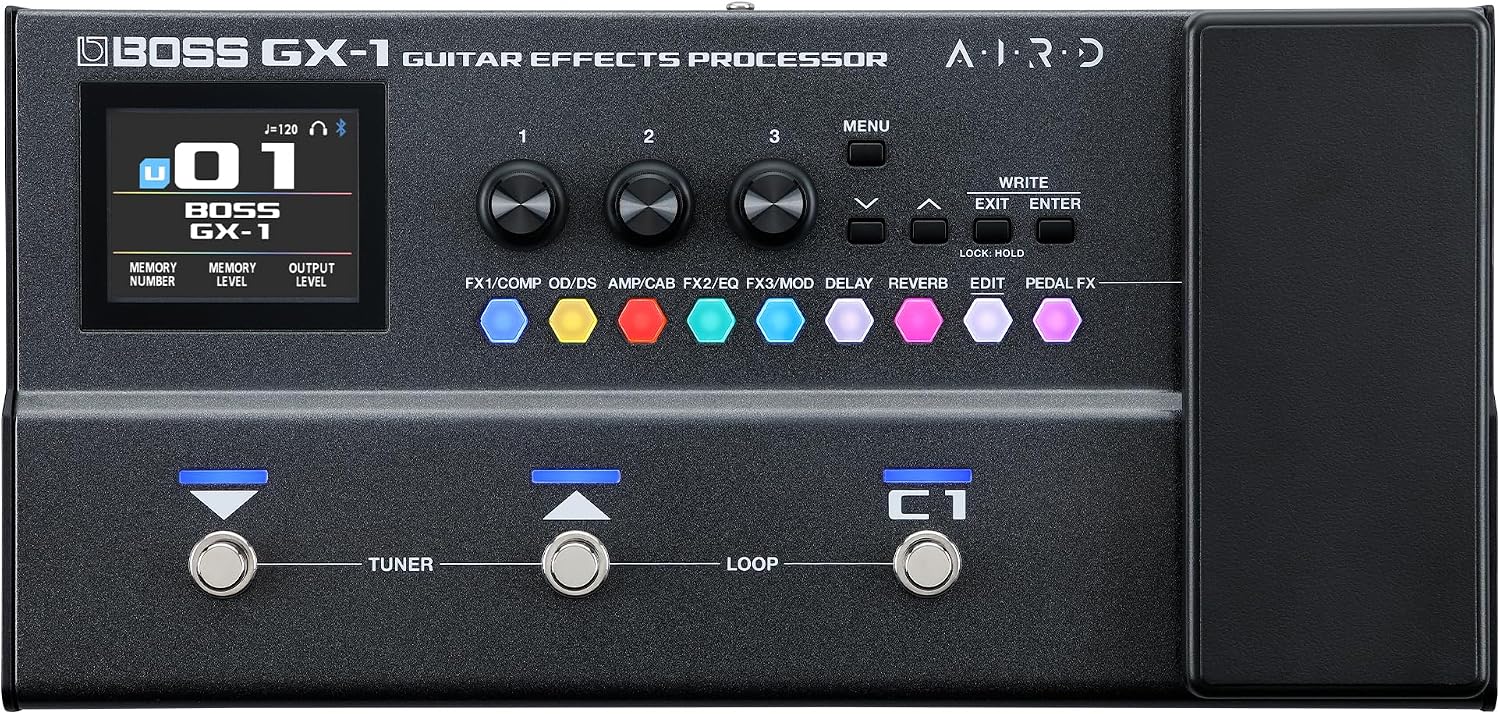
The BOSS GX-1 Guitar Effects Processor brings amplifier modelling, a large collection of guitar effects and practical performance controls together in a compact floor unit designed for practice, recording and live playing.
Instead of building a pedalboard from separate overdrive, modulation, delay and reverb pedals, the GX-1 allows guitarists to combine those sounds digitally and save complete setups for later use.
BOSS has equipped the processor with 23 AIRD amplifier models, 146 effect types, a colour display, three footswitches and an integrated expression pedal. Bluetooth connectivity, USB-C recording and flexible power options make it equally interesting for home players and musicians who regularly travel with their equipment.
At approximately 1.2 kg, it is substantially easier to carry than a large collection of individual pedals and a conventional amplifier.
The GX-1 is not intended to replace every piece of guitar equipment, but it offers a practical way to explore different sounds without filling an entire room with separate devices.
Why the BOSS GX-1 works for guitarists
The strongest attraction of the GX-1 is its versatility.
A guitarist might want a clean amplifier sound for fingerpicked passages, a lightly driven tone for blues and something heavier for rock.
With a conventional setup, those sounds might involve different amplifier settings, several effects pedals and a certain amount of adjustment between songs.
The GX-1 takes a different approach.
Amplifier models and effects can be combined into complete digital signal chains, allowing the player to create and store sounds for different musical situations.
BOSS includes 99 ready-to-play factory presets, alongside 99 user memories for storing personalised settings.
That means a guitarist can begin with the supplied sounds, make adjustments and gradually develop a collection of familiar tones.
For somebody who enjoys playing several musical styles, that flexibility is particularly useful.
Rather than buying a different pedal every time a new sound becomes interesting, the GX-1 provides a broad collection of processing tools within one unit.
What it feels like to use
The GX-1 has a compact floor-mounted design, measuring approximately 307 mm wide, 149 mm deep and 56 mm high.
That makes it noticeably smaller than many large professional multi-effects processors.
The three footswitches occupy the lower section of the unit, while the integrated expression pedal sits towards the right.
Above them is a colour LCD display surrounded by dedicated buttons and adjustment controls.
The display provides a visual reference when selecting patches and editing sounds.
BOSS also uses distinctive hexagonal effect-category buttons, making the main processing sections easier to identify.
This is a welcome approach because one of the frustrations with digital effects processors can be navigating through several menus simply to change an ordinary setting.
With the GX-1, the main effect categories have dedicated controls.
A short press can switch an effect section on or off, while holding a category button gives access to more detailed editing.
The footswitches are positioned for operation while standing, and the expression pedal provides hands-free control over assigned parameters.
At 1.2 kg, the GX-1 has enough physical substance to be a proper floor controller without carrying the weight and bulk of a large pedalboard.
AIRD amplifier modelling
The GX-1 includes 23 amplifier types based on BOSS’s AIRD technology.
AIRD stands for Augmented Impulse Response Dynamics and is designed to reproduce important aspects of amplifier behaviour, including how an amplifier responds to playing dynamics.
This goes beyond simply applying a fixed equalisation curve to the guitar signal.
The intention is to provide a more natural interaction between the player’s picking technique, the guitar’s controls and the modelled amplifier.
Different amplifier types allow the GX-1 to cover a wide range of musical styles.
A clean amplifier model can provide a starting point for jazz, country or general rhythm playing.
More driven models can be used for blues and classic rock, while higher-gain options are available for heavier music.
The amplifier models can also be combined with effects before and after the amp section.
That creates possibilities similar to conventional guitar rigs, where an overdrive pedal might sit before the amplifier while delay and reverb provide additional space around the finished sound.
For somebody who enjoys experimenting with different amplifiers, the GX-1 provides useful flexibility without requiring a room full of equipment.
146 effects and flexible signal chains
BOSS provides 146 different effect types, covering many familiar guitar-processing categories.
These include compression, overdrive, distortion, modulation, delay, reverb and other sound-shaping effects.
The GX-1 can operate up to eight effect blocks simultaneously, alongside its volume-pedal and noise-suppression functions.
That gives enough flexibility for many practical guitar sounds.
A straightforward clean setup might include compression, an amplifier model and reverb.
A blues sound could combine an overdrive effect with a suitable amplifier and a short delay.
A more atmospheric arrangement might use modulation, longer delays and spacious reverb.
The processor also allows the order of effect blocks to be adjusted.
That matters because the position of an effect within a signal chain can change the result considerably.
Placing modulation before an amplifier model produces a different response from putting it after the amplifier.
The same applies to delay and reverb.
Being able to experiment with those arrangements helps guitarists understand how different sounds are constructed.
The available effects provide plenty of variety, although the eight-block limit is something to consider when building more elaborate patches.
Gear Suite makes editing easier
One of the more interesting features of the GX-1 is Gear Suite.
Digital effects processors often offer numerous adjustable parameters, which can become intimidating when somebody simply wants to create a useful guitar sound.
Gear Suite is intended to simplify that process.
Instead of starting with every amplifier or effect parameter individually, the player can select professionally configured combinations of settings.
These provide a starting point for shaping the sound without having to understand every technical adjustment immediately.
For example, choosing an amplifier model and a suitable Gear Suite setting can establish a useful foundation before smaller changes are made.
The player can then adjust the individual parameters according to personal preference.
Customised settings can also be stored for later use.
This approach should appeal particularly to guitarists who want the flexibility of digital processing but do not enjoy spending hours navigating detailed menus.
It allows the creative part of choosing a sound to come before the more technical work of refining it.
Footswitches and expression pedal
The GX-1 includes three assignable footswitches and an integrated expression pedal with a toe switch.
These are important features because a guitar processor needs to be manageable while both hands are occupied.
The footswitches can be assigned to different functions depending on how the player wants to organise a setup.
For example, one arrangement might concentrate on moving between saved sounds.
Another could use switches to control individual effects within a patch.
The expression pedal introduces another layer of control.
It can be used for familiar functions such as volume adjustment or expression-based effects, while more advanced assignments allow other parameters to be controlled.
That makes it possible to change aspects of a sound while playing rather than stopping to reach for a knob.
BOSS also provides an external control connection for additional compatible footswitches or an expression pedal.
Supported wireless controllers can further extend the available options.
For guitarists performing live, these control features can be just as important as the quality of the amplifier models.
A good sound is useful only when it can be selected or adjusted reliably during a song.
Practice features for home playing
The GX-1 is particularly well equipped for home practice.
A headphone connection allows the processor to be used without a conventional guitar amplifier.
That is useful for players practising in a bedroom, apartment or shared household where amplifier volume may be inconvenient.
Bluetooth connectivity allows audio from a compatible mobile device to be played through the unit.
This makes it possible to practise alongside recorded music, backing tracks or instructional material.
The BOSS Tone Studio application provides additional practice facilities, including rhythm tools, a metronome and options for working through songs and lessons.
The Session feature supports functions such as slowing down material and repeating selected sections.
Those facilities can be especially useful when learning a difficult passage.
Rather than repeatedly restarting an entire song, the guitarist can concentrate on the section that needs attention.
There is also a built-in tuner, keeping another frequently used accessory within the processor itself.
For someone who mainly plays at home, these features make the GX-1 more than simply a collection of guitar effects.
It can become a central part of an everyday practice arrangement.
Built-in phrase looper
The GX-1 includes a phrase looper.
This allows a guitarist to record a short passage and play over it.
Looping is useful for practising scales, developing lead phrases and experimenting with rhythm arrangements.
For example, a simple chord progression can be recorded and repeated while the player works on improvisation.
It is also useful for developing musical ideas without needing recording software.
However, the available recording time is relatively short.
BOSS specifies 38 seconds in mono or 19 seconds in stereo.
That is enough for many short practice phrases, but it does not provide the extended recording capacity of a dedicated looping workstation.
The built-in looper is therefore best understood as a convenient practice and performance feature rather than a replacement for a specialist looper designed around elaborate layered arrangements.
USB-C recording and computer connectivity
The GX-1 includes a USB-C connection for working with compatible computers and mobile devices.
This allows the processor to function as a USB audio interface for recording guitar into suitable music-production software.
For someone creating demos, recording song ideas or working in a small home studio, that removes the need for a separate interface in a straightforward guitar-recording setup.
The guitarist can build a sound using the onboard amplifier models and effects, then record through the digital connection.
BOSS uses 24-bit analogue-to-digital conversion, 32-bit digital-to-analogue conversion and 32-bit floating-point internal processing at a 48 kHz sampling rate.
These specifications provide a capable foundation for a compact digital guitar processor.
The USB connection also allows the unit to work with BOSS Tone Studio on supported computers.
Within the software, patches can be edited, organised and managed more comfortably than through the processor’s smaller display.
For players who enjoy experimenting with sounds, the combination of direct controls and computer-based editing provides useful flexibility.
BOSS Tone Studio and downloadable sounds
BOSS Tone Studio is another important part of the GX-1 system.
The application is available for compatible Windows, macOS, iOS and Android devices.
It provides an alternative way to edit amplifier settings, build effects chains and organise saved sounds.
That can be particularly convenient when creating more complicated patches.
Working on a computer or tablet screen may feel easier than navigating numerous parameters on the processor itself.
The GX-1 also supports BOSS Tone Exchange, where compatible sound collections can be downloaded and shared.
This provides another starting point for exploring different musical styles.
Rather than constructing every sound from scratch, a guitarist can begin with an existing patch and modify it to suit a particular guitar, amplifier or playing technique.
The GX-1 also supports compatible WAV speaker impulse responses.
These allow different speaker-cabinet characteristics to be incorporated into suitable sound configurations.
For players interested in direct recording and amplifier modelling, that adds another useful level of control.
Portable power options
BOSS has given the GX-1 several power options.
It can operate using four AA alkaline batteries, a compatible external AC adaptor or USB bus power.
The battery option is particularly useful for guitarists who want a portable practice setup.
BOSS quotes approximately five hours of continuous operation using alkaline batteries, although actual running time depends on conditions.
USB power provides another practical option when connecting to a suitable computer or compatible power source.
For regular use in a fixed music room or on a pedalboard, an AC adaptor may be more convenient.
The important detail is that the GX-1 is not restricted to one power arrangement.
However, the compatible PSA-S series AC adaptor is sold separately, so buyers intending to use mains power should account for that before setting everything up.
The drawbacks
The BOSS GX-1 offers a considerable range of features, but there are several compromises worth understanding before deciding whether it is the right guitar processor.
The first is the learning curve.
Although BOSS has made the interface more approachable with dedicated effect buttons and Gear Suite, the GX-1 remains a sophisticated digital processor.
There are 23 amplifier models, 146 effects and numerous adjustable parameters.
That creates a great deal of flexibility, but it also means there is more to learn than with a conventional single-function pedal.
Someone accustomed to plugging into an amplifier and adjusting three or four knobs may initially find the available options overwhelming.
It can be tempting to spend more time browsing presets and changing settings than actually playing guitar.
Gear Suite helps simplify sound creation, but learning how amplifier models, effect blocks, routing and output settings interact still takes time.
For players who enjoy experimenting, that is part of the attraction.
For somebody who wants immediate simplicity, a conventional amplifier and a small selection of pedals may feel more natural.
The compact footswitch arrangement is another compromise.
The GX-1 has three onboard footswitches and an expression pedal.
That is a sensible arrangement for a small processor, but it is not the same as having a large professional floor unit with numerous dedicated switches.
A guitarist who regularly needs immediate access to several effects may find the available foot controls restrictive.
For example, switching between numerous sounds and independently controlling several effects during the same song can require careful assignment of the available switches.
External controllers can expand the possibilities, but that introduces additional equipment.
The GX-1 works best when the guitarist plans how the controls will be used rather than assuming every feature can have its own dedicated footswitch.
The expression pedal is also relatively compact.
Its integrated design helps keep the processor portable, but players accustomed to a full-size standalone volume or wah pedal may prefer a larger surface beneath the foot.
Pedal size and resistance are personal preferences.
A guitarist who uses an expression pedal occasionally may find the GX-1 arrangement convenient.
Someone whose playing depends heavily on precise, continuous expression control may prefer an external pedal with a different physical feel.
This is particularly relevant for musicians who use wah effects extensively.
The built-in pedal is useful, but compactness inevitably influences the available foot space.
The eight-effect-block limit deserves attention.
BOSS includes 146 effect types, which sounds like an enormous collection.
However, that does not mean all 146 effects can operate simultaneously.
The GX-1 allows eight effect blocks at once, plus its volume and noise-suppression functions.
For ordinary guitar arrangements, eight blocks will often be sufficient.
A typical sound involving compression, drive, amplifier modelling, modulation, delay and reverb fits comfortably within that general approach.
More elaborate patches can become restrictive.
Someone wanting several separate modulation effects, multiple delays, additional equalisation stages and extensive processing may need to simplify the signal chain.
The GX-1 is powerful for its size, but it does not offer unlimited processing.
The built-in looper is useful but limited.
The maximum recording time is 38 seconds in mono or 19 seconds in stereo.
That is adequate for short chord progressions, practice exercises and simple musical ideas.
However, serious loop-based performers may find it restrictive.
A dedicated looper can offer longer recording times, more elaborate overdubbing arrangements and additional control over different layers.
Someone who uses looping only occasionally may appreciate having it included.
A guitarist building entire performances around recorded loops should probably consider a specialist unit.
The available connections are another limitation.
The GX-1 provides a conventional guitar input, stereo quarter-inch outputs, a headphone connection, USB-C and an external controller connection.
That covers many common practice, recording and performance arrangements.
However, it does not have dedicated balanced XLR outputs.
A musician connecting directly to a professional mixing desk over a long cable run may therefore need additional equipment, such as a suitable DI box.
There is also no dedicated external effects loop for inserting separate pedals at a chosen point within the GX-1’s internal amplifier and effects chain.
That matters for guitarists who already own several specialist pedals and want to combine them with digital amplifier modelling in a particular order.
Individual pedals can still be used in an external signal chain, but the routing flexibility is not the same as with a processor offering dedicated send-and-return connections.
For someone building a hybrid digital-and-analogue rig, that could be a significant consideration.
The GX-1 does not have a built-in speaker.
This sounds obvious for a floor effects processor, but it is worth making clear.
The unit produces guitar sounds through its outputs rather than reproducing them acoustically on its own.
You will need headphones, a compatible amplifier, powered speakers or another suitable audio system to hear what you are playing.
That makes the GX-1 different from a compact practice amplifier.
A guitarist who simply wants one box to plug into and hear immediately may find a small modelling amplifier more convenient.
The GX-1 offers considerably more control over sound creation, but it still requires an appropriate listening arrangement.
Bluetooth should also be understood correctly.
The wireless connection is useful for playing music from a mobile device and working with supported software.
It does not replace the normal guitar input cable.
A guitarist wanting to play without an instrument cable would still need a compatible separate wireless guitar system.
Bluetooth audio is also not necessarily the best option for every real-time monitoring task because wireless transmission can introduce delay.
For ordinary backing tracks, that may be perfectly acceptable.
For recording or monitoring situations where timing is critical, a suitable wired connection is generally preferable.
The battery option involves compromises.
BOSS quotes approximately five hours of continuous operation using four AA alkaline batteries.
That is useful for portable practice, but it may be less convenient for musicians using the processor for long sessions every day.
Batteries need replacing, and actual operating time varies with conditions.
The unit also does not contain an internal rechargeable battery that can simply be topped up between sessions.
USB power provides another option, but a suitable power source and cable are required.
For regular pedalboard use, a compatible mains adaptor is likely to be the more convenient choice.
However, the AC adaptor is sold separately.
Anyone planning to use the GX-1 immediately as part of a permanent setup should check that the necessary power equipment is available.
The small display also has limitations.
The colour LCD is useful for navigating the processor, but it cannot provide the same editing experience as a large computer screen.
Detailed sound creation may involve moving between pages and adjusting multiple parameters.
BOSS Tone Studio provides a more spacious editing environment, but that means using a separate compatible device.
A guitarist who dislikes working with apps or computer software may prefer a processor with a larger onboard display or a simpler collection of physical controls.
The GX-1 provides both onboard editing and software support, but the compact hardware naturally places limits on how much information can be displayed at once.
Amplifier modelling is not identical to owning the original amplifiers.
AIRD technology is designed to reproduce important aspects of amplifier tone and playing response.
That is useful for exploring different sounds without owning numerous physical amplifiers.
However, a digital model does not provide the same physical experience as standing beside a powerful valve amplifier and speaker cabinet.
The response will also depend on the headphones, powered speakers, guitar amplifier or PA system being used.
A carefully configured processor through suitable monitoring equipment can provide a very practical playing setup.
Connected through an unsuitable speaker or poorly adjusted output arrangement, the same sound may be disappointing.
The GX-1 therefore requires some attention to how it is connected.
Buying the processor alone does not guarantee that every listening system will reproduce its amplifier models in the same way.
There is also the danger of relying too heavily on presets.
Factory sounds provide useful starting points, but they are not necessarily tailored to every guitar.
A low-output single-coil instrument can respond differently from a guitar fitted with powerful humbuckers.
Pickup height, playing technique and amplification all influence the result.
Some factory presets may need adjustment before they feel right.
The GX-1 becomes more useful when the player learns to refine sounds rather than assuming that the first preset selected will automatically suit the music being played.
Finally, this is a compact all-in-one processor rather than a collection of independent pedals.
That has obvious advantages for portability and organisation.
However, some guitarists prefer having separate physical pedals that can be replaced, rearranged or upgraded individually.
A traditional pedalboard also allows a player to retain favourite effects while changing other parts of the setup.
The GX-1 offers considerable flexibility within one device, but it is still one integrated electronic system.
If the processor develops a fault, several parts of the signal chain may become unavailable at once.
For regular live performance, having a simple backup arrangement is sensible.
These drawbacks do not make the GX-1 a poor choice.
They simply define the situations where its compact size, integrated design and digital flexibility are most useful — and where a different arrangement might suit the guitarist better.
Who it suits best
The BOSS GX-1 is particularly well suited to guitarists who want to explore different amplifier sounds and effects without building a large pedalboard.
It should appeal to home players who practise through headphones, musicians recording guitar into a computer and guitarists who regularly experiment with different musical styles.
The built-in footswitches and expression pedal also make it suitable for rehearsals and smaller live setups where portability matters.
Beginners can start with the factory presets and Gear Suite settings, while more experienced players can explore detailed editing, custom routing and external controls.
It is particularly attractive for someone who wants one compact processor to cover practice, recording and occasional performance.
Players who need extensive physical footswitch control, elaborate external pedal routing or sophisticated looping may prefer a larger processor or specialist equipment.
Is it worth the pedalboard space?
The BOSS GX-1 Guitar Effects Processor brings together an impressive selection of practical guitar features in a compact format.
Its 23 AIRD amplifier models and 146 effect types provide plenty of room for exploring different sounds, while Gear Suite helps make the editing process more approachable.
The three footswitches, expression pedal and 198 total preset and user memory locations give it useful performance flexibility.
Bluetooth, USB-C recording and BOSS Tone Studio add further possibilities for practice and home recording.
The compact dimensions and choice of battery, USB or adaptor power also make the GX-1 easier to accommodate than a large multi-effects floorboard.
Its limitations are understandable.
The small control layout cannot replace a large professional switching system, the looper is relatively short, and players wanting extensive external hardware connections may find the available options restrictive.
But for guitarists who value portability, sound variety and the convenience of having several familiar effects in one place, the GX-1 offers a sensible balance.
It is particularly worthwhile for someone who wants to spend more time playing different sounds and less time assembling and transporting a complicated collection of equipment.
Rather than being another individual pedal on a crowded board, the GX-1 can provide the foundation for an entire compact guitar setup.
For more guitar effects, pedals and sound-shaping equipment, explore our Pedals & Effects guides.
As an Amazon Associate I earn from qualifying purchases.