
Roadie Bass Automatic Guitar Tuner
As an Amazon Associate I earn from qualifying purchases.
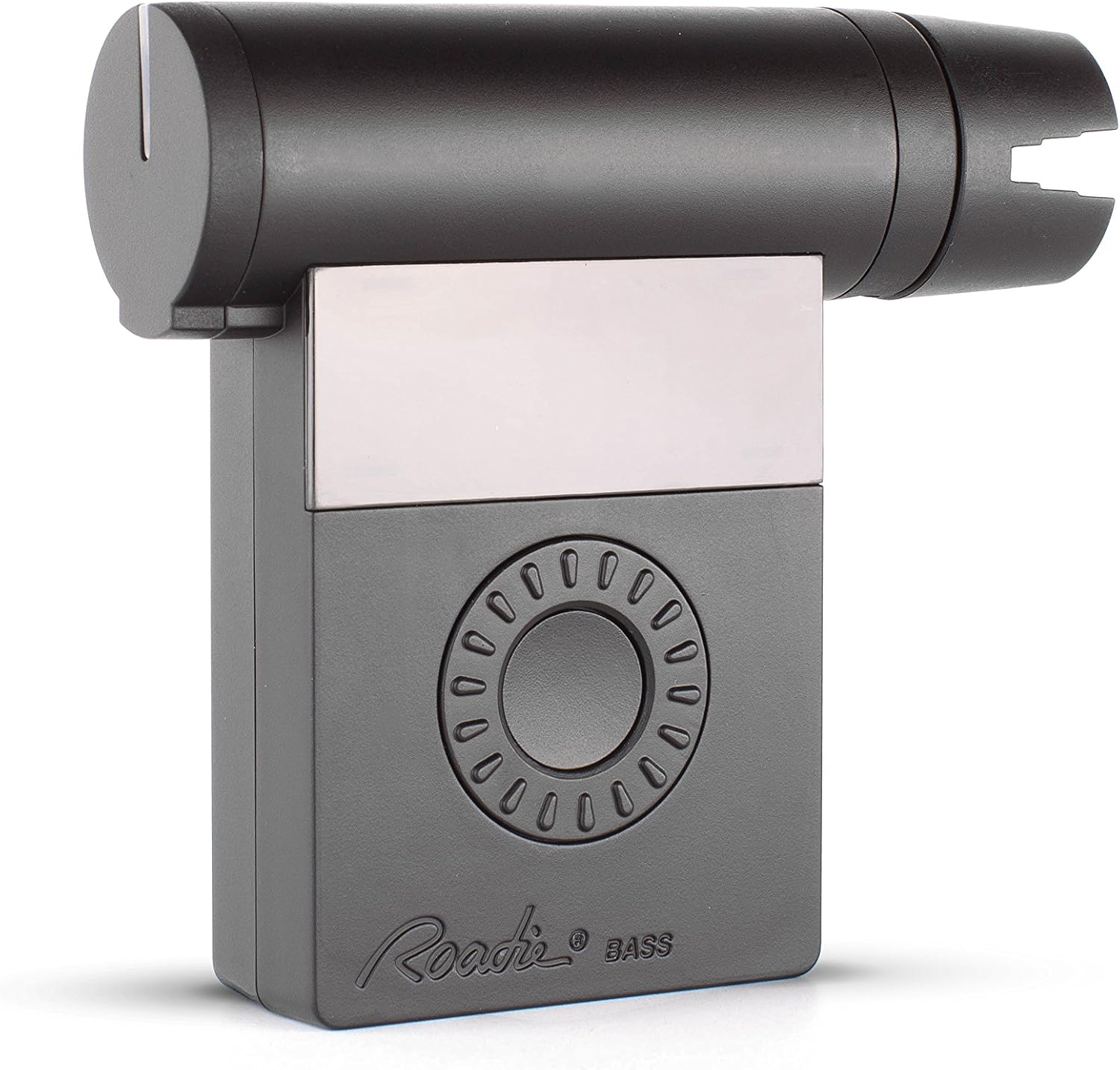
The Roadie Bass Automatic Guitar Tuner offers a different approach to keeping guitars and basses in tune. Rather than simply displaying whether a string is sharp or flat, it uses a motorised mechanism to turn the instrument’s tuning peg automatically.
Designed for bass guitars as well as a wide range of other string instruments, the Roadie Bass combines vibration-based pitch detection, precise motor control and an integrated string winder in one rechargeable handheld device.
For musicians who regularly tune several instruments, change strings or experiment with alternative tunings, this approach has some obvious attractions.
Instead of repeatedly turning each tuning peg by hand while watching a separate tuner, the player positions the Roadie Bass over the machine head, plucks the appropriate string and allows the motor to make the adjustment.
The device can operate independently of a smartphone, making it suitable for ordinary tuning at home, during rehearsals or when preparing instruments for a performance.
It also includes more than 40 preset alternative tunings, while the companion Roadie Tuner app allows additional custom arrangements to be created.
However, automatic tuning introduces its own considerations.
The device needs charging, requires compatible geared tuning pegs and is considerably larger than a conventional clip-on tuner. It also cannot correct mechanical problems with an instrument simply by adjusting string tension.
The Roadie Bass therefore makes most sense when its automatic functions provide genuine convenience rather than simply replacing a task that a guitarist already finds straightforward.
Why automatic tuning can be useful
Keeping an instrument correctly tuned is a fundamental part of playing guitar or bass.
Even a well-made instrument will gradually move away from its intended tuning because of normal playing, temperature changes, string condition and other factors.
For most musicians, adjusting the tuning pegs is a familiar part of preparing to play.
A conventional electronic tuner detects the pitch and indicates which direction the player needs to turn the machine head.
The Roadie Bass takes this process a stage further.
It detects the vibrating string and uses its internal motor to rotate the tuning peg.
This reduces the amount of manual adjustment required.
The advantage becomes more noticeable when several instruments need attention.
A musician who owns an electric guitar, an acoustic guitar and a bass may regularly move between instruments during practice or recording.
Each instrument has its own tuning arrangement and string characteristics.
Using a motorised tuner can provide a consistent method of making those adjustments.
It can also be convenient when working with instruments that have numerous strings.
A twelve-string guitar, for example, requires twice as many tuning adjustments as an ordinary six-string guitar.
That does not make manual tuning impossible, but it increases the amount of repetitive work.
The Roadie Bass is designed to simplify this process.
Its benefits are most meaningful for musicians who spend a considerable amount of time maintaining and tuning their instruments.
A motor designed for bass guitar tuning pegs
The Roadie Bass differs from smaller automatic tuners because it uses a higher-torque motor.
Bass guitars typically have heavier strings and larger geared tuning mechanisms than ordinary electric guitars.
Turning those machine heads may require more force, particularly on instruments with older or relatively stiff mechanisms.
Roadie developed the Bass model to accommodate these requirements.
According to the manufacturer, its motor provides approximately 3.6 kg-cm of torque, with a maximum rotation speed of 40 revolutions per minute.
The gearing allows the device to make controlled adjustments rather than simply rotating the tuning peg at full speed.
This is important because accurate tuning requires relatively small changes as the string approaches the desired pitch.
The motor needs enough force to turn the machine head while remaining sufficiently precise to make fine adjustments.
Roadie specifies support for string gauges up to .140.
That makes the device suitable for many conventional bass guitar strings, including the heavier gauges commonly used on extended-range instruments.
However, this specification is a maximum supported gauge rather than a guarantee that every unusual instrument or machine head will be compatible.
The physical design of the tuning peg still matters.
For bass players, the stronger motor is one of the principal reasons to consider this model rather than a standard Roadie guitar tuner.
Suitable for four, five and six-string bass guitars
The Roadie Bass is designed to tune four-string, five-string and six-string bass guitars.
This versatility is useful because bass instruments are not all tuned in the same way.
A conventional four-string bass normally uses E, A, D and G tuning.
A five-string instrument commonly adds a lower B string, while many six-string basses add both a low B and a higher C.
These extra strings increase the instrument’s pitch range.
The Roadie Bass has a specified detection range extending down to approximately 25Hz, allowing it to recognise low bass notes within its supported range.
The stronger motor is intended to accommodate the heavier strings and larger machine heads associated with bass instruments.
For someone who owns several bass guitars, this can be particularly useful.
A four-string instrument used for ordinary rock and blues playing may require a different tuning arrangement from a five-string bass used for more extended musical styles.
The Roadie Bass allows the appropriate instrument profiles and tunings to be selected.
It is also useful for bass players who experiment with alternative tunings.
However, musicians using unusually heavy strings or extreme low tunings should verify that their intended arrangement remains within the manufacturer’s stated limits.
The Roadie Bass offers broad compatibility, but it is not intended to turn every possible tuning mechanism or accommodate unlimited string gauges.
More than a bass guitar tuner
Despite its name, the Roadie Bass is not restricted to bass instruments.
It is designed to work with many string instruments fitted with compatible geared tuning pegs.
These include electric guitars, acoustic guitars, classical guitars, seven-string guitars and twelve-string guitars.
The manufacturer also identifies compatibility with instruments such as ukuleles, mandolins and banjos when suitable machine heads are fitted.
For someone who plays more than one instrument, this is a particularly appealing feature.
Instead of maintaining a separate tuning device for each instrument, the musician can use the same motorised system for several different applications.
An acoustic guitarist might use the Roadie Bass before a practice session, then use it to tune a bass guitar when preparing to record a rhythm section.
A musician who owns both six-string and twelve-string guitars could benefit from using the automatic winding and tuning features across both instruments.
However, compatibility is determined by the tuning mechanism as well as the instrument type.
The Roadie Bass is designed for geared machine heads.
It is not intended for ordinary wooden friction pegs, such as those traditionally found on violins.
Some instruments also have unusual tuner placement or hardware that may make it difficult to position the motorised connector.
The most sensible approach is to confirm that the individual instrument uses a compatible tuning arrangement before relying on the Roadie Bass.
What it feels like to use
The operating process is relatively straightforward once the instrument has been selected.
The user switches on the Roadie Bass and chooses the relevant instrument from the device’s menu.
The screen indicates the string that should be tuned.
The motorised connector is then positioned over the corresponding tuning peg.
After the player plucks the string, the device detects its pitch through vibration and begins rotating the machine head.
As the pitch approaches the required note, the motor makes further adjustments.
When the target pitch has been reached, the Roadie Bass provides visual, audible and vibration feedback.
The device then indicates the next string in the sequence.
This process continues until the instrument has been tuned.
One important point is that the Roadie Bass still requires physical involvement.
The user must hold the device, position it correctly and pluck the selected string.
It does not attach itself to the instrument and independently tune every string without assistance.
For ordinary use, that is unlikely to be a serious inconvenience.
However, it is worth understanding that automatic tuning refers to the turning of the machine head and the adjustment of pitch, not complete hands-free operation.
The greatest convenience comes from removing the need to make repeated fine adjustments manually.
For players who regularly tune several instruments, this can simplify a familiar maintenance task.
Vibration sensing instead of relying on a microphone
The Roadie Bass uses vibration sensing to identify the pitch of the selected string.
This is a useful distinction from tuners that rely entirely on a built-in microphone.
A microphone-based tuner listens to sound travelling through the surrounding air.
That can work well in a quiet room, but it becomes less dependable when other musicians are playing nearby.
Rehearsal rooms and backstage areas are rarely silent.
Amplifiers, drums, conversations and other instruments may produce sound that interferes with ordinary microphone-based tuning.
The Roadie Bass uses a vibration sensor to detect the instrument’s string vibrations.
This reduces its reliance on the surrounding acoustic environment.
As a result, it is designed to work in situations where a microphone tuner might struggle.
The manufacturer specifies pitch detection accuracy of approximately ±1 cent and tuning accuracy of up to ±2 cents under its stated conditions.
For most ordinary guitar and bass applications, that represents useful precision.
However, the accuracy of an electronic tuner and the lasting tuning stability of an instrument are not the same thing.
A string can be accurately tuned and then move out of tune because of friction at the nut, loose hardware, unstable strings or other mechanical problems.
The Roadie Bass can adjust the pitch, but it cannot eliminate every cause of tuning instability.
More than 40 alternative tunings
Alternative tunings are an important part of modern guitar playing.
Although standard tuning remains familiar, many musicians explore different arrangements to change the way chords, melodies and open strings interact.
The Roadie Bass includes more than 40 preset alternative and open tunings.
These include familiar arrangements such as Drop D, Open G and Open D.
For guitarists who regularly switch between musical styles, this can be convenient.
Instead of remembering the exact pitch required for each string and adjusting everything manually, the player can select the appropriate tuning from the available options.
For example, Drop D lowers the sixth string of a standard guitar from E to D.
This is a common arrangement in rock and alternative music.
Open G and Open D produce different relationships between the strings, making certain chord shapes and slide-guitar techniques easier to explore.
A musician might use one arrangement for conventional rhythm guitar and another for songwriting.
The Roadie Bass provides a way to move between these tunings without relying entirely on memory.
This is particularly attractive for someone with several instruments kept in different tunings.
However, changing the pitch of several strings still takes time.
The motor must physically rotate each relevant tuning peg.
The device makes the adjustments automatically, but it cannot change the tuning of an entire guitar instantaneously.
Custom tunings through the Roadie app
The Roadie Bass can operate without a smartphone for normal tuning.
However, the free Roadie Tuner app provides additional control.
Through the app, musicians can create custom instrument profiles and alternative tunings.
This is useful when working with arrangements that are not already included among the factory presets.
A player can define the intended pitch for individual strings, save the arrangement and synchronise it with the Roadie device.
The app also supports instrument management.
For example, a musician might create separate profiles for an acoustic guitar, a four-string bass and a five-string bass.
Each can then be associated with its intended tuning.
This provides a more organised approach than repeatedly entering the same settings.
Bluetooth connectivity allows the Roadie Bass to communicate with the companion application.
The app is also used for synchronisation and supported device updates.
However, the Roadie Bass should not be confused with a Bluetooth audio device.
Its wireless connection is used for configuration and communication rather than carrying the guitar’s sound to headphones or speakers.
The app is most useful for musicians who want customised tuning arrangements.
Someone who uses only standard tuning may have little reason to explore these functions regularly.
That is a sensible balance: ordinary tuning remains available directly on the device, while additional options are provided for those who need them.
Automatic string winding
One of the most useful secondary features is the built-in string winder.
Changing guitar strings can involve a surprising amount of repetitive turning, particularly on instruments with numerous machine heads.
The Roadie Bass can rotate the tuning peg automatically during winding and unwinding.
This helps remove some of the manual work involved.
The manufacturer specifies three adjustable motor speeds, with the fastest reaching 40 RPM.
Different speeds allow the user to choose a suitable level of control for the task.
For example, a faster setting may be useful when loosening a string that is about to be removed.
A slower setting can provide greater control when taking up slack in a newly installed string.
This may be especially convenient for bass players, as their larger tuning pegs and heavier strings can require considerable turning.
Twelve-string guitar owners may also appreciate the reduction in repetitive winding.
However, the motorised winder does not replace the complete string-changing process.
The musician must still remove the old string, install the replacement correctly, ensure suitable winding around the post and check the instrument.
New strings also need to settle before their tuning becomes stable.
The Roadie Bass can assist with the mechanical winding process, but it cannot correct poor string installation or damaged hardware.
It is best regarded as a useful maintenance tool rather than an automatic restringing machine.
Rechargeable battery and standalone operation
The Roadie Bass uses an internal rechargeable battery.
This avoids the need to carry ordinary disposable batteries for regular operation.
The manufacturer specifies that the device can tune up to approximately 150 strings on a single charge, although actual performance depends on use and operating conditions.
Charging takes place through a USB-C connection.
A compatible charging cable is supplied.
For musicians who already charge phones, tablets and other portable equipment, this arrangement is straightforward.
The internal battery also means the Roadie Bass can be used without connecting it to an electrical outlet while tuning.
That is useful during rehearsals, backstage preparation and other situations where mains power is inconvenient.
The standalone operation is equally important.
A smartphone is not required every time the player wants to tune an instrument.
The user can select a saved profile and tuning directly through the Roadie’s own controls.
This makes it a practical piece of equipment to keep alongside other guitar accessories.
However, the battery must be maintained.
If the device is left uncharged for an extended period, it may not be ready when needed.
For musicians who depend on it regularly, checking the battery before rehearsals or performances is sensible.
A practical accessory for musicians with several instruments
The Roadie Bass is particularly interesting for multi-instrumentalists.
Someone who owns a single six-string guitar may have little difficulty tuning it manually.
A player with several guitars and basses faces a different routine.
Each instrument may use different strings, machine heads and tunings.
A home musician might have an acoustic guitar in standard tuning, an electric guitar in Drop D and a bass guitar prepared for recording.
Moving between these instruments introduces repeated tuning adjustments.
The Roadie Bass provides one consistent approach.
The relevant instrument profile can be selected, and the device then guides the user through the tuning process.
For a guitarist who regularly changes strings, the motorised winder adds another practical function.
This combination makes the device more useful than a simple tuning display.
It addresses two related tasks: bringing strings to the correct pitch and assisting with the winding involved in string changes.
However, the convenience depends on how frequently those tasks are performed.
A musician who tunes one instrument briefly before playing may not save much time.
The Roadie Bass becomes more compelling as the number of instruments and tuning changes increases.
The drawbacks
The Roadie Bass is an interesting and capable accessory, but it is not necessarily the best choice for every musician.
Its automatic operation introduces extra equipment, additional maintenance and several compatibility considerations.
The first drawback is that it is considerably larger than a conventional tuner.
The Roadie Bass has a substantial handheld body designed to accommodate its motor, gearbox, battery and controls.
Roadie specifies a weight of approximately 6 ounces, or 170 grams.
That is not especially heavy, but the device is noticeably bulkier than a small clip-on tuner.
A conventional clip-on model can remain attached to the instrument’s headstock or fit into a very small accessory compartment.
The Roadie Bass requires more storage space.
Its angular design also makes it less convenient to carry in a pocket.
For musicians already travelling with guitars, cables, straps and other accessories, this may be a minor issue.
However, someone who values extremely compact equipment may prefer an ordinary electronic tuner.
The motorised mechanism provides additional functionality, but it necessarily makes the device larger.
It is not completely hands-free.
The phrase automatic guitar tuner can create the impression of a device that tunes the instrument without any physical involvement.
That is not how the Roadie Bass operates.
The player must switch on the device, select the correct instrument and position the connector over the relevant tuning peg.
The string must then be plucked so that its pitch can be detected.
Once the adjustment is complete, the device must be moved to the next tuning peg.
This process is repeated for the remaining strings.
Although the motor handles the turning, the user remains actively involved.
For someone expecting a fully automated system that adjusts every string simultaneously, this may be disappointing.
The Roadie Bass simplifies the tuning operation rather than eliminating the entire task.
The tuning sequence requires attention.
The Roadie Bass normally guides the user through the strings in a selected order.
The musician must place the connector on the tuning peg corresponding to the note shown on the screen.
This is particularly important when working with several instruments that use different string layouts.
A six-string guitar, four-string bass and twelve-string acoustic do not have identical tuning arrangements.
Selecting the wrong instrument profile or placing the motor on the wrong tuning peg can create an incorrect adjustment.
Because the device turns the machine head automatically, care is essential.
An incorrect setting could increase string tension unexpectedly.
The safest approach is to confirm the instrument profile and string selection before activating the motor.
Automatic operation does not remove the need to pay attention to the instrument.
The motor cannot correct mechanical problems with tuning machines.
The Roadie Bass is designed to turn compatible geared tuning pegs.
However, not every tuning problem is caused by an incorrectly adjusted peg.
Worn gears, loose machine-head components, damaged strings and friction at the nut can all affect tuning stability.
A motorised tuner cannot repair these problems.
For example, if a string repeatedly sticks in the nut and then suddenly releases, the pitch may change after tuning.
The Roadie Bass can adjust the string again, but the underlying cause remains.
Likewise, a machine head with damaged gearing may not maintain the selected tension reliably.
Using greater motor torque is not a substitute for mechanical repair.
Instruments with stiff or damaged tuning mechanisms should be inspected rather than repeatedly forced into adjustment.
It is designed for geared tuning pegs, not every type of string instrument.
Roadie identifies broad compatibility with guitars, basses, mandolins, ukuleles and other instruments.
However, that compatibility depends on the instrument having a suitable machine head.
Traditional violin-style wooden friction pegs are not the intended application.
Certain specialist instruments may also have unusual tuner shapes, recessed hardware or restricted access.
Even where the instrument uses geared tuners, the physical connector must fit securely.
A musician should never force the Roadie Bass onto an incompatible peg.
Doing so could damage the connector or the instrument.
Owners of unusual string instruments should check compatibility carefully before purchasing.
The manufacturer’s broad list of supported instrument types should not be interpreted as a guarantee that every individual design will work.
The .140 string-gauge limit must be respected.
The Roadie Bass supports heavier strings than ordinary Roadie guitar tuners.
Its stated maximum gauge is .140.
That covers many conventional guitar and bass applications.
However, musicians using unusually heavy bass strings or extreme extended-range tunings may exceed this specification.
A string gauge beyond the supported range should not be assumed compatible simply because the instrument has ordinary tuning machines.
The motor’s torque and the pitch-detection system both have defined limits.
For players working with specialist extended-range instruments, these details deserve attention.
The Roadie Bass offers useful bass compatibility, but it is not unlimited in what it can accommodate.
The motor is slower than those of some newer Roadie tuners.
The Roadie Bass has a maximum winding speed of 40 RPM.
This is appropriate for its high-torque design, but newer Roadie guitar-focused models use faster motors.
For example, Roadie’s later guitar tuners can offer substantially higher rotation speeds.
The difference may become noticeable when winding or unwinding several guitar strings.
The Roadie Bass prioritises the strength needed for bass tuning mechanisms.
For a player who primarily owns ordinary six-string guitars and rarely works with basses, a lighter, faster model may be more convenient.
The stronger motor is an advantage only when that additional capability is required.
The device relies on a rechargeable battery.
A conventional manual tuner does not need a motor to rotate the machine head.
A small electronic tuner may use a simple replaceable battery.
The Roadie Bass depends on its internal rechargeable battery for normal operation.
If the battery is exhausted, the automatic tuning and winding features cannot be used until sufficient charge is restored.
This is inconvenient if the device has been left unused for an extended period.
Rechargeable batteries also age.
Over time, their ability to hold a charge gradually decreases.
The Roadie Bass therefore has a long-term electronic component that requires consideration.
For a musician who uses the device frequently, charging may become an easy habit.
For someone who only occasionally needs it, remembering to recharge the battery may be less convenient than reaching for a basic tuner.
Vibration detection does not guarantee flawless operation in every situation.
The Roadie Bass is designed to identify string vibrations rather than depend entirely on surrounding sound.
That gives it an advantage in noisy environments.
However, the instrument still needs to produce a suitable vibration for the system to analyse.
Poorly plucked strings, unwanted sympathetic vibrations and unusual string behaviour may interfere with the process.
A musician may occasionally need to pluck the string again or adjust the way the device is held.
The manufacturer’s accuracy specifications describe the capability of the system under appropriate conditions.
They do not mean every tuning operation will be perfect regardless of the instrument’s condition or how the user operates it.
The Roadie Bass is a precision tool, but it still requires correct handling.
Automatic tuning does not eliminate string breakage risks.
Tuning always involves changing string tension.
If a string is old, damaged, incorrectly installed or already close to its breaking point, increasing the tension may cause it to snap.
The Roadie Bass incorporates software intended to reduce the risk of inappropriate adjustments.
However, no automatic system can guarantee that a string will never break.
The user must still select the correct instrument and target pitch.
This is particularly important when experimenting with unfamiliar alternative tunings.
Raising a string significantly above its intended range can create unnecessary tension.
The device should be used thoughtfully, and any unusual resistance or unexpected behaviour should be investigated rather than ignored.
The string winder does not replace proper restringing technique.
The automatic winding feature is genuinely useful, particularly when several strings need replacing.
However, correct string installation involves more than rotating a machine head.
The string must be fitted to the appropriate bridge or tailpiece arrangement.
It must be positioned correctly at the tuning post.
Suitable winding and tension are also important.
Some instruments use locking tuners or specialised bridge systems that require a different approach.
The Roadie Bass cannot perform these tasks independently.
It also cannot determine whether a string has been installed correctly.
A musician who winds a string improperly may still experience slipping, tuning instability or unnecessary stress on the hardware.
The motorised winder saves repetitive work, but the underlying technique remains essential.
Twelve-string guitars can be awkward despite the compatibility.
The Roadie Bass supports twelve-string guitars fitted with suitable machine heads.
That is attractive because tuning twelve strings takes longer than tuning six.
However, twelve-string headstocks can be crowded.
The tuning machines may sit close together, and their arrangement can vary considerably.
A relatively large motorised tuner may be less convenient to position on certain pegs.
There is also the need to select the correct string within each pair.
The higher-pitched octave strings require particular care because they operate at different tensions.
Automatic adjustment can be helpful, but the user still needs to understand the instrument’s tuning arrangement.
Compatibility does not necessarily mean that every twelve-string headstock provides equally easy access.
The display and controls are less sophisticated than those on newer models.
The Roadie Bass uses a monochrome OLED display and a relatively simple navigation arrangement.
This is adequate for selecting instruments, viewing tuning information and navigating settings.
However, newer Roadie products use larger colour displays and more advanced interface designs.
The Roadie Bass also has a comparatively substantial, angular housing.
The screen is positioned on the side rather than on a broad front-facing surface.
Depending on the instrument and the player’s handedness, that can make the display less convenient to view while positioning the tuner.
For ordinary tuning, this may be a manageable compromise.
Nevertheless, someone who prioritises a modern interface and compact ergonomic design may prefer one of Roadie’s newer guitar-specific products if bass compatibility is unnecessary.
There is no built-in metronome.
Some newer automatic tuning devices provide a metronome alongside their tuning functions.
The Roadie Bass does not include that feature.
Its purpose is instrument tuning and string winding rather than providing a complete collection of practice tools.
For guitarists who already use a separate metronome or practice app, this omission may be irrelevant.
However, someone hoping to combine tuning, rhythm practice and other functions in one accessory should understand the limitation.
The Roadie Bass is a specialised mechanical tuning device.
It does not replace every other accessory used during musical practice.
Custom tuning management introduces some software dependence.
The device works without a smartphone for ordinary tuning.
That is an important advantage.
However, creating and managing more elaborate custom tunings involves the companion Roadie Tuner app.
The user may need to establish a Bluetooth connection, configure profiles and synchronise information with the device.
This introduces another software-based task.
Application compatibility and updates can change over time.
Someone who prefers musical equipment with no mobile-app involvement may find these advanced features less attractive.
The factory presets provide useful flexibility, but fully custom arrangements are not as independent of software as ordinary standard tuning.
It cannot fix intonation problems.
This is an important distinction that is often overlooked when discussing electronic tuners.
A guitar can have perfectly tuned open strings while still sounding out of tune when notes are fretted higher up the neck.
This may be caused by incorrect intonation, excessive string action, worn strings or other setup issues.
The Roadie Bass adjusts string pitch at the tuning peg.
It does not alter the bridge saddle position or correct the instrument’s fret relationships.
If the guitar’s intonation is incorrect, automatic tuning will not solve it.
The same applies to neck relief, nut condition and other mechanical adjustments.
The device is a tuner and string winder, not a complete instrument setup system.
Musicians who experience persistent tuning difficulties should investigate the underlying cause rather than assuming that a more sophisticated tuner will eliminate every problem.
It may be unnecessarily complicated for someone who owns one guitar.
A musician with a single instrument in standard tuning can often complete the tuning process quickly using a conventional clip-on tuner.
Such devices are compact, straightforward and easy to keep in a guitar case.
The Roadie Bass adds a motor, rechargeable battery, instrument profiles and additional operating steps.
For some users, the automatic adjustment will be welcome.
For others, positioning the motor over each peg may feel less convenient than turning the machines manually.
The benefit depends on the player’s circumstances.
Someone who changes tunings frequently or manages several instruments is more likely to appreciate the additional functionality.
For occasional tuning of one ordinary guitar, a simpler device may be entirely sufficient.
Finally, automatic operation does not replace an understanding of tuning.
Every guitarist and bassist benefits from knowing how their instrument is tuned.
Understanding the relationship between string tension and pitch is useful when replacing strings, checking setup and recognising mechanical problems.
The Roadie Bass can simplify the adjustment process, but the musician should still know which notes belong to the selected tuning.
Relying entirely on automatic equipment without understanding the result can create difficulties when a string behaves unexpectedly.
The best approach is to regard the Roadie Bass as an assistant to good instrument maintenance.
It can reduce repetitive work and provide accurate adjustments, but musical knowledge and sensible handling remain important.
Who it suits best
The Roadie Bass Automatic Guitar Tuner is particularly well suited to bass players and guitarists who regularly manage several instruments.
Its high-torque motor makes it useful for four-, five- and six-string bass guitars, while the broader instrument compatibility adds flexibility for musicians who also play electric or acoustic guitar.
Guitarists who frequently experiment with open tunings, Drop D and other arrangements may appreciate the preset and custom tuning options.
The automatic string winder is another worthwhile feature for musicians who replace strings regularly.
Owners of twelve-string guitars may find it especially convenient, provided the motorised connector can be positioned comfortably on their instruments.
The vibration-sensing system is also attractive for musicians who often tune in busy rehearsal spaces.
However, the device is less suitable for someone who wants the smallest possible tuner, dislikes rechargeable accessories or rarely changes tuning.
Its value is greatest when automatic adjustment and motorised winding solve tasks the musician performs frequently.
Is it worth the guitar gear space?
The Roadie Bass Automatic Guitar Tuner offers a genuinely different approach to an essential part of instrument maintenance.
Rather than simply indicating pitch, it uses a high-torque motor to adjust the tuning peg automatically.
Its compatibility with bass guitars is particularly important, distinguishing it from Roadie’s smaller guitar-focused tuners.
The vibration sensor provides a useful way to detect string pitch in noisy environments, while more than 40 alternative tunings create opportunities for musical experimentation.
The ability to create custom tuning arrangements through the companion app adds further flexibility.
The integrated string winder is another practical advantage, particularly when replacing several strings or maintaining multiple instruments.
There are meaningful limitations.
The Roadie Bass is bulkier than a conventional tuner, depends on a rechargeable battery and requires the user to position it correctly on each machine head.
It is also designed for compatible geared tuning systems and cannot correct problems such as poor intonation, damaged hardware or unstable strings.
For a guitarist who owns one instrument and rarely changes tuning, a conventional electronic tuner may be more convenient.
However, for bass players, multi-instrumentalists and musicians who spend considerable time tuning and restringing instruments, the Roadie Bass offers a useful combination of precision and mechanical assistance.
Its strongest attraction is not novelty.
It is the ability to remove some of the repetitive work involved in keeping instruments prepared for playing.
For musicians who regularly maintain several guitars and basses, that makes the Roadie Bass a worthwhile accessory to consider.
For more guitar tuners, maintenance accessories and practical equipment for musicians, explore our Guitar Gear guides.
As an Amazon Associate I earn from qualifying purchases.