
JOYO JAM BUDDY III Desktop Guitar Amp
As an Amazon Associate I earn from qualifying purchases.
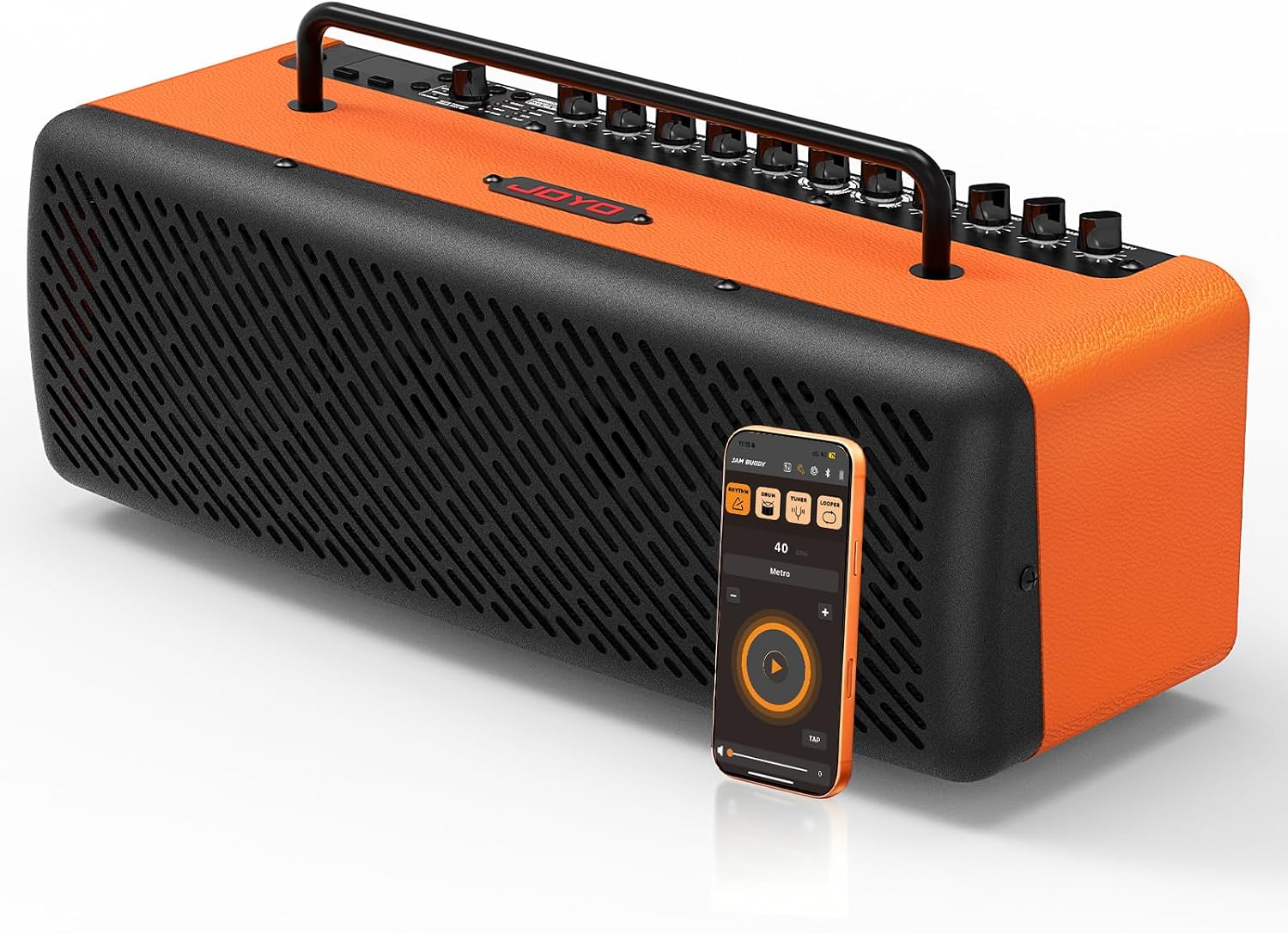
The JOYO JAM BUDDY III Desktop Guitar Amp combines guitar amplification, digital effects, wireless connectivity and recording functions in one compact desktop-style unit.
Rather than serving only as a conventional practice amplifier, it is designed to handle several different musical tasks. Electric guitarists can explore amplifier models and effects, acoustic players have dedicated tonal options, and bass guitarists can access sounds intended for their instruments.
The amplifier also includes a microphone input, making it possible to work with vocals or other suitable microphone sources.
With 40 watts of stereo amplification, an extensive digital sound library and a built-in rechargeable battery, the JAM BUDDY III is intended for players who want a flexible practice and recording setup without assembling a collection of separate devices.
Its onboard features include 52 amplifier-head models, 25 cabinet models, 49 digital effects, 40 stored presets, an 80-second looper and 40 drum patterns.
A wireless instrument transmitter is also supplied, allowing compatible guitars to connect without a traditional instrument cable.
The bright orange enclosure gives the amplifier a distinctive appearance, while its physical controls provide direct access to common adjustments.
For home musicians, the attraction is easy to understand.
A player can practise with a clean or overdriven tone, experiment with effects, play alongside a rhythm pattern and connect the amplifier to suitable recording equipment.
However, combining so many functions introduces a degree of complexity.
The companion app is important for detailed sound editing, the built-in speakers cannot reproduce every characteristic of a larger stage amplifier, and the rechargeable battery requires sensible management.
The JAM BUDDY III is therefore best understood as a multifunction practice and recording amplifier rather than a universal replacement for every piece of guitar equipment.
Why it works for guitarists
The strongest feature of the JOYO JAM BUDDY III is the number of practical functions it brings together.
A traditional guitar practice arrangement may involve a small amplifier, several effects pedals, a tuner, a metronome and perhaps a separate recording interface.
The JAM BUDDY III incorporates versions of many of these functions within one unit.
That creates a more convenient starting point for guitarists who want to practise without connecting several accessories.
For example, an electric guitarist can select a clean amplifier model, add delay or reverb, and play along with music through the amplifier.
Another player may prefer an overdriven tone with a drum pattern running underneath.
A musician experimenting with songwriting can use the looper to record a short phrase and practise another part over it.
The ability to switch between these activities makes the amplifier more versatile than a basic practice speaker.
It also encourages experimentation.
Players who have not previously used many effects may find it convenient to explore different types of modulation, distortion and ambience without buying individual pedals.
However, the large feature set is only an advantage when the controls remain manageable.
JOYO addresses this with two operating approaches: a straightforward panel mode and a more flexible preset mode.
This allows musicians to choose between immediate control and deeper sound editing.
40W stereo amplification
The JAM BUDDY III provides a rated 40W stereo output.
Its speaker arrangement includes two 4-inch drivers and two smaller 2-inch drivers.
This combination is designed to reproduce instrument sounds, effects and accompanying music within a relatively compact enclosure.
Stereo amplification can be useful when working with effects that create movement or space between the left and right channels.
For example, certain delay, modulation and reverb settings can benefit from stereo reproduction.
It can also make backing tracks more engaging than listening through a single small speaker.
The amplifier’s output is suitable for a range of home practice situations.
Its built-in volume controls allow the player to adjust the guitar level and the overall output.
There is also separate control over accompanying audio.
This is important when playing along with recorded music.
The guitar needs to remain audible without overpowering the backing track.
However, 40 watts should not be interpreted as a guarantee that the amplifier can handle every performance environment.
Loudness depends on speaker design, available headroom, playing style and the surrounding conditions.
A desktop amplifier with relatively small speakers behaves differently from a larger guitar combo fitted with a substantial speaker cabinet.
For home playing, rehearsal at controlled levels and personal practice, the JAM BUDDY III offers useful flexibility.
For a loud band rehearsal or an unamplified live performance, a more powerful dedicated stage amplifier may be appropriate.
Eight amplifier types available from the panel
One of the most practical aspects of the JAM BUDDY III is that players do not need to use a smartphone for every adjustment.
Its panel mode provides eight amplifier categories.
These include Clean, Crunch, Lead, Hi-Gain, Special, Bass, Acoustic and Flat.
The categories cover several common playing requirements.
A clean model offers a starting point for clear electric guitar sounds.
Crunch and lead settings introduce different levels of drive, while the higher-gain selections are intended for more heavily distorted styles.
The Bass and Acoustic options provide alternative starting points for those instruments.
The Flat setting offers a more neutral approach to amplification.
These eight panel selections are especially useful when a player simply wants to switch on the amplifier and begin practising.
The gain, three-band equalisation and volume controls can then be used to shape the selected sound.
For many everyday situations, that may be all the adjustment required.
The physical control arrangement resembles the familiar layout of a conventional guitar amplifier.
This makes the JAM BUDDY III easier to approach than equipment controlled entirely through a screen.
Nevertheless, the eight panel categories represent only part of the unit’s wider modelling capabilities.
The expanded library is accessed through its preset system and companion app.
A library of 52 amplifier models
Beyond its eight basic panel categories, the JAM BUDDY III provides 52 amplifier-head models.
These are digital recreations of different amplifier characteristics.
The intention is to provide access to a broad range of tonal styles without requiring a separate amplifier for every sound.
Guitarists interested in blues, classic rock, modern metal, pop or cleaner instrumental playing can explore models designed around different gain structures and tonal responses.
For example, a player seeking a bright clean sound may choose a different amplifier model from someone looking for a thick, heavily driven rhythm tone.
The available models can be combined with cabinet simulations and effects to create more complete sound arrangements.
This is particularly useful for guitarists who enjoy changing styles.
Someone recording a clean rhythm part and then a distorted lead passage may not want to rearrange physical equipment between takes.
With digital modelling, the sound can be changed through the amplifier’s controls and presets.
However, the number of models should not be confused with the number of completely different physical amplifiers.
These are digital interpretations, not individual valve amplifiers with their own cabinets, transformers and speaker behaviour.
The quality and suitability of any particular tone remain matters of musical preference.
The most useful approach is to explore a manageable selection of sounds rather than continually switching through every available model.
Cabinet simulations and digital effects
Amplifier modelling is only part of the JAM BUDDY III’s sound-shaping system.
The unit also provides 25 digital cabinet models and 49 effects.
Cabinet simulation is important because a guitar loudspeaker influences the character of an amplified electric guitar.
Different cabinets can affect perceived brightness, low-frequency response and the overall character of a distorted sound.
Digital cabinet models allow the player to explore those differences without changing physical speaker cabinets.
The effects library adds further possibilities.
Available effect types include overdrive, distortion, chorus, tremolo, delay and reverb.
Each serves a different purpose.
Overdrive and distortion can change the amount and character of gain.
Chorus creates a modulation effect that can add movement or width to a sound.
Tremolo varies the signal level rhythmically.
Delay repeats portions of the guitar signal, while reverb adds a sense of space.
These are familiar tools in many guitar styles.
A player might use a clean amplifier model with chorus and reverb for atmospheric chords.
Another may combine an overdriven model with delay for lead guitar.
The JAM BUDDY III allows these combinations to be explored within one system.
However, some effects and routing options require deeper editing through the companion app.
Anyone who prefers a dedicated physical knob for every available parameter may find that less convenient.
The large library offers variety, but learning how the different models and effects interact will take time.
Forty ready-to-use presets
The JAM BUDDY III includes 40 stored presets.
These provide prepared sound arrangements that can be selected without building every tone from the beginning.
For guitarists who are unfamiliar with digital modelling, presets are a useful introduction.
They allow the player to hear different combinations of amplifier models, cabinets and effects.
A clean preset may provide a convenient starting point for chord practice.
A more heavily driven preset might suit rock rhythm playing.
Other arrangements can demonstrate modulation or ambient effects.
The presets also provide a way to move between sounds during a practice session.
Instead of adjusting several controls repeatedly, the player can recall an existing arrangement.
The companion app provides further editing options.
This allows presets to be customised and saved for later use.
However, the factory presets will not necessarily suit every guitar.
Pickup output, playing technique and personal preference can all influence how a particular setting feels.
A preset developed around a powerful humbucker-equipped guitar may respond differently when used with lower-output single-coil pickups.
The most useful approach is to treat the stored sounds as starting points.
Small adjustments to gain, equalisation and effects can often make a preset more suitable for the instrument being played.
Physical controls for everyday playing
Despite its digital capabilities, the JAM BUDDY III retains a substantial collection of physical controls.
These include gain, bass, middle, treble, master volume and additional controls for effects and instrument levels.
The layout is intended to provide immediate access to commonly adjusted settings.
This matters because digital equipment can sometimes become frustrating when simple changes require several menus.
A guitarist should be able to adjust volume or tonal balance without interrupting the entire practice session.
The three-band equaliser provides familiar bass, middle and treble adjustments.
These are useful for compensating for differences between guitars.
For example, a particularly bright instrument may benefit from a reduced treble setting.
A darker guitar might require a different equalisation balance.
The gain control helps shape the amount of drive within the chosen amplifier model.
Separate effect controls provide access to commonly used modulation and ambience.
There is also a tap-tempo function for adjusting suitable time-based effects and rhythm settings.
This is useful when matching delay repeats to a musical phrase.
However, direct control has its limits.
The physical panel cannot expose every parameter across all the available amplifier and effect models.
Detailed editing still requires learning the wider operating system.
For players who prefer straightforward adjustment, panel mode is likely to be the most welcoming place to begin.
Included wireless guitar transmitter
A notable feature of the JAM BUDDY III is its integrated wireless instrument receiver.
JOYO supplies a compatible wireless transmitter with the amplifier.
This allows a guitar to be connected without a conventional instrument cable.
For home practice, the benefit is convenience.
A player can move around the room without dragging a cable across the floor.
It also reduces the number of accessories needed to begin playing.
The transmitter is inserted into a compatible guitar output socket, while the amplifier receives its signal wirelessly.
This is particularly appealing for someone who keeps the amplifier on a desk or shelf rather than directly beside their playing position.
The wireless instrument connection should not be confused with Bluetooth audio playback.
They are different functions designed for different purposes.
The supplied transmitter handles the instrument connection, while Bluetooth can be used for compatible audio playback and app-related operations.
However, a wireless system introduces its own practical considerations.
The transmitter needs to be powered and charged appropriately.
Its physical connector also needs to suit the guitar’s output-jack arrangement.
Some recessed sockets or unusual guitar designs may make positioning less convenient.
A conventional guitar cable remains a useful backup.
The wireless feature offers freedom, but it is not essential for the amplifier to function.
Electric, acoustic and bass guitar compatibility
Many compact guitar amplifiers are designed primarily for electric guitars.
The JAM BUDDY III offers a broader set of instrument options.
JOYO specifies compatibility with electric guitar, electric bass and acoustic guitar.
This is particularly useful for musicians who own several types of instrument.
An electric guitarist can explore clean and driven amplifier sounds.
A player using an electro-acoustic guitar can select an acoustic-oriented model or other suitable setting.
A bass player can access the dedicated bass option.
The flexibility reduces the need for separate small practice amplifiers for every instrument.
However, each type of instrument places different demands on a speaker system.
A bass guitar produces substantial low-frequency energy.
The JAM BUDDY III’s relatively compact speakers cannot be expected to reproduce deep bass in the same way as a large dedicated bass cabinet.
The bass settings make the amplifier compatible with the instrument, but they do not transform it into a full-size bass rig.
Likewise, an acoustic guitar may require careful gain and equalisation settings to avoid unwanted harshness or feedback.
The best results will depend on the guitar, its pickup system and the playing environment.
The multi-instrument capability is valuable, but specialist amplification may still be preferable for demanding situations.
Microphone input for vocals and recording
The JAM BUDDY III also includes a microphone connection.
Its rear panel provides a combined XLR and 6.35mm microphone input.
This allows a suitable microphone to be connected alongside an instrument.
The microphone channel has dedicated gain and reverb controls.
That arrangement is useful for singer-guitarists who want a compact practice setup.
A musician can connect a guitar and microphone without automatically needing a separate mixer.
The amplifier also supports switchable 48V phantom power for compatible condenser microphones.
This expands its potential uses in a small recording or streaming arrangement.
However, phantom power must be handled correctly.
It should only be enabled when appropriate for the connected microphone.
JOYO specifically warns against enabling it with unsuitable microphones.
The microphone manufacturer’s instructions should always be followed.
Another important limitation is that the JAM BUDDY III is not intended to replace every function of a full recording mixer.
A larger recording setup may require more microphone inputs, individual channel routing and additional processing.
For a solo musician using one instrument and one microphone, though, the built-in arrangement can be convenient.
An 80-second looper for practice
The JAM BUDDY III includes an 80-second looper.
A looper records a musical phrase and repeats it, allowing the player to perform additional parts over the recorded material.
This is particularly useful for guitar practice.
For example, a guitarist could record a short chord progression and then practise scales or melodic phrases over it.
A player working on rhythm guitar might record a repeating pattern and experiment with different lead ideas.
The looper can also help with songwriting.
A simple chord sequence can become the foundation for developing additional musical parts.
The JAM BUDDY III allows the looper to work with its drum machine, making rhythm-based practice more convenient.
However, the available recording duration is limited.
Eighty seconds is sufficient for many short progressions, riffs and practice exercises.
It is not intended for recording an entire extended song arrangement.
Nor should the looper be confused with a full multitrack recording system.
A dedicated looping pedal or recording application may offer more tracks, storage functions and performance controls.
The integrated looper is best regarded as a useful creative practice tool.
For everyday improvisation and learning, it adds genuine value.
Forty drum patterns for playing along
Practising with a consistent rhythm is an important part of guitar playing.
The JAM BUDDY III includes 40 drum patterns covering different musical styles.
These allow the guitarist to play against a repeating rhythmic accompaniment.
The tempo can be adjusted to suit the exercise.
This is useful when practising chord changes, picking patterns or timing.
For example, a beginner may start with a slow rhythm while learning to change chords cleanly.
A more experienced guitarist could use a faster pattern when developing rhythmic accuracy.
The drum machine also provides a convenient foundation for using the looper.
A guitarist can record a short phrase against the rhythm and then practise another part over it.
This is more engaging for some players than practising with a simple metronome.
However, the drum patterns are not a replacement for a skilled drummer.
Their arrangements and variations are limited by the programmed material.
Someone composing detailed drum parts may prefer dedicated drum software or a full-featured drum machine.
The main value here is convenience.
The JAM BUDDY III provides an immediate rhythm source without requiring a separate device.
Bluetooth audio and backing tracks
Bluetooth connectivity is useful for playing along with recorded music.
A compatible phone or other device can supply accompanying audio while the guitarist plays through the amplifier.
This arrangement can be particularly helpful for learning songs.
The player can listen to the original recording and practise matching the rhythm, chord changes or lead parts.
It can also be useful for practising with instrumental backing tracks.
Separate volume controls help balance the guitar against the accompanying audio.
This is important because backing tracks can vary greatly in recording level.
A good balance allows the guitar to remain clear without the accompanying music becoming overwhelming.
The amplifier also provides an auxiliary input for compatible wired audio sources.
That gives the user another option when Bluetooth is inconvenient.
It is worth noting that Bluetooth audio playback and wireless instrument transmission are separate systems.
The included guitar transmitter does not simply use ordinary Bluetooth playback as a substitute for a guitar cable.
That distinction matters because different wireless technologies have different requirements and potential latency characteristics.
For playing along with recordings, however, Bluetooth playback adds a practical everyday feature.
USB recording and live-streaming functions
The JAM BUDDY III includes connections intended for recording and live streaming.
These include a USB-C OTG connection and additional ports for compatible mobile-device recording arrangements.
There are also left and right line outputs for connecting the amplifier to suitable external equipment.
This makes the JAM BUDDY III more flexible than an amplifier designed solely to produce sound through its built-in speakers.
A guitarist may want to record a practice session, capture a musical idea or connect to a computer-based recording application.
The available outputs provide several possible approaches.
For someone creating guitar videos, the ability to combine instrument sounds and a microphone may be especially useful.
The amplifier’s integrated modelling and effects also mean that a processed guitar sound can be used without assembling a separate pedalboard.
However, recording connections need to be configured correctly.
The correct cable, compatible device and input settings will depend on the chosen recording arrangement.
USB-C compatibility should not be assumed for every phone or computer simply because the connectors appear similar.
It is important to check JOYO’s instructions and the requirements of the recording software.
The amplifier offers useful recording possibilities, but it should not be mistaken for a professional multichannel studio interface with unrestricted routing.
A dedicated audio interface may still be preferable for more demanding recording work.
Headphone practice
The JAM BUDDY III includes a headphone output.
This is useful for guitarists who need to practise without using the built-in speakers.
Headphone playing can be particularly valuable in shared accommodation or households where amplified guitar sound would disturb other people.
It also allows a player to concentrate on details such as picking accuracy, string noise and the character of effects.
The amplifier’s digital sound processing remains available, providing access to a range of tones without relying on a loudspeaker.
For musicians who practise at different times of day, a headphone connection is an important practical feature.
However, headphone listening produces a different experience from hearing an amplifier through speakers.
The sound can feel more direct, and stereo effects may be more noticeable.
The quality of the headphones will also influence the result.
Good headphones can make practice enjoyable, but they do not reproduce the physical sensation of a large guitar cabinet moving air.
For quiet practice, though, the headphone output substantially increases the usefulness of the amplifier.
Rechargeable battery and portability
The JAM BUDDY III includes an internal rechargeable battery.
JOYO’s published specifications indicate approximately five hours of operation under suitable conditions.
This provides an alternative to continuous mains-powered use.
For example, a guitarist may want to practise in a room where an electrical socket is inconveniently positioned.
Battery operation gives more freedom when choosing where to play.
It can also be useful for temporary setups and informal music sessions.
However, the JAM BUDDY III is not an especially small handheld amplifier.
Its body measures approximately 44cm across and weighs around 5.2kg.
That makes it portable in the sense that it can be moved between locations, but it is still a substantial piece of equipment.
The integrated handle makes carrying more convenient.
Battery runtime will also vary according to volume, the functions being used and other operating conditions.
The published figure should not be treated as a guaranteed duration at maximum output.
Anyone planning an extended session away from mains electricity should prepare accordingly.
Battery operation is a useful feature, but the amplifier still requires sensible charging and storage.
The companion app
The JAM BUDDY III provides a dedicated companion app for deeper control over its digital functions.
This is where the amplifier becomes particularly flexible.
The app allows access to detailed amplifier and cabinet choices, effects parameters and stored sound arrangements.
For guitarists who enjoy building their own tones, this can be an important part of the experience.
For example, a player may begin with a particular amplifier model, choose a cabinet simulation and then add an overdrive or modulation effect.
Additional adjustments can be made to the individual components.
The completed arrangement can then be saved for future use.
This is more flexible than simply choosing one of the panel’s eight basic amplifier categories.
The app also provides access to additional utility functions and settings.
However, dependence on an external app introduces considerations that do not exist with a conventional amplifier.
The phone must be compatible, the app needs to remain available, and the connection must work reliably.
Android users should pay particular attention to the installation process.
JOYO distributes an Android installation package through its official website rather than relying exclusively on Google Play.
Anyone using this method should obtain the software only from JOYO’s verified source and consider their phone’s security settings before installing it.
For players who enjoy app-based equipment, this may be manageable.
For those who prefer physical controls and no software dependencies, it is a meaningful drawback.
What it feels like to use at home
The JAM BUDDY III is designed to bring several musical activities into one practice area.
A typical setup could involve placing the amplifier on a stable desk or suitable stand, connecting an electric guitar and selecting a clean amplifier model.
The physical gain and equalisation controls can then be adjusted to suit the instrument.
If a different style of sound is required, the player can move to an overdriven or higher-gain model.
Effects such as delay or reverb can be added.
For practice with accompaniment, a backing track can be played through Bluetooth or a suitable wired input.
The drum machine provides another option.
Someone working on a short musical idea can use the looper to create a repeating phrase.
For more detailed sound design, the companion app provides additional editing options.
The amplifier also supports headphone listening when loudspeaker use is inappropriate.
This variety is the main attraction.
The JAM BUDDY III offers several ways to practise without requiring a complete recording studio or a large collection of separate accessories.
However, there is a learning process.
The user will need to understand the difference between panel and preset modes, become familiar with the connection options and decide which features are most useful.
The experience is likely to be most rewarding for someone who enjoys exploring sounds and musical arrangements.
A player who wants only a single clean sound and one volume knob may prefer something simpler.
The drawbacks
The JOYO JAM BUDDY III offers an impressive selection of functions, but there are substantial limitations that should be considered before choosing it.
These are particularly important because the amplifier combines several types of equipment in one product.
It is more complicated than a conventional guitar amplifier.
A simple guitar combo may require only a cable, power connection and a few control adjustments.
The JAM BUDDY III includes amplifier models, cabinet simulations, effects, presets, wireless operation, a looper, drum patterns and recording functions.
These provide flexibility, but they also introduce more controls and operating procedures.
Someone unfamiliar with digital modelling may need time to understand the different modes.
Switching between panel operation and preset editing is not necessarily intuitive at first.
The learning process is worthwhile for players who want to use the advanced functions, but it could frustrate someone seeking straightforward amplification.
The companion app is important for detailed editing.
The physical controls are useful, but they do not provide unrestricted access to every parameter.
More detailed sound creation requires the app.
This means part of the amplifier’s functionality depends on a compatible smartphone or tablet.
If the app becomes unavailable or stops working with a future operating-system version, some editing convenience could be affected.
The amplifier can still perform basic functions independently, but its full flexibility is more closely connected to the software.
That is a genuine consideration for anyone who wants equipment that remains completely self-contained.
Android installation may be inconvenient.
JOYO provides an Android installation package through its website.
This can require steps that are less familiar than installing an application through Google Play.
Depending on the device’s security settings, the user may need to approve installation from an external source.
That introduces an additional responsibility to verify the download source.
Some users may be uncomfortable installing software in this way.
The manufacturer’s official website should be used, and the software should never be obtained from an unknown third-party download service.
For musicians who prefer simple plug-and-play equipment, the installation process may be an unnecessary complication.
Forty watts does not make it a universal stage amplifier.
The JAM BUDDY III provides 40W stereo output, but its speaker arrangement is relatively compact.
It is designed primarily around flexible practice, desktop use and multimedia functions.
Its performance in a loud rehearsal room cannot be judged from wattage alone.
A drummer playing acoustically can create substantial volume.
A guitarist in that environment may require a different amplifier with greater speaker capability and usable headroom.
The JAM BUDDY III may also be less suitable for large venues without appropriate external amplification.
Its output options add flexibility, but the unit should not automatically be treated as a replacement for a dedicated stage rig.
Bass guitar performance has physical limitations.
The amplifier includes a dedicated bass setting, but its speakers are considerably smaller than those fitted to many conventional bass cabinets.
Reproducing low frequencies at higher volume places substantial demands on loudspeakers.
The JAM BUDDY III may be useful for bass practice at appropriate levels.
However, it should not be expected to provide the deep low-frequency output or headroom of a substantial bass amplifier.
Players who use extended-range bass guitars or heavily lowered tunings should be particularly realistic about the limitations of a compact speaker system.
Compatibility with bass guitars does not mean equivalence to a large bass rig.
Digital modelling is not identical to playing through the original amplifiers.
The JAM BUDDY III offers numerous digital amplifier models.
These can provide a wide range of useful tones, but they remain simulations.
A large valve amplifier with a substantial speaker cabinet has physical characteristics that a compact digital system cannot reproduce in exactly the same way.
Speaker movement, room interaction and high-volume response can all influence the playing experience.
Some guitarists will appreciate the versatility of digital modelling.
Others may still prefer the response of their existing valve amplifier or traditional combo.
The JAM BUDDY III is best judged on the usefulness of its own sounds rather than the expectation that it can duplicate every detail of expensive physical equipment.
The wireless transmitter introduces another battery to manage.
The included wireless instrument connection is convenient, but the transmitter needs to be powered appropriately.
If its charge becomes depleted, the wireless feature may become unavailable.
The user also needs to ensure that the transmitter fits the guitar’s output socket correctly.
Some guitar designs have recessed or unusually positioned sockets.
A transmitter that protrudes from the instrument may be less convenient on certain guitars.
A conventional instrument cable is a sensible backup.
Wireless operation is useful, but it does not eliminate the practical reliability of a wired connection.
Wireless connections can be affected by interference.
Wireless instrument systems and Bluetooth audio connections operate in environments containing other electronic devices.
Their performance can depend on distance, physical obstructions and local wireless activity.
This does not mean the JAM BUDDY III will necessarily experience interference.
However, it is a factor that does not affect a conventional guitar cable in the same way.
Musicians recording important material should consider whether a wired connection would provide greater certainty.
Wireless convenience involves accepting some dependence on the surrounding environment.
The 80-second looper has limited recording capacity.
The integrated looper is useful for short chord progressions and improvisation.
However, it is not a full songwriting recorder.
Its 80-second duration limits the length of material that can be captured in one loop.
A musician wanting to record several song sections, store multiple arrangements or create a complex layered performance may find it restrictive.
A dedicated looping pedal or recording application can offer more advanced functionality.
The JAM BUDDY III’s looper is best regarded as a practice feature rather than a complete recording workstation.
The drum machine offers limited musical variation.
Forty patterns provide a useful selection for practising rhythm.
Nevertheless, they remain programmed patterns.
They cannot fully replace the responsiveness and variation of a live drummer.
Players creating detailed arrangements may want more control over individual drum parts, fills and structure.
Specialist drum software provides a broader range of possibilities.
The JAM BUDDY III is suitable for practising against a consistent rhythm, but the drum machine is not intended to replace a complete production system.
Recording connections require some understanding.
The amplifier provides USB and other recording-related connections, but the correct setup depends on the external device.
A smartphone, tablet or computer may require a particular cable, adapter or software configuration.
Not every USB-C connection automatically supports the same recording functions.
Audio routing and monitoring can also become complicated when several sources are involved.
Someone unfamiliar with recording equipment may need to consult the manual before obtaining the expected result.
For regular multitrack recording, a dedicated audio interface may offer a more suitable workflow.
The JAM BUDDY III adds recording convenience, but it does not eliminate the learning process.
The microphone channel is useful but limited.
A combined microphone input allows the amplifier to support a singer-guitarist.
However, it does not provide the flexibility of a multichannel mixing desk.
A small band recording several microphones simultaneously would require more inputs and routing options.
The microphone processing controls are also less extensive than those available from dedicated vocal processors.
Switchable phantom power is helpful for compatible microphones, but incorrect use can create problems.
Users must understand whether their microphone requires it.
The microphone input is a practical addition, not a replacement for all-purpose recording equipment.
The enclosure is heavier than its desktop description may suggest.
At approximately 5.2kg, the JAM BUDDY III is not a miniature portable speaker.
Its 44cm-wide enclosure also requires a reasonable amount of desk or shelf space.
This is not necessarily a problem in a dedicated music room.
However, someone working at a small desk may find the amplifier competes with a computer monitor, keyboard or other equipment.
The built-in handle helps with moving it, but the size and weight remain noticeable.
Before choosing the amplifier, it is worth deciding where it will sit during regular use.
Battery runtime is variable.
JOYO indicates approximately five hours of battery operation.
Actual duration can depend on listening level, operating conditions and the way the amplifier is used.
A session at relatively modest volume may place different demands on the battery from one involving higher output.
The advertised runtime should therefore be treated as an approximate figure.
Anyone relying on battery power for an important session should ensure the amplifier is fully charged and have a suitable mains supply available where practical.
The battery also introduces a component that will age over time.
Long-term battery replacement arrangements should be checked with the manufacturer.
The large number of sounds can become distracting.
Having 52 amplifier models and 49 effects sounds appealing.
However, more choices do not automatically produce better playing.
It is easy to spend a substantial amount of practice time changing models, adjusting effects and comparing presets.
For some musicians, that experimentation is part of the enjoyment.
For others, it can become a distraction from learning songs or developing technique.
The most productive approach may be to create a small number of reliable sounds and use them regularly.
A simpler amplifier can sometimes be more effective for a player who prefers to concentrate entirely on playing.
It does not replace a dedicated pedalboard for everyone.
The effects library covers many familiar sounds, but some musicians depend on particular pedals for their performance style.
A guitarist may prefer the feel, controls or distinctive character of an existing overdrive pedal.
Others require specialised effects or immediate foot-operated switching.
The JAM BUDDY III offers digital alternatives, but it does not necessarily replicate every external pedal.
Its desktop design also differs from a floor-based multi-effects processor intended for frequent changes during a performance.
Players who rely on complicated live pedal arrangements should consider how the JAM BUDDY III would fit into their existing setup.
The physical controls do not expose every digital setting.
The front panel provides useful direct adjustments, but the full range of parameters requires more detailed access.
That can interrupt the workflow when making complex changes.
A guitarist might begin by adjusting the bass, middle and treble controls, then discover that another part of the sound requires app-based editing.
This is a common trade-off in compact digital equipment.
The JAM BUDDY III balances hands-on controls against a much larger software-controlled feature set.
Whether that balance feels convenient depends on how the user likes to work.
Long-term software support matters.
Smart musical equipment can depend on companion applications, firmware updates and mobile-device compatibility.
These factors are less relevant to a conventional analogue amplifier.
The JAM BUDDY III has useful physical controls, but its more advanced editing options depend partly on software.
Owners should keep official documentation and follow manufacturer guidance when updating the system.
It is sensible to consider how important app-based editing will be over the life of the amplifier.
Anyone seeking equipment with minimal software dependence may prefer a more traditional design.
It may be unnecessary for guitarists who already own a capable recording setup.
A musician with a good amplifier, established pedalboard, audio interface and studio monitors may already have access to most of the JAM BUDDY III’s functions.
In that situation, the main benefit is consolidation.
The amplifier offers a convenient way to bring several tools together, but it may not replace equipment that is already well suited to the player’s needs.
For a guitarist building a first home practice setup, the all-in-one arrangement could be especially attractive.
For someone with a fully equipped studio, it may serve better as an additional practice amplifier.
These limitations are worth weighing against the amplifier’s flexibility.
Its strongest advantage is bringing several useful musical functions together, but no single unit can replace every specialist piece of equipment.
Who it suits best
The JOYO JAM BUDDY III Desktop Guitar Amp is particularly suitable for guitarists who enjoy experimenting with different sounds and want a flexible practice setup.
Electric guitarists can explore a broad range of clean, driven and heavily distorted tones without assembling a large collection of separate effects pedals.
Acoustic guitarists may appreciate having suitable models available alongside microphone and recording connections.
Bass players can use the dedicated bass setting for appropriate practice situations, while recognising the limitations of the compact speaker arrangement.
The amplifier is also interesting for singer-songwriters.
A guitar and suitable microphone can be connected to the same unit, making it useful for informal practice and straightforward recording arrangements.
For guitarists who enjoy improvisation, the looper and drum machine provide useful creative tools.
The wireless transmitter is another convenience for players who prefer avoiding instrument cables during home sessions.
The JAM BUDDY III is less suitable for someone who wants the simplest possible amplifier, does not enjoy app-based editing or requires the output of a substantial stage rig.
It may also be unnecessary for musicians who already own a complete collection of recording and effects equipment.
Its ideal user is someone who values flexibility, enjoys experimenting with tones and wants several practical guitar functions available in one reasonably compact system.
Is it worth the practice space?
The JOYO JAM BUDDY III Desktop Guitar Amp offers a substantial range of features for home musicians.
Its 40W stereo speaker system provides the foundation, while digital amplifier and cabinet models allow the player to explore different sounds.
The extensive effects library adds further flexibility without automatically requiring separate pedals.
Forty stored presets provide convenient starting points, and the physical controls make everyday adjustments more approachable.
The 80-second looper and 40 drum patterns are particularly useful for practising timing, developing musical ideas and experimenting with short arrangements.
Wireless instrument connectivity, Bluetooth playback and recording outputs extend the amplifier’s usefulness beyond ordinary guitar practice.
The microphone input also makes it interesting for musicians who sing and play.
However, the JAM BUDDY III is not without compromises.
Its advanced features take time to learn, detailed sound editing relies on the companion app, and the relatively compact speakers cannot replace a full-size stage amplifier in every situation.
Recording connections also require careful configuration, and the rechargeable battery needs regular attention.
For players who want a straightforward amplifier with very few controls, a simpler model may remain preferable.
But for guitarists who enjoy changing sounds, recording ideas and practising with built-in accompaniment, the JOYO JAM BUDDY III brings together several genuinely useful capabilities.
Its strongest quality is not simply the number of effects or amplifier models.
It is the convenience of having amplification, tone shaping, wireless operation, rhythm tools and recording connections available within one practical home-music system.
For more guitar amplifiers, practice equipment and useful sound-shaping technology, explore our Amplifiers guides.
As an Amazon Associate I earn from qualifying purchases.