
Peterson StroboStomp HD Pedal Tuner
As an Amazon Associate I earn from qualifying purchases.
The Peterson StroboStomp HD Pedal Tuner is designed for guitarists and bass players who value accurate tuning, dependable construction and a clear display that remains useful under demanding stage conditions.
With 0.1-cent tuning accuracy, a large high-definition strobe display and a stainless-steel enclosure, it offers a more specialised approach than many conventional chromatic pedal tuners.
Its features extend beyond ordinary standard tuning. Peterson includes an extensive collection of Sweetened Tunings, guided alternative tunings and several signal-routing options, making the StroboStomp HD particularly interesting for musicians who regularly perform, record or experiment with different instruments.
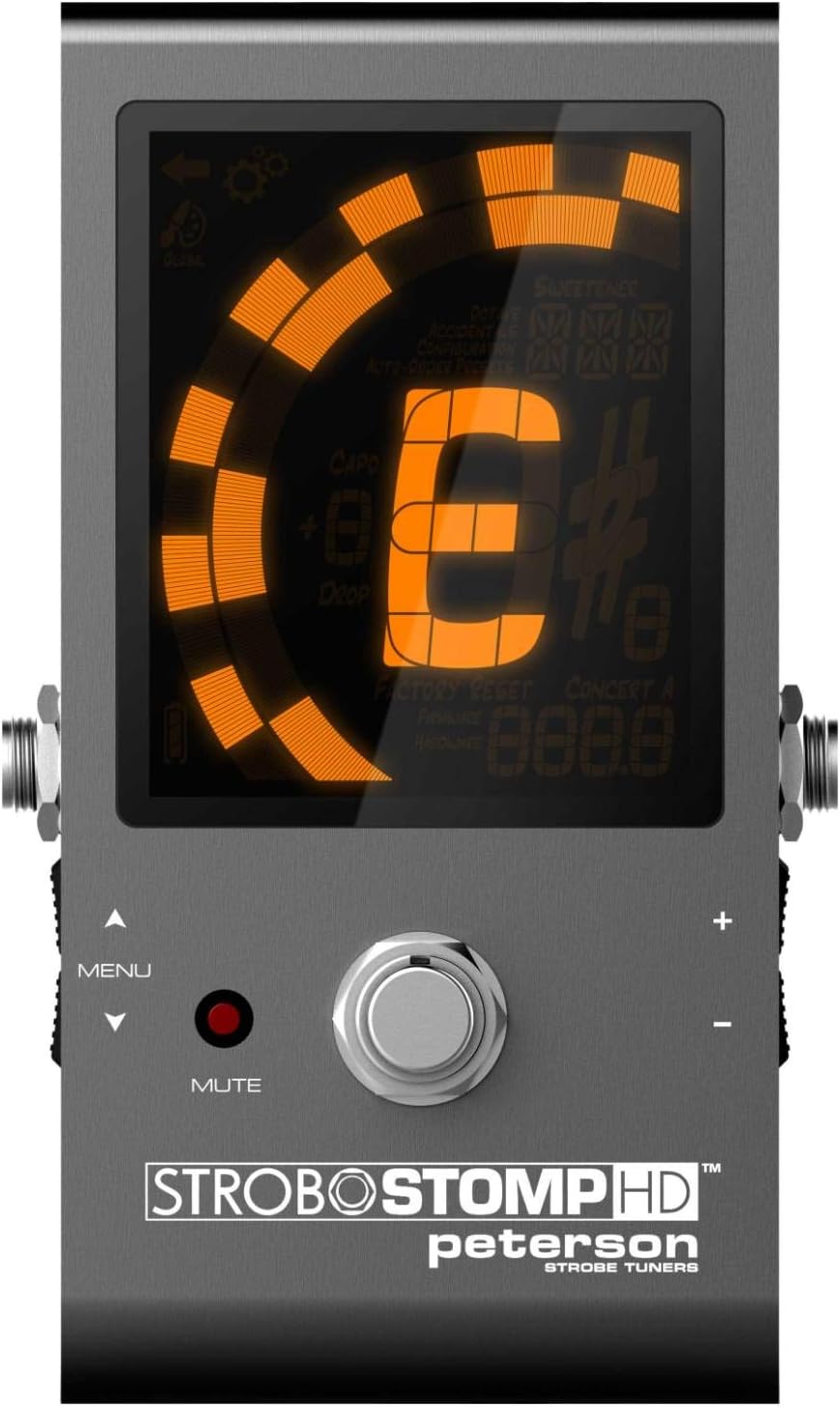
The large multicolour display is another attraction. Rather than relying on a small row of indicator lights, it provides detailed visual feedback that helps the player make very fine pitch adjustments.
For musicians who want a dedicated tuning pedal that can remain on their pedalboard, the StroboStomp HD combines precision with practical everyday features.
Why Accurate Tuning Matters
A guitar can be beautifully constructed, fitted with excellent pickups and connected to a quality amplifier, yet still sound disappointing when its tuning is slightly wrong.
Even small differences in pitch can become noticeable when playing sustained chords, recording layered guitar parts or performing alongside other instruments.
A reliable tuner provides a consistent reference, helping musicians prepare their instruments before practising, recording or performing.
The Peterson StroboStomp HD takes this process further by offering accuracy within 0.1 cents.
A cent is one hundredth of a semitone, so this represents a particularly fine level of pitch measurement.
This precision is useful when adjusting guitar intonation, where small changes to the string length at the bridge can affect how accurately notes play across the fretboard.
It also helps musicians who need consistent tuning between multiple instruments.
However, a highly accurate tuner cannot correct every cause of tuning instability. Worn strings, poorly adjusted nuts and loose machine heads still need attention.
The StroboStomp HD provides precise information, but the instrument itself must be properly maintained.
What It Feels Like to Use
The StroboStomp HD has the familiar rectangular shape of a traditional guitar effects pedal, but its stainless-steel enclosure gives it a substantial, purposeful character.
At approximately 408 grams, it has enough physical weight to feel reassuringly solid without becoming excessively heavy.
Its dimensions of approximately 129mm long, 66mm wide and 54mm high, including the footswitch, make it suitable for a conventional pedalboard arrangement.
The large display dominates the upper surface.
Unlike a conventional tuner with a moving needle or small collection of LEDs, the Peterson uses a detailed strobe pattern to show whether the incoming note is sharp or flat.
As the string approaches the correct pitch, the movement slows. When the pattern becomes stationary, the note has reached the selected tuning reference.
This provides extremely fine visual feedback, although it takes some practice to interpret confidently.
The footswitch allows the player to control tuning and muting functions according to the selected operating mode.
For stage use, this combination of a large display, physical switch and substantial enclosure is particularly practical.
The design concentrates on doing one important job accurately rather than adding unrelated effects or unnecessary controls.
A High-Definition Display for Stage and Studio
One of the most distinctive features of the StroboStomp HD is its large LCD screen with adjustable LED backlighting.
Peterson provides ten preset display colours, allowing musicians to choose a colour that suits their preference or the surrounding lighting.
Different colours can also be assigned to particular tuning presets.
This could be useful for a guitarist who regularly changes between standard tuning, Drop D and open tunings during a performance.
Instead of relying entirely on small preset names, the display colour can provide another visual indication of the selected arrangement.
The screen is also designed to remain readable in bright conditions.
Peterson states that the strobe pattern and note names remain visible in direct sunlight, where some conventional illuminated displays can become difficult to see.
For guitarists performing outdoors, that is a meaningful practical consideration.
The large screen may also appeal to players who prefer checking tuning while standing rather than bending towards a small pedalboard display.
Sweetened Tunings and Alternative Tunings
The StroboStomp HD includes more than 130 Sweetened and Guided tuning options, making it considerably more versatile than a tuner intended only for ordinary chromatic operation.
Peterson’s Sweetened Tunings apply carefully selected pitch offsets to particular strings or notes.
The intention is to accommodate certain musical and instrumental characteristics rather than always using identical equal-tempered references.
For example, a guitarist may prefer a tuning arrangement specifically designed for acoustic guitar or particular chord relationships.
Dedicated options are also available for bass guitars, twelve-string guitars, baritone guitars and other string instruments.
Importantly, Sweetened Tunings are optional.
Someone who prefers conventional equal-tempered tuning can continue using the standard chromatic setting.
The pedal also provides Guided Tunings for alternative arrangements such as Drop D, Open G and DADGAD.
These modes can display string numbers to help players identify the correct tuning sequence.
That is particularly useful for musicians exploring unfamiliar arrangements or switching between different tunings during a performance.
With so many options available, the StroboStomp HD can support a wide range of playing styles without requiring several separate tuning devices.
True Bypass, Buffered Output and Monitor Mode
A tuner becomes part of the guitar’s signal path when connected to a pedalboard.
That makes its bypass design important.
The StroboStomp HD offers true-bypass and buffered-output operation, allowing the player to choose an arrangement suitable for their equipment.
In true-bypass mode, the pedal provides a direct signal path when disengaged.
Peterson uses a relay-based switching system designed to minimise the unwanted popping noises that can occur with some switching circuits.
Buffered mode provides an alternative for guitarists using longer instrument cables or complicated pedalboards.
Long cables and multiple effects connections can introduce electrical loading that affects the high-frequency response of a passive guitar signal.
A suitable buffer can help preserve signal clarity through these arrangements.
The StroboStomp HD also provides Monitor Mode, allowing tuning information to remain visible during playing.
This can be useful when checking pitch without interrupting the performance.
These options make the pedal adaptable to different setups, although choosing the best arrangement requires some understanding of how the equipment is connected.
Useful for Guitar and Bass Intonation
The StroboStomp HD is particularly attractive for musicians who maintain and adjust their own instruments.
Correct intonation helps ensure that notes remain close to their intended pitch as the player moves along the fretboard.
For a conventional electric guitar, setting intonation normally involves comparing the pitch of the open string with the corresponding fretted note and adjusting the bridge saddle accordingly.
A precise tuner makes these small differences easier to identify.
The Peterson’s strobe display is well suited to this type of work because it provides more detailed pitch information than many ordinary tuning displays.
It can also help when checking bass guitar intonation or preparing several instruments for recording.
However, the tuner does not make physical adjustments to the instrument.
Nut height, string condition, fret placement and playing pressure can all affect intonation.
Its advantage is providing an accurate reference while the musician performs the necessary adjustments.
Power and Pedalboard Integration
The StroboStomp HD can operate using a standard 9V battery or a compatible 9V DC centre-negative power supply.
Peterson specifies a nominal current requirement of approximately 85mA.
An external power supply is optional rather than included as standard equipment.
The pedal also provides a 9V power-through connection that can supply another compatible pedal when the external supply has sufficient capacity.
This may be useful for musicians trying to organise power connections across a pedalboard.
A Micro-USB connection allows the tuner to communicate with Peterson Connect for supported firmware updates, custom tuning configurations and display preferences.
That adds flexibility for musicians who want to personalise their equipment.
For players who simply need standard tuning, however, most of the pedal’s essential functions remain available without computer-based configuration.
The Drawbacks
The Peterson StroboStomp HD offers exceptional tuning precision and considerable flexibility, but it will not be the ideal choice for every musician.
Its extensive settings, specialised display and physical dimensions introduce compromises that are worth understanding before adding it to a pedalboard.
The Strobe Display Takes Practice
Perhaps the most noticeable difference from a conventional tuner is the way the StroboStomp HD displays pitch.
Instead of showing a familiar needle moving towards the centre, it uses a moving strobe pattern.
The player must learn to recognise the direction and speed of that movement.
Although the principle is straightforward, someone accustomed to a basic chromatic tuner may initially find the display more difficult to interpret.
Its sensitivity also means the pattern can respond to extremely small pitch variations.
A note may appear almost perfectly tuned on an ordinary device while the Peterson still shows movement.
This is useful for precision work, but beginners may find themselves repeatedly adjusting strings in pursuit of a completely stationary display.
The additional accuracy is valuable only when the player understands how to use it.
Most Guitarists Will Not Need Every Tuning Option
The StroboStomp HD includes an extensive collection of Sweetened Tunings and alternative tuning presets.
For musicians using several instruments or specialist tuning systems, these features can be genuinely useful.
However, someone who plays a six-string electric guitar in standard tuning may rarely explore them.
The large selection can also make the pedal appear more complicated than necessary.
Although conventional chromatic tuning remains straightforward, working through specialist presets and configurations takes additional time.
Players who simply want to tune quickly before rehearsals may prefer a less complicated pedal with fewer options.
Sweetened Tunings Require Understanding
Peterson’s Sweetened Tunings are designed to compensate for particular musical or instrument characteristics.
They are not automatically the correct choice for every guitarist or musical arrangement.
A specialised tuning offset may sound pleasing in one context but be less appropriate when playing alongside instruments using a different tuning reference.
This is particularly relevant in ensembles where all musicians need to agree on their tuning approach.
Players should understand the intended purpose of a Sweetened Tuning before selecting it.
For ordinary situations, standard equal-tempered tuning remains a reliable starting point.
It Occupies More Pedalboard Space Than a Mini Tuner
Although the StroboStomp HD has conventional pedal dimensions, it is considerably larger than miniature tuning pedals.
That may not matter on a spacious pedalboard.
However, musicians using compact travel boards or carrying only a small collection of essential effects may prefer something narrower.
The large display provides excellent visibility, but the enclosure necessarily occupies a reasonable amount of space.
It is worth measuring the available pedalboard area before purchasing, particularly when other pedals use side-mounted audio and power connections.
External Power Requires Another Purchase
The StroboStomp HD accepts a 9V battery, but an external power adapter is not supplied as standard.
For occasional home use, battery operation may be convenient.
However, musicians performing regularly will probably prefer a suitable external power supply.
This avoids relying on battery condition during extended rehearsals or performances.
The power-through connection is useful, but it is not an unlimited power source.
The connected supply must provide sufficient current for the tuner and any compatible pedal receiving power through it.
Anyone using several effects should calculate their combined power requirements rather than assume that one connection can safely supply everything.
It Cannot Solve Mechanical Tuning Problems
A tuner with 0.1-cent accuracy can identify extremely small differences in pitch, but it cannot make an unstable instrument remain in tune.
Strings may continue to slip because of worn machine heads, poorly fitted strings or friction at the nut.
Likewise, a guitar with badly adjusted intonation may show accurate open-string tuning while fretted notes remain noticeably sharp or flat.
The Peterson can reveal these issues, but repairing them requires appropriate instrument maintenance.
Buying a more precise tuner is not a substitute for correcting the underlying mechanical problem.
Computer Configuration Adds Complexity
The Micro-USB connection and Peterson Connect system provide useful customisation options.
However, musicians wanting to create custom configurations or manage certain settings through a computer must use compatible software and a suitable connection.
This is an additional step compared with tuners that provide every option directly from a few physical controls.
For players comfortable with computer-based equipment management, the process may be straightforward.
Others may find it unnecessary complication for a device whose main purpose is simply measuring pitch.
Fortunately, normal tuning does not depend on using these advanced features.
It Has No Built-In Microphone
The StroboStomp HD is designed primarily as a pedalboard tuner using a conventional quarter-inch instrument input.
It does not have a built-in microphone.
This is perfectly suitable for electric guitars, electric basses and acoustic instruments fitted with compatible pickups.
However, players wanting to tune an ordinary acoustic guitar without a pickup cannot simply place the pedal nearby and expect it to detect the instrument acoustically.
A suitable pickup or another method of supplying the instrument signal is required.
For musicians who regularly tune unamplified instruments away from their pedalboards, a clip-on or handheld tuner may be more convenient.
Greater Precision Is Not Always Necessary
The 0.1-cent specification is impressive, but not every playing situation requires that degree of accuracy.
For ordinary home practice, a dependable conventional tuner may be entirely sufficient.
The Peterson becomes more compelling when the musician values its detailed display, specialist tuning systems or usefulness for precise adjustments.
Someone who rarely changes tunings, performs occasionally and does not maintain their own instruments may find that a simpler tuner meets their requirements.
The important question is not whether the StroboStomp HD is more precise than many alternatives.
It is whether that additional precision and flexibility will make a meaningful difference to the individual player.
Who It Suits Best
The Peterson StroboStomp HD is particularly well suited to guitarists and bassists who want a dependable, precise tuner for regular playing.
Its large display makes it attractive for stage performers, while the detailed strobe indication is useful for recording sessions and instrument maintenance.
Musicians who regularly explore alternative tunings will appreciate the extensive preset collection.
The choice between true-bypass and buffered operation also makes it interesting for players with more complicated pedalboards.
However, anyone wanting something simpler may wish to consider our BOSS TU-3 Chromatic Tuner, which takes a more conventional approach to stage tuning.
For musicians who prefer a device that actually turns the tuning pegs, our Roadie Bass Automatic Guitar Tuner explores a different solution, with motorised adjustment and string-winding functions.
These alternatives highlight an important point: the best tuning equipment depends on how the musician plays and maintains their instruments.
Is the Peterson StroboStomp HD Worth the Pedalboard Space?
The Peterson StroboStomp HD combines professional tuning precision, substantial construction and thoughtful stage-friendly features in one dedicated pedal.
Its high-definition display is the main attraction, providing detailed visual feedback with adjustable colours and good visibility in different lighting conditions.
The extensive Sweetened Tunings, guided alternative tuning modes and configurable signal path add further flexibility.
Its stainless-steel enclosure and conventional footswitch design also suit musicians who want equipment intended for repeated use.
Nevertheless, the strobe display requires some familiarity, while the large selection of tuning options may be unnecessary for players who only need ordinary chromatic tuning.
For guitarists who value precision, maintain their own instruments or regularly perform with different tunings, the StroboStomp HD is a well-considered piece of equipment.
It is not a pedal that changes the character of a guitar’s sound. Its purpose is more fundamental: helping the instrument begin each performance as accurately tuned as possible.
Explore more carefully selected accessories, cases, tuners and practical playing equipment in our Guitar Gear collection.
As an Amazon Associate I earn from qualifying purchases.