
BOSS WL-20 Wireless Guitar System
As an Amazon Associate I earn from qualifying purchases.
The BOSS WL-20 Wireless Guitar System provides a straightforward way to connect an electric guitar or bass to an amplifier without using a traditional instrument cable.
Designed particularly for instruments with passive pickups, it combines a compact transmitter and receiver with automatic wireless setup, rechargeable batteries and built-in cable-tone simulation.
Its purpose is simple: to give guitarists greater freedom of movement without requiring a complicated wireless installation.
BOSS specifies a transmission range of up to 15 metres under clear line-of-sight conditions, with latency of just 2.3 milliseconds. These figures make the WL-20 a practical option for home practice, rehearsals and suitable live performances.
However, wireless convenience comes with responsibilities. Batteries need charging, connections must be compatible, and the surrounding wireless environment can affect performance.
For guitarists who value freedom of movement and want to reduce the amount of cable running across the floor, the WL-20 offers a thoughtful alternative to a conventional guitar lead.
Why the BOSS WL-20 Works for Guitarists
A traditional instrument cable remains one of the simplest ways to connect a guitar to an amplifier.
It is inexpensive to maintain, requires no charging and provides a direct physical connection.
However, cables can become inconvenient.
They may twist around chair legs, catch beneath equipment or restrict movement when practising and performing.
For guitarists who stand while playing, the cable can also become an unnecessary distraction.
The BOSS WL-20 addresses these problems by replacing the instrument cable with a compact digital wireless connection.
One unit plugs into the guitar, while the other connects to the amplifier or the first suitable device in the signal chain.
There is no separate beltpack transmitter to attach to clothing and no cable running from the guitar to a wireless pack.
This makes the system particularly appealing to musicians who prefer a simple setup.
The WL-20 also includes cable-tone simulation, helping preserve a familiar tonal character when using traditional passive guitar pickups.
Rather than trying to introduce additional effects or change the instrument’s sound dramatically, BOSS has concentrated on making the wireless connection feel like an ordinary part of playing guitar.
What It Feels Like to Use
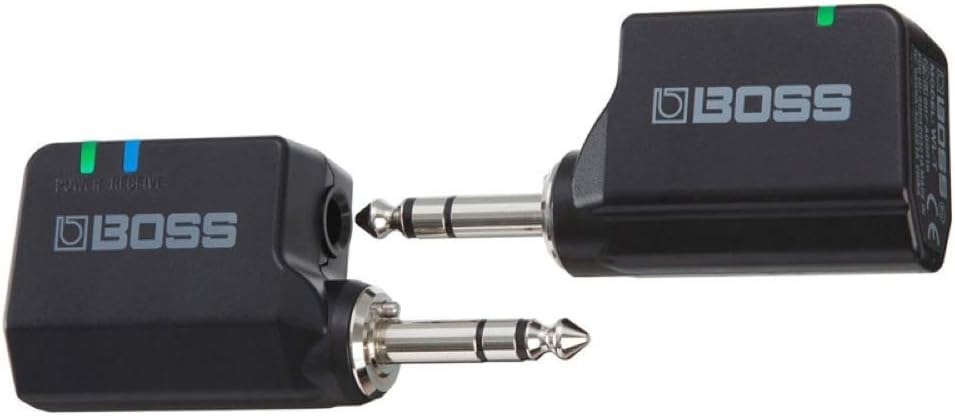
The WL-20 consists of two small plug-in units.
The transmitter connects directly to the instrument’s output socket, while the receiver connects to the amplifier or compatible equipment.
Both units have a compact, practical appearance, without unnecessary displays or complicated controls.
Their small dimensions are particularly useful for guitarists who regularly carry their equipment between home, lessons and rehearsals.
There is no substantial receiver box to position on the floor.
The system is also designed to avoid the lengthy setup procedures associated with some professional wireless equipment.
Simple Automatic Setup
BOSS uses an automatic connection process.
The transmitter and receiver are temporarily connected together, allowing the system to scan the local wireless environment and establish an appropriate connection.
BOSS recommends allowing approximately 10 seconds for this process.
Once completed, the units can be separated and connected to the guitar and amplifier.
This approach reduces the need to understand frequency selection or manually configure individual wireless channels.
For guitarists who want to concentrate on playing rather than adjusting equipment, that simplicity is one of the WL-20’s most useful characteristics.
However, it is still sensible to establish the connection in the location where the system will actually be used, particularly before a rehearsal or performance.
Wireless conditions can differ considerably between rooms and venues.
Does the BOSS WL-20 Affect Guitar Tone?
This is an important question, especially for guitarists who have spent time developing the sound of their instrument and amplifier.
The WL-20 uses digital wireless transmission, but the WL-20 model also includes cable-tone simulation.
Understanding Cable-Tone Simulation
A traditional guitar cable introduces capacitance into the signal path.
With passive guitar pickups, this can slightly reduce the upper treble frequencies.
The effect depends on several factors, including the pickups, cable construction and cable length.
Some guitarists appreciate the subtle tonal character produced by a conventional cable.
When that cable is removed, the guitar may sound noticeably brighter.
BOSS addresses this with a simulation designed to reproduce the capacitive effect of a typical 3-metre instrument cable.
The aim is to preserve a familiar response rather than add a dramatic effect.
This makes the WL-20 particularly appropriate for many traditional electric guitars fitted with passive pickups.
Does Every Guitar Need Cable Simulation?
No.
Instruments with active pickups or onboard preamplifiers generally respond differently to cable capacitance.
For these guitars, the WL-20L version may be more appropriate.
The WL-20L uses the same basic wireless technology but does not include cable-tone simulation.
Players should therefore consider their instrument’s electronics before selecting a model.
The standard WL-20 is not automatically incompatible with every active instrument, but its tonal treatment is principally intended for passive pickups.
Wireless Range and Playing Freedom
BOSS specifies a maximum wireless range of approximately 15 metres under line-of-sight conditions.
For many guitarists, this is enough for ordinary home practice and modest performance spaces.
Being able to move around without dragging a cable behind the instrument can make a surprising difference to the practicality of a playing setup.
Home Practice
At home, wireless operation allows a guitarist to move between the amplifier and other parts of the room without being restricted by the length of a cable.
This can be convenient when adjusting equipment, following lessons or practising while standing.
It is also useful in smaller spaces where a trailing cable would otherwise run across a frequently used walkway.
For a compact home setup, the WL-20 could complement an amplifier such as the BOSS Katana-Mini X Compact Guitar Amp, provided the connections and intended arrangement are suitable.
Rehearsals
In a rehearsal room, the additional freedom can make it easier to communicate with other musicians or move between pieces of equipment.
There is less concern about an instrument cable running underneath microphone stands or around other players.
However, rehearsal spaces often contain wireless microphones, routers and other electronic equipment.
This means wireless performance should always be checked in the actual room.
Live Performances
For suitable live performances, the WL-20 provides a tidy alternative to an ordinary guitar cable.
It can be especially useful for guitarists who need some movement around a smaller stage.
However, it is not intended to provide unlimited range or guarantee uninterrupted operation in every wireless environment.
Larger venues and complex productions may require more advanced wireless equipment.
Latency and Wireless Performance
Latency refers to the short delay between playing a note and hearing the result through the amplifier.
Excessive latency can make an instrument feel disconnected from the player’s movements.
BOSS specifies latency of approximately 2.3 milliseconds for the WL-20.
That is a very small delay and is intended to support responsive playing.
For most ordinary guitar applications, this specification should allow natural timing and articulation.
However, the complete signal chain also matters.
Digital effects processors, recording interfaces and other equipment may introduce their own processing delays.
The WL-20’s stated latency therefore describes the wireless system itself, not necessarily the total delay of an entire guitar setup.
The 2.4GHz Wireless Connection
The WL-20 operates in the 2.4GHz frequency band.
This is also used by many Wi-Fi and other wireless devices.
BOSS includes automatic channel selection to help establish a suitable connection.
Nevertheless, wireless interference remains a practical consideration.
Performance can vary depending on the number of nearby devices, physical obstacles and local conditions.
The advertised transmission range should therefore be treated as an indication of the system’s capabilities rather than a guarantee in every environment.
Battery Life and Charging
One of the practical advantages of the WL-20 is that both units contain rechargeable batteries.
There is no need to keep replacing disposable batteries.
However, the two units have different operating times.
BOSS specifies approximately:
- 12 hours of continuous use for the transmitter.
- 7 hours of continuous use for the receiver.
Actual battery life depends on operating conditions.
The receiver’s shorter operating time is particularly important.
Even when the transmitter has plenty of remaining power, the wireless connection cannot continue once the receiver is depleted.
For lengthy rehearsals or performances, charging both units beforehand is essential.
Charging the WL-20
The system uses Micro-USB charging rather than a modern USB-C connection.
BOSS includes a Micro-USB charging cable, and a suitable 5V USB power adaptor is required.
Charging the receiver and transmitter together takes approximately four hours under BOSS’s specified conditions.
This makes overnight charging convenient, but it also means the system requires some preparation.
Musicians who frequently forget to charge their equipment may find a conventional instrument cable more dependable.
Keeping a suitable spare cable in the guitar case is a sensible precaution, particularly for live performances.
Guitar and Bass Compatibility
The WL-20 is primarily aimed at conventional electric guitars and basses, especially those fitted with passive pickups.
Many familiar guitar designs use standard quarter-inch output sockets suitable for plug-in wireless transmitters.
However, compatibility depends on more than the type of guitar.
Output Socket Position
The transmitter connects directly to the instrument’s output jack.
Some guitars have recessed sockets, unusual jack plates or body shapes that can make physical clearance difficult.
A transmitter that works comfortably on one guitar may not fit another instrument without an adaptor or short extension lead.
Players should inspect the socket arrangement before assuming compatibility.
Active Pickups and Preamplifiers
Some instruments with active electronics have output socket wiring that can cause problems with particular wireless transmitters.
BOSS specifically warns that certain wiring arrangements may not work correctly.
For instruments with active pickups or built-in preamplifiers, the WL-20L is generally the more suitable model to investigate.
That is particularly relevant for some modern bass guitars and electro-acoustic instruments.
Stereo and Specialist Instruments
The WL-20 is not intended as a universal replacement for every type of instrument connection.
Instruments with stereo outputs or specialist wiring may not behave as expected.
It is important to check the manufacturer’s compatibility guidance when using an instrument with anything other than a conventional mono guitar output.
Using the WL-20 With Guitar Pedals
The WL-20 can be used in a conventional guitar signal chain.
The transmitter connects to the guitar, while the receiver feeds the amplifier or the first suitable pedal.
This allows guitarists to retain their preferred effects arrangement while removing the cable between the guitar and the rest of the equipment.
That is useful for players who have built a pedalboard and do not want to change the basic layout.
However, the receiver is a physical plug-in device rather than a small floor-mounted receiver with a separate cable.
Its shape and position can create practical challenges when connecting directly to tightly spaced pedals.
A suitable short cable or carefully planned connection may be necessary.
For players who rely on a large pedalboard or need several wireless channels, a more comprehensive wireless system may be worth considering.
The Drawbacks
The BOSS WL-20 is a convenient wireless system, but removing an instrument cable does not automatically make every guitar setup better.
Its rechargeable batteries, compact plug-in design and reliance on wireless transmission introduce limitations that deserve proper consideration.
1. The Receiver Has Shorter Battery Life
The transmitter’s advertised 12-hour operating time sounds generous.
However, the receiver is specified for approximately seven hours.
That difference matters.
A guitarist could begin a long session assuming both units have equal remaining capacity, only to find the receiver needs charging sooner.
Players should plan around the shorter figure rather than the longest advertised battery duration.
For a concert or important rehearsal, both units should be fully charged beforehand.
A spare instrument cable remains a sensible backup.
2. Wireless Interference Is Still Possible
The WL-20 uses automatic channel selection, but it operates in the widely used 2.4GHz frequency band.
Other wireless devices can share this environment.
In busy venues, competing signals and physical obstructions may affect connection quality.
The system cannot guarantee the same performance in every building or on every stage.
A guitarist who regularly performs in complicated wireless environments may prefer equipment offering more extensive frequency management.
Testing the connection before playing is important.
3. It Cannot Replace Every Guitar Cable
One of the WL-20’s greatest strengths is its simplicity, but its direct plug-in design also creates compatibility restrictions.
Some guitars have unusual jack socket positions or insufficient clearance around the output.
Others use active electronics or specialist wiring that may not function correctly.
The system is therefore not a universal wireless solution for every electric guitar, bass or electro-acoustic instrument.
Checking the particular instrument before buying is essential.
4. The WL-20 and WL-20L Are Easy to Confuse
The two models look similar and share much of the same wireless technology.
However, their intended applications differ.
The WL-20 includes cable-tone simulation designed principally for passive pickups.
The WL-20L omits that simulation and is generally preferable for active instruments and those with onboard preamplifiers.
Choosing the wrong version may not prevent the system from operating, but it could introduce an unwanted tonal difference.
Buyers should establish which model best suits their instruments rather than selecting one solely on appearance.
5. The Plug-In Units Can Be Exposed to Accidental Damage
The transmitter projects directly from the guitar’s output socket.
Depending on the instrument, this may leave the unit exposed when the guitar is placed on a stand, set down or moved around other equipment.
A knock against the transmitter could place stress on the output socket.
This is particularly worth considering with guitars that have awkwardly positioned jacks.
Players should avoid leaving the transmitter attached when storing the instrument in a case unless there is suitable clearance.
Wireless operation removes the trailing cable, but it does not eliminate every physical risk around the connection.
6. Charging Requires Planning
A conventional guitar cable works whenever it is connected and undamaged.
The WL-20 depends on charged batteries in two separate devices.
For a guitarist who plays occasionally, it may be easy to forget when the units were last charged.
Discovering an empty receiver just before a rehearsal would be frustrating.
The Micro-USB charging connection also means carrying a suitable charging cable and power source.
Anyone who prefers equipment with minimal maintenance may find a traditional cable more convenient.
7. The System Uses Micro-USB Rather Than USB-C
Micro-USB remains functional, but many newer devices have moved to USB-C.
This can mean keeping another type of charging cable specifically for the wireless system.
Micro-USB connectors also require careful handling over time.
This is not a major problem when the system is treated properly, but it is less convenient for musicians whose other equipment already uses USB-C.
8. The Maximum Range Is Conditional
The quoted 15-metre range is based on suitable line-of-sight conditions.
Walls, stage equipment, people and competing wireless signals can affect real-world performance.
Guitarists should not assume that the WL-20 will operate reliably at the maximum advertised distance in every venue.
Its range is best regarded as suitable for ordinary practice rooms and modest performance spaces rather than extensive stages.
9. It Adds Another Potential Point of Failure
A good-quality guitar cable is a relatively simple component.
A wireless system contains electronics, batteries and a radio connection.
Although BOSS has designed the WL-20 to be easy to operate, this added complexity means there are more factors to check if the sound disappears.
A flat battery, incompatible jack or poor wireless connection may interrupt playing.
For professional situations where reliability is especially important, keeping a cable available is sensible.
10. It Does Not Automatically Improve Guitar Tone
The WL-20 is principally a convenience accessory.
Its cable-tone simulation is designed to maintain a familiar tonal response, not transform an ordinary instrument into a better-sounding guitar.
Someone hoping for a major improvement in clarity, sustain or distortion may be disappointed.
Pickup adjustment, amplifier settings and playing technique can have a greater influence on the final sound.
The main reason to choose the WL-20 is freedom of movement and reduced cable clutter.
11. Not Everyone Needs Wireless Operation
For guitarists who spend most of their time seated directly beside an amplifier, a short, good-quality instrument cable may be entirely adequate.
A cable does not require charging and avoids concerns about wireless interference.
The WL-20 becomes more valuable when the ability to move freely is genuinely useful.
Its convenience should justify the additional equipment and maintenance involved.
Who It Suits Best
The BOSS WL-20 is particularly appealing to guitarists who use passive-pickup electric guitars and want a straightforward wireless connection.
It suits home players who regularly practise while standing, guitarists working in rehearsal spaces and musicians performing on smaller stages.
Its compact plug-in design also makes sense for players who prefer not to carry a separate wireless receiver unit.
The automatic connection process is useful for anyone who wants wireless operation without complicated configuration.
However, players with active pickups, specialist guitar outputs or particularly demanding wireless requirements should investigate compatibility carefully.
For musicians who rarely move away from their amplifier, a traditional cable may remain the simplest option.
Is the BOSS WL-20 Worth Adding to Your Setup?
The BOSS WL-20 provides a practical way to remove the traditional instrument cable from a guitar setup.
Its automatic connection, low stated latency, compact transmitter and receiver, and cable-tone simulation make it particularly interesting for players using conventional passive-pickup instruments.
The system is designed to feel straightforward rather than technologically demanding.
Nevertheless, its shorter receiver battery life, Micro-USB charging, possible wireless interference and instrument compatibility restrictions are important considerations.
It is not the ideal solution for every guitar or every performance environment.
For someone who genuinely values moving freely while practising or performing, the WL-20 offers useful convenience without requiring a large wireless receiver or complicated equipment rack.
Its strongest quality is not that it changes the way a guitar sounds, but that it can make the experience of playing feel less restricted.
For guitarists considering a more substantial amplifier setup for rehearsals and performances, our Roland JC-40 Jazz Chorus Guitar Amplifier article explores a different part of the playing setup.
You can also explore more carefully selected accessories and practical equipment in our Guitar Gear collection.
As an Amazon Associate I earn from qualifying purchases.