
BOSS BP-1W Waza Craft Booster/Preamp
As an Amazon Associate I earn from qualifying purchases.
The BOSS BP-1W Waza Craft Booster/Preamp is an interesting choice for guitarists who want to improve their existing tone rather than cover it with another obvious effect.
Built in Japan as part of the Waza Craft range, this compact analogue pedal draws inspiration from the preamp circuits of two legendary pieces of equipment: the BOSS CE-1 Chorus Ensemble and Roland RE-201 Space Echo.
Rather than reproducing their famous chorus and echo effects, the BP-1W concentrates on the tonal character of their preamplifiers.
It offers three distinct modes, allowing guitarists to move between natural clean boost, brighter vintage character and warmer, more saturated sounds.
For players who already enjoy their amplifier but want additional control over its response, this is a pedal worth understanding.
However, its relatively specialised purpose means it will not suit every guitarist.
Why It Works for Guitar Tone
A booster or preamp pedal can influence how a guitar interacts with an amplifier.
Sometimes the aim is simply to increase signal level. In other situations, a guitarist wants additional warmth, presence, harmonic character or a slightly different response beneath the fingers.
The BP-1W provides both approaches.
Its analogue circuitry offers three selectable voices, each with a different relationship between gain, output level and tonal character.
This makes the pedal useful for refining an existing sound without necessarily replacing the amplifier’s natural personality.
With a clean amplifier, it can provide additional presence or introduce mild saturation.
Placed before an amplifier that’s already beginning to break up, the increased signal can encourage more overdrive and sustain.
The actual result depends on the guitar, amplifier and existing effects.
That flexibility is an important part of the BP-1W’s appeal.
Three Analogue Modes With Different Characters
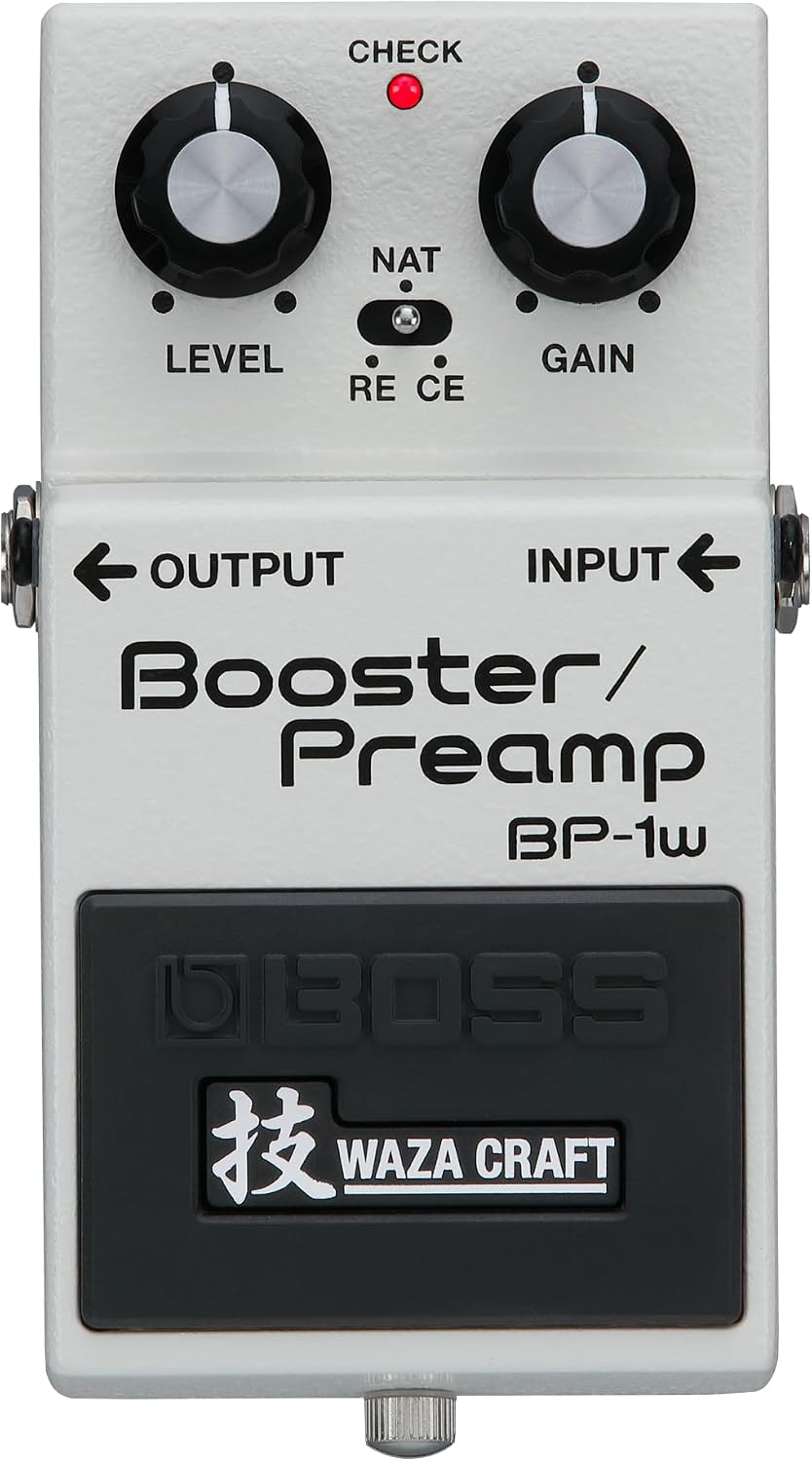
The BP-1W includes NAT, CE and RE modes, selected using the pedal’s three-position switch.
Each offers a different approach to shaping the guitar signal.
NAT — Natural Clean Boost
NAT provides a relatively transparent boost with minimal additional tonal colouring.
This is useful for guitarists who already like their basic sound but occasionally need more level or a stronger signal driving their amplifier.
It may suit clean rhythm playing, melodic passages and situations where preserving the guitar’s familiar character is important.
The extra level can also help push a responsive valve amplifier towards natural breakup.
CE — Bright Vintage Preamp Character
CE is inspired by the preamp circuitry of the original BOSS CE-1 Chorus Ensemble.
The emphasis here is on a brighter, bell-like character with a controlled low-frequency response.
This can be particularly interesting with guitars that benefit from additional presence or definition.
Clean chord work, articulate rhythm playing and blues-inspired lead sounds are obvious applications.
Increasing the Gain control introduces additional saturation, moving beyond simple tonal enhancement.
Importantly, CE mode does not reproduce the chorus effect of the original CE-1. It concentrates on the character of its preamp.
RE — Warmth and Saturation
RE takes its inspiration from the preamp circuitry of the Roland RE-201 Space Echo.
It offers a warmer, fuller character, with additional saturation available as the Gain control is increased.
This mode may appeal to guitarists looking for a thicker foundation beneath single-note lines or gently driven chords.
The resulting compression and tonal colouring can create a different relationship between picking intensity and amplifier response.
Once again, this isn’t an echo effect. The BP-1W reproduces the preamp character rather than the tape-delay processing.
Simple Controls Without Complicated Menus
The BP-1W uses two main rotary controls: Gain and Level.
Gain adjusts the amount of saturation and tonal drive produced by the selected mode.
Level controls the output volume, making it possible to balance the pedal against the bypassed signal or deliberately push the next device in the chain.
This straightforward arrangement is appealing.
There are no digital menus, elaborate presets or software applications to navigate.
Instead, the guitarist selects a mode and adjusts the controls according to the amplifier and playing style.
A modest Gain setting can provide subtle enhancement, while increasing it introduces a more noticeable tonal change.
The Level control then helps determine how strongly the pedal drives the amplifier or subsequent effects.
For guitarists who prefer direct physical controls, this keeps the creative process uncomplicated.
What It Feels Like to Use
The BP-1W follows the familiar compact BOSS pedal design.
Its silver-coloured metal enclosure has a purposeful appearance, with clearly labelled controls and the distinctive Waza Craft emblem.
The traditional BOSS footswitch occupies much of the lower surface, providing a broad area for engaging and bypassing the effect.
At approximately 430g with its battery installed, the pedal has a reassuringly substantial weight without being particularly bulky.
Its dimensions are consistent with the classic BOSS compact format, allowing it to fit alongside existing pedals without demanding an unusually large space.
The controls encourage small adjustments rather than constant reprogramming.
A guitarist might begin with NAT mode for a clean level increase, experiment with CE for extra brightness, then select RE when a warmer, more compressed character is preferred.
Because the three modes respond differently, the best Gain and Level settings may change when switching between them.
The BP-1W is therefore more rewarding when treated as part of the overall guitar-and-amplifier system rather than an isolated effect.
Two Buffer Options for Different Responses
An interesting feature is the selectable input buffer.
A switch on the rear of the pedal allows a choice between standard and vintage buffer characteristics while the effect is engaged.
The standard setting provides a conventional high-impedance input arrangement.
The vintage setting uses a lower input impedance, influencing how passive guitar pickups interact with the circuit.
This can create a warmer response and alter the way the instrument reacts.
The effect is particularly relevant when connecting a guitar with passive pickups directly to the BP-1W.
However, the difference may be less noticeable when other buffered pedals or active electronics are placed before it.
BOSS also specifies buffered bypass rather than true bypass.
The standard buffer remains involved in signal conditioning when the effect is switched off.
For many pedalboard arrangements, a quality buffer is helpful, particularly when longer cables are involved.
Nevertheless, guitarists who specifically prefer true-bypass signal chains should understand this distinction.
How It Compares With Other Guitar Pedals
The BP-1W occupies an interesting position between a conventional boost pedal and a dedicated overdrive.
Our guide to the MXR Duke of Tone Overdrive Pedal explores an alternative designed around boost and overdrive sounds.
The Duke of Tone provides a more conventional approach to generating overdrive, with dedicated tone shaping and selectable operating characteristics.
The BP-1W is different because its three modes are inspired by particular vintage preamp circuits.
For guitarists looking for a complete collection of amplifier sounds and effects, the BOSS GX-1 Guitar Effects Processoroffers a much broader alternative.
The GX-1 combines amplifier modelling, numerous effects, presets and performance controls.
The BP-1W deliberately avoids that complexity.
It focuses on a small selection of analogue sounds that can complement an existing guitar rig.
The choice depends on whether you want a specialist tone-shaping pedal or an all-in-one effects system.
The Drawbacks
The BOSS BP-1W is a carefully designed analogue pedal, but its strengths are quite specific. There are several practical limitations worth understanding before giving it a permanent place on a pedalboard.
Its Tonal Changes Can Be Subtle
The BP-1W isn’t designed to deliver an enormous transformation every time it’s engaged.
At restrained settings, differences between the modes may be relatively subtle, particularly when playing through an amplifier that already has a strong tonal character.
This is an advantage for guitarists seeking careful refinement.
However, someone expecting an immediately dramatic effect may find the results underwhelming.
Appreciating the pedal’s character often requires listening to how notes respond, how the amplifier breaks up and how the overall sound sits within the music.
That makes it less immediately exciting than a conventional distortion, delay or modulation pedal.
It Doesn’t Reproduce Chorus or Tape Echo
The CE and RE labels refer to the vintage preamp circuits that inspired the pedal.
They do not mean the BP-1W includes the chorus of the BOSS CE-1 or the tape echo of the Roland RE-201.
This distinction matters.
Anyone purchasing the pedal expecting those classic modulation or delay effects will be disappointed.
The BP-1W is strictly a booster and preamp device.
Guitarists wanting chorus, delay or other effects will need additional equipment.
There Is No Dedicated Tone Control
Although the BP-1W offers three different tonal characters, it doesn’t include an independent tone or equalisation control.
The available adjustments are Gain, Level, the mode selector and the buffer switch.
That keeps operation simple, but it limits the amount of detailed tonal adjustment available directly on the pedal.
For example, a guitarist wanting to reduce specific high frequencies or emphasise particular midrange frequencies cannot make those changes using a dedicated EQ section.
Instead, they must rely on the pedal’s modes, their guitar controls, amplifier settings or an additional equaliser.
This may frustrate players who expect the flexibility of a conventional three-knob overdrive.
The Vintage Buffer Won’t Behave Identically in Every Rig
The vintage buffer setting is interesting, but its influence depends on what is connected before the pedal.
Passive pickups connected directly to the BP-1W can interact with its lower input impedance.
However, an active guitar or another buffered pedal placed earlier in the signal chain may reduce that interaction.
Consequently, not every guitarist will hear the same difference between the two buffer settings.
Players experimenting with the vintage mode should consider pedal order and the electronics inside their instrument.
It isn’t a universal tone improvement that behaves identically in every setup.
Buffered Bypass May Not Suit Every Preference
The BP-1W uses buffered bypass rather than true bypass.
For most modern pedalboards, this is not inherently a disadvantage.
A suitable buffer can help maintain signal integrity when using longer cable runs.
However, some guitarists prefer the direct interaction between passive pickups and particular vintage-style pedals.
In those arrangements, an additional buffer may influence the response of equipment placed later in the chain.
Anyone using impedance-sensitive fuzz pedals or similarly specialised circuits should think carefully about pedal order.
This is a matter of compatibility and personal preference rather than an indication of poor construction.
It Isn’t a High-Gain Distortion Pedal
The BP-1W can produce saturation and push an amplifier into additional drive.
However, it is not intended to replace a dedicated high-gain distortion pedal.
Its character is more closely associated with vintage preamp coloration, natural boost and controlled saturation.
Guitarists who mainly play heavy modern rock or metal may want more gain and dedicated tone shaping than the BP-1W provides on its own.
It can still be useful for tightening or driving another gain stage, but those results depend heavily on the surrounding equipment.
For some players, a conventional overdrive or distortion pedal will be a more direct solution.
Power Requirements Need Considering
The pedal can operate from a 9V alkaline battery or a compatible BOSS PSA-series power adapter.
However, the external power adapter is sold separately.
BOSS specifies a current draw of 60mA and estimates approximately 4.5 hours of continuous operation from an alkaline battery, depending on conditions.
That makes regular battery operation less convenient for frequent rehearsal or performance.
For a permanent pedalboard setup, a suitable regulated power supply is the more practical arrangement.
Buyers should check voltage, polarity and available current before connecting any existing adapter.
No Presets or Remote Switching
The BP-1W is entirely focused on traditional hands-on operation.
It doesn’t provide MIDI connectivity, digital presets or remote switching between the three operating modes.
That means changing from NAT to CE or RE requires moving the physical selector switch.
Gain and Level settings must also be adjusted manually when different sounds require different balances.
For home playing and straightforward pedalboards, this may be perfectly acceptable.
However, guitarists using programmable switching systems or needing several precisely recalled sounds during a performance may find it restrictive.
The simplicity is appealing, but it comes at the expense of automation.
Not Every Guitarist Needs a Dedicated Preamp Pedal
Perhaps the most important consideration is whether the BP-1W adds something genuinely useful to an existing setup.
A guitarist with an excellent amplifier, suitable boost functions and an overdrive pedal may already have access to similar practical results.
Although the BP-1W has its own distinctive tonal character, it doesn’t automatically make every guitar rig sound better.
The difference depends on personal taste and the equipment involved.
For players with limited pedalboard space, a specialist preamp may be less useful than a tuner, versatile overdrive or another essential effect.
The BP-1W makes the most sense when its particular tonal character is something the guitarist actively wants.
Who It Suits Best
The BOSS BP-1W is particularly suited to guitarists who enjoy refining the response of their existing amplifier.
Blues, classic rock, country and clean-tone players may appreciate its ability to introduce additional warmth, brightness or controlled saturation.
It should also appeal to musicians interested in vintage analogue equipment who want access to CE-1- and RE-201-inspired preamp characteristics without acquiring the original effects units.
The straightforward controls and compact construction make it practical for conventional pedalboards.
However, players wanting dramatic effects, extensive preset management or heavy distortion should consider alternatives.
For more equipment that helps shape guitar tone, explore our Pedals & Effects collection.
Is It Worth the Pedalboard Space?
The BOSS BP-1W Waza Craft Booster/Preamp offers a thoughtful approach to analogue guitar tone.
Its three operating modes provide distinctly different ways to enhance, colour or strengthen a guitar signal.
The familiar BOSS construction, simple physical controls and selectable buffer characteristics add to its practical appeal.
Nevertheless, this is a specialist pedal rather than an essential purchase for every guitarist.
Its tonal differences may be subtle, its controls are deliberately limited, and it cannot replace a full collection of drive or modulation effects.
For guitarists who already have a sound they enjoy and want more control over its character and response, the BP-1W deserves serious consideration.
Sometimes the most useful addition to a pedalboard isn’t another dramatic effect. It’s a carefully chosen piece of equipment that helps the guitar and amplifier work together more expressively.
As an Amazon Associate I earn from qualifying purchases.