
BOSS DD-8 Digital Delay Pedal
As an Amazon Associate I earn from qualifying purchases.
A good delay pedal can add remarkable depth to a guitar sound without taking anything away from the original playing. A short echo can give a solo more presence, carefully timed repeats can create rhythmic movement, and longer delays can turn simple notes into atmospheric layers.
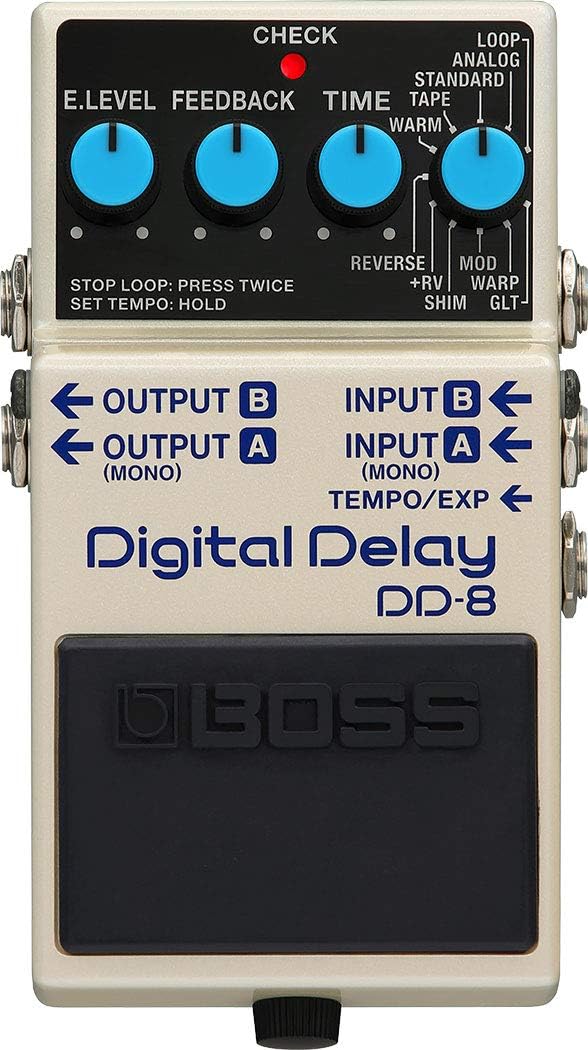
The BOSS DD-8 Digital Delay brings these possibilities together in a compact effects pedal designed for guitarists who want versatility without filling their pedalboard with separate delay units.
With ten different delay types, a built-in looper, stereo connections and external control options, the DD-8 offers considerably more flexibility than its familiar four-knob appearance might suggest.
It is equally relevant to guitarists looking for a subtle everyday delay and players interested in creating more experimental sounds.
Why the BOSS DD-8 Works on a Guitar Pedalboard
Delay is one of the most adaptable effects available to a guitarist because it works across so many styles of music.
For blues and classic rock, a short delay can help lead notes sound fuller without introducing obvious repetitions. Clean rhythm guitar can benefit from echoes that follow the tempo, while ambient and progressive styles often use longer delays to create overlapping patterns.
The DD-8 accommodates these different approaches through its selection of delay modes.
Rather than being restricted to one particular echo character, the player can move between clean digital repetitions, vintage-inspired sounds and more unusual effects.
The physical design is another advantage.
At approximately 73 mm wide and 129 mm deep, the DD-8 occupies the same general pedalboard space as a conventional BOSS compact pedal.
That makes it particularly useful for guitarists who already have an overdrive, tuner, modulation pedal and other equipment competing for space.
Ten Delay Types with Different Musical Characters
Although BOSS describes the DD-8 as having 11 modes, one is dedicated to looping. The remaining ten provide different forms of delay processing.
Understanding these modes helps explain why the pedal can suit such a wide range of guitarists.
Standard, Analog and Tape
Standard mode produces clear digital repeats, making it useful when accurate timing and note definition are important.
For rhythmic guitar playing, these clean repetitions can form part of the musical arrangement rather than simply adding background ambience.
Analog mode is designed to recreate the warmer character associated with traditional bucket-brigade delay circuits.
The softer repetitions can complement blues leads, classic rock and other styles where an exceptionally bright echo might become distracting.
Tape mode draws inspiration from vintage tape echo equipment, introducing the modulation associated with older mechanical delay systems.
This can give sustained notes a more fluid, slightly shifting character.
Warm and Modulated Delay
Warm mode offers a softer digital delay sound, allowing echoes to support the original guitar without dominating it.
Mod mode introduces modulation into the repetitions.
This can add movement to sustained chords, arpeggios and melodic passages, particularly when the guitarist wants something more atmospheric than a conventional delay.
These modes are useful because delay does not always need to be rhythmically prominent.
Sometimes its purpose is simply to make the guitar sound less dry and more spacious.
Reverse, Shimmer and Delay with Reverb
Reverse mode plays the delayed signal backwards, creating unusual effects that can make familiar guitar phrases sound quite different.
Shimmer introduces pitch-shifted sounds into the repetitions, producing spacious textures associated with ambient guitar music.
The +RV mode combines digital delay with reverb.
This is particularly convenient when a player wants both echo and a sense of space without necessarily adding another reverb pedal.
Each mode offers a distinct approach to the same basic idea of repeating the guitar signal.
Warp and GLT
Warp and GLT are intended for more expressive and experimental playing.
Warp allows the guitarist to build sustained ambient effects by holding down the pedal switch, increasing the feedback and effect level.
GLT produces rapid, glitch-like repetitions when the switch is pressed.
These sounds are less conventional than Standard or Analog delay, but they give the DD-8 additional creative possibilities for transitions, atmospheric passages and rhythmic experimentation.
Straightforward Controls with Useful Flexibility
Despite the variety of sounds available, the DD-8 retains the familiar BOSS control arrangement.
Four main knobs handle the essential functions.
The Mode control selects the delay type, while Time determines the interval between the original note and its repetitions.
Feedback adjusts how the echoes develop, and E.Level controls the amount of delayed signal mixed with the guitar.
These controls make ordinary adjustments relatively straightforward.
For example, reducing Feedback and E.Level produces a restrained echo suitable for adding thickness to a lead guitar sound.
Increasing the delay time and feedback produces longer, more noticeable repetitions.
The pedal also provides tap-tempo functionality, allowing delay timing to follow the pace of a song.
BOSS specifies delay times of up to ten seconds when using tap tempo, depending on the selected mode and settings.
That provides considerably more scope than a pedal intended purely for short slapback effects.
Stereo Connectivity and Signal Routing
The DD-8 has two inputs and two outputs, supporting both mono and stereo arrangements.
For guitarists using one amplifier, a conventional mono connection is usually the simplest approach.
However, musicians using two amplifiers, stereo effects chains or recording equipment can take advantage of the additional connections.
The pedal offers three stereo output modes.
Independent mode maintains separate left and right signal relationships. Panning mode creates repetitions that move between stereo channels, while wide stereo is designed to create a broader spatial impression.
These options can be particularly useful when recording guitar parts that need to occupy a wider stereo field.
The DD-8 also supports wet/dry and wet-only connections, allowing the original and delayed signals to be routed separately in suitable setups.
Another practical feature is the Carryover switch.
This determines whether the remaining delay repeats continue after the effect is bypassed.
Keeping the trails active can make transitions between musical passages sound more natural, especially when longer delays are being used.
Built-In Looper for Practice and Songwriting
The DD-8 includes a looping mode that can record a guitar passage and repeat it while the player adds further parts.
The maximum recording time is 40 seconds in mono or 20 seconds in stereo.
Overdubbing allows additional guitar parts to be layered over the original recording.
For home practice, this is particularly useful.
A guitarist can record a short chord progression and practise improvisation, scales or melodic ideas over the repeated accompaniment.
It can also help with songwriting, allowing a musical idea to be developed without immediately opening recording software.
The built-in footswitch controls the basic looping functions, while optional external footswitches offer additional operating convenience.
For occasional looping, having this facility within a delay pedal is a practical advantage.
Construction, Size and Power
The DD-8 follows the established BOSS compact pedal design.
Its metal enclosure, broad footswitch and accessible controls are consistent with the familiar construction of the company’s long-running effects pedal range.
At approximately 440 grams including the battery, it has a relatively substantial weight for such a compact unit.
The DD-8 uses buffered bypass, and its compact dimensions make it straightforward to incorporate into many conventional pedalboard arrangements.
Power comes from a 9V alkaline battery or a compatible BOSS PSA-series power adapter.
For regular use, a suitable pedalboard power supply is likely to be the more convenient arrangement.
BOSS specifies a current draw of 100 mA, so anyone connecting the pedal to a shared power system should check that the appropriate output provides the required current, voltage and polarity.
A Dedicated Delay or an All-in-One Effects Processor?
One consideration is whether a guitarist actually needs a dedicated delay pedal.
The DD-8 makes sense when a player already has a guitar amplifier and perhaps several other effects pedals, but wants more control over echo sounds.
Its physical controls make the delay effect directly accessible without navigating a digital display.
However, some musicians prefer having multiple effects and amplifier models in one unit.
Our BOSS GX-1 Guitar Effects Processor guide explores a compact alternative that combines amplifier modelling, delay, modulation, reverb and other effects with programmable sound settings.
Another option is the Line 6 POD Express Guitar Effects Processor, which brings several guitar effects and amplifier sounds together in a portable format.
These products take a different approach from the DD-8.
A dedicated delay pedal provides focused control over one category of effect, while a multi-effects processor offers a broader collection of sounds within an integrated system.
The better choice depends on the equipment a guitarist already owns and how they prefer to control their sound.
The Drawbacks
The BOSS DD-8 offers an extensive range of delay sounds for its size, but there are several practical compromises that deserve attention before choosing it.
No Display or Preset Memories
One of the most significant limitations is the absence of a display and programmable preset memories.
The four-knob arrangement makes the DD-8 approachable for straightforward adjustments, but it also means that different sounds must be recreated manually.
A guitarist who uses the same delay setting for an entire performance may have no difficulty with this.
However, someone regularly switching between precise rhythmic delays, ambient sounds and vintage-style echoes could find the repeated adjustments inconvenient.
Larger digital delay processors often provide stored settings that can be recalled instantly.
The DD-8 prioritises compactness and direct operation instead.
Advanced Functions Require Some Learning
Although the basic controls are familiar, the pedal has more operational complexity than its appearance suggests.
Certain settings, including output configurations and specialised functions, require procedures that are not immediately obvious from looking at the controls.
Using tap-tempo subdivisions and optional external control features also requires some understanding of how the pedal operates.
Anyone intending to use every function should be prepared to consult the official instructions.
This is not necessarily a problem for an experienced guitarist, but it may disappoint someone expecting every feature to be instantly accessible.
The Looper Has Limited Recording Time
The built-in looper is useful, but it is not a substitute for a dedicated looping workstation.
Forty seconds of mono recording time is suitable for short chord progressions and practice exercises, but longer musical arrangements may exceed that limit.
Stereo recording reduces the available time to twenty seconds.
The single onboard footswitch also places several looping operations under one control.
With practice, this arrangement is manageable, but dedicated loopers generally provide more immediate access to recording, playback and stopping functions.
For musicians who build entire performances around layered loops, the DD-8 may feel restrictive.
Battery Life Is Relatively Short
BOSS estimates approximately 3.5 hours of continuous use from a 9V alkaline battery.
Actual battery life varies with operating conditions.
While that may be sufficient for occasional use, it is not particularly convenient for long rehearsals, recording sessions or frequent practice.
A compatible external power supply is therefore a sensible consideration.
However, the BOSS PSA-series adapter is sold separately.
Anyone planning to add the DD-8 to an existing pedalboard should check power compatibility before installation.
External Controllers Add Space and Expense
The DD-8 supports compatible footswitches and expression pedals, expanding the options for hands-free control.
These accessories are not included.
Adding an external footswitch can make tap tempo or looping functions more convenient, while an expression pedal allows selected delay parameters to be adjusted during playing.
The compromise is additional equipment, cables and pedalboard space.
For guitarists trying to keep their setup as compact as possible, this may reduce some of the advantages of choosing a small pedal in the first place.
Stereo Features Are Not Useful to Everyone
Stereo connectivity is a genuine strength, but its value depends heavily on the rest of the guitar setup.
Someone using one traditional guitar amplifier will not experience the complete stereo panning effect.
Using two amplifiers or a suitable stereo recording system introduces additional connections and potentially more complicated signal routing.
For home recording, this flexibility can be worthwhile.
For a guitarist who simply connects a pedalboard to one amplifier, the additional stereo options may rarely be used.
Some Delay Modes Are Quite Specialised
Warp, GLT, Reverse and Shimmer offer creative possibilities, but they will not appeal equally to every guitarist.
Someone primarily interested in subtle slapback, traditional analog-style delay or occasional rhythmic echoes may spend most of their time using just a few modes.
The more experimental sounds can be impressive in the appropriate musical setting, but they are not automatically useful for conventional playing styles.
It is worth considering whether the additional modes match the music being played rather than treating the number of available sounds as an advantage by itself.
Limited Sound Editing Compared with Larger Processors
The DD-8’s four-knob interface makes ordinary adjustments easy, but it does not provide the detailed programming capabilities of more sophisticated delay processors.
The individual modes have their own characteristics, yet not every aspect of each sound can be adjusted independently.
There is also no MIDI connection for integration with more elaborate tempo-controlled pedalboard systems.
Guitarists who rely on precisely synchronised effects, extensive parameter editing or automated preset changes may prefer equipment designed specifically for those requirements.
The DD-8 provides plenty of musical flexibility, but it remains a compact effects pedal rather than a comprehensive digital workstation.
Who It Suits Best
The BOSS DD-8 is particularly suitable for guitarists who want a wide selection of delay sounds without dedicating a large amount of pedalboard space to the effect.
It should appeal to players who regularly move between clean rhythm work, blues, rock and more atmospheric styles.
Guitarists who enjoy experimenting with different delay characters will appreciate the choice between digital, analog-inspired, tape-style and more unusual effects.
The built-in looper also makes it useful for home practice and developing musical ideas.
Recording musicians may find the stereo connections and alternative routing arrangements particularly valuable.
However, players who need extensive preset management, longer looping times or sophisticated external synchronisation may find a larger processor more appropriate.
Is the BOSS DD-8 Worth a Place on Your Pedalboard?
The strongest argument for the BOSS DD-8 is its ability to cover several different approaches to delay without requiring a large or complicated piece of equipment.
Its familiar controls make ordinary delay settings accessible, while the range of modes provides opportunities for more creative playing.
Stereo connections, tap tempo, external control support and the built-in looper add useful flexibility.
There are limitations, particularly the lack of preset memories, relatively short battery life and restrictions of the built-in looper.
Nevertheless, for guitarists who value a compact pedal with a broad selection of delay sounds, the DD-8 is a credible and versatile option.
It offers a practical middle ground between a simple single-purpose delay and a larger programmable effects processor.
For more equipment covering everything from individual effects pedals to complete guitar processors, explore our Pedals & Effects collection.
As an Amazon Associate I earn from qualifying purchases.