
BOSS RC-5 Loop Station
As an Amazon Associate I earn from qualifying purchases.
Some of the most useful guitar equipment doesn’t change your tone. Instead, it changes what you can do with the music you’re already playing.
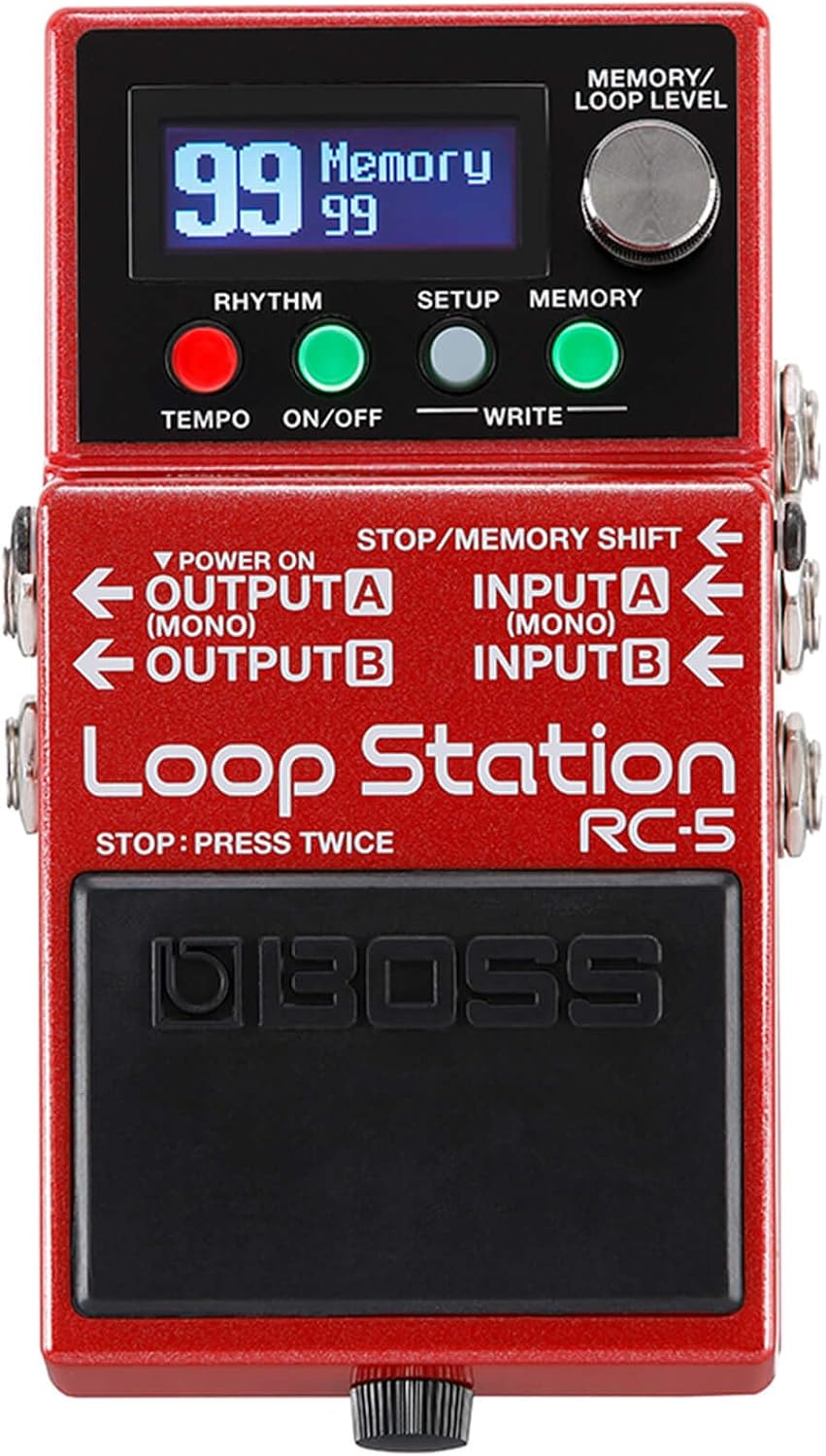
The BOSS RC-5 Loop Station is a compact looping pedal that allows guitarists to record a musical phrase, play it back continuously and add further layers without needing another musician.
Whether you’re practising lead guitar over a chord progression, developing a song or experimenting with atmospheric textures, a good looper can make playing alone considerably more interesting.
The RC-5 combines familiar BOSS pedal construction with 32-bit audio processing, stereo looping, built-in rhythms and enough memory to store musical ideas for later use.
It offers an impressive range of functions for such a small pedal, although its single-track design and compact controls won’t suit every looping musician.
Why the BOSS RC-5 Is Worth Considering
The attraction of a looper is straightforward: it allows one guitarist to create a musical foundation and then play something different over it.
You might record four bars of rhythm guitar, allow that progression to repeat and practise improvising a lead melody.
Alternatively, you could record a simple fingerpicked pattern and add harmonies, percussion-like tapping or other textures.
The RC-5 captures the initial phrase and allows additional overdubs to be recorded onto the same loop.
That makes it useful for practice, creative experimentation and carefully prepared live performances.
Unlike a simple playback pedal, it allows music to be built in real time.
However, all those layers belong to one loop track. They are not separate tracks that can be independently mixed or arranged later.
32-Bit Sound Quality and Stereo Recording
BOSS equips the RC-5 with 32-bit analogue-to-digital and digital-to-analogue conversion, together with 32-bit floating-point processing.
This is designed to preserve the clarity of recorded guitar sounds, even as additional overdubs are introduced.
The pedal records at a 44.1 kHz sampling rate and supports stereo audio.
For guitarists using conventional mono setups, the A/MONO connections provide a straightforward starting point.
Those using stereo effects can take advantage of the separate left and right inputs and outputs.
This is particularly useful when recording modulation, delay or other effects that produce movement across two channels.
It’s important to remember that stereo operation requires suitable equipment throughout the signal chain.
Connecting the pedal to a conventional single-speaker amplifier will not reproduce the full stereo effect.
Built-In Rhythms for Better Practice
One of the RC-5’s most practical features is its rhythm section.
BOSS includes 57 rhythm patterns, each with two variations, alongside seven different drum kits.
This provides a useful alternative to practising with a basic metronome.
A simple drum pattern can make repetitive chord exercises feel more musical while giving the guitarist a consistent rhythmic reference.
For example, a player working on blues phrasing could establish a suitable rhythm, record a twelve-bar progression and then practise lead guitar over the result.
The rhythm section can also help with timing when recording the initial loop.
Without a reliable rhythmic reference, even a small timing error at the loop boundary can become distracting when the phrase repeats.
The RC-5’s rhythms are useful practice tools, although they don’t replace a fully programmable drum machine.
A Display That Makes Looping Easier
The RC-5 includes a small LCD with a multi-colour backlight.
Its colours change to indicate different looping states, including recording, playback and overdubbing.
This provides useful feedback when performing.
With some simpler loop pedals, players need to interpret a small indicator light or remember exactly which operating mode is active.
The RC-5 provides more visible information.
A multifunction control knob and dedicated buttons give access to stored phrases, rhythm settings and other parameters.
The arrangement is more informative than a basic one-knob looper, although some functions still require working through menus.
99 Memories for Saving Musical Ideas
The RC-5 includes 99 phrase memories.
These allow loops to be saved and recalled rather than disappearing when the pedal is switched off.
That makes the pedal particularly useful for songwriting.
A guitarist can develop a chord progression during practice, save it and return to it later.
BOSS specifies approximately 13 hours of total recording capacity across all memories, with a maximum of approximately 1.5 hours for an individual track.
These figures refer to stored audio capacity, not thirteen hours of uninterrupted recording within one loop.
USB Backup and WAV Files
The USB connection allows recorded phrases to be backed up to a computer.
Using BOSS Tone Studio for RC, players can also import compatible WAV audio files.
This makes it possible to prepare backing material on a computer and bring it into the looping setup.
However, the RC-5 is not a USB audio interface.
It cannot stream its live output directly into recording software as USB audio. Real-time recording to a computer requires a suitable audio interface connected to the pedal’s audio outputs.
Connecting the RC-5 to Other Guitar Equipment
A looper becomes especially interesting when combined with other effects.
Placing the RC-5 after your tone-shaping pedals allows it to record those processed sounds into the loop.
Placing certain effects after the looper allows them to influence the loop playback as well as the live signal.
The best arrangement depends on what the guitarist wants to achieve.
Our BOSS GX-1 Guitar Effects Processor article explores a multi-effects unit that provides amplifier models and sound-shaping options for musicians developing more versatile guitar setups.
The RC-5 also makes sense with an amplifier that can reproduce clean and detailed sounds.
For example, our Roland JC-40 Jazz Chorus Guitar Amplifier article explains a stereo amplifier with useful connections for compatible external effects.
The RC-5 also supports expanded control through optional footswitches, an expression pedal and MIDI connections.
These features make it more adaptable than its compact appearance initially suggests.
The Drawbacks
The BOSS RC-5 offers a substantial number of features, but there are important compromises to understand before choosing it.
Only One Stereo Loop Track
This is the most significant limitation.
The RC-5 supports overdubbing, allowing multiple musical layers to be combined, but those layers remain part of one stereo track.
You cannot independently control several separate loops in the way a dedicated multi-track looping workstation allows.
For simple rhythm-and-lead practice, this may be entirely sufficient.
For performers building complicated arrangements with independently controlled sections, a more advanced looper may be necessary.
Footswitch Operation Takes Practice
One physical pedal switch manages several different looping functions.
Recording, playback, overdubbing, stopping and undoing operations require the guitarist to understand the relevant controls.
This isn’t especially unusual for a compact looper, but mistakes can happen during the learning process.
Stopping a loop at the wrong moment or accidentally entering overdub mode can interrupt a performance.
Practising the switching sequence before using the pedal live is sensible.
Limited Onboard Sound Effects
The RC-5 is primarily a looping device, not a conventional multi-effects processor.
It includes a reverse looping function and reverb for its rhythm section, but it does not provide an extensive selection of guitar distortion, modulation and delay effects.
Players wanting to shape their guitar sound will generally need separate pedals, a multi-effects processor or suitable amplifier features.
That introduces additional equipment and cabling.
Battery Life Is Relatively Short
The RC-5 can operate using a 9V alkaline battery.
However, BOSS estimates approximately two hours of continuous use, depending on conditions.
That is adequate for some practice sessions but isn’t particularly reassuring for extended performances.
For regular use, a compatible mains power supply is the more practical choice.
The appropriate BOSS PSA-series adaptor is sold separately.
Additional Controllers Cost Extra
Although the RC-5 supports external footswitches, expression control and MIDI operation, the required accessories are not included as standard.
A compatible MIDI setup may also require specialist TRS MIDI cables.
These additional connections provide useful flexibility, but players shouldn’t assume the pedal arrives with every accessory needed for advanced control.
The Display Is Still Small
The multi-colour LCD is useful, but it remains a compact display fitted into a conventional pedal enclosure.
Editing settings involves turning the control knob and navigating menus.
That can be less convenient than working with a larger display or dedicated controls for every function.
During a performance, adjusting complex settings may be awkward.
No Dedicated Headphone Output
The RC-5 does not provide a headphone socket for completely self-contained private practice.
It must be connected to suitable amplification, monitoring equipment or an audio interface.
Guitarists hoping to practise silently with only a guitar, the looper and headphones will need an additional solution.
Loop Timing Still Matters
The RC-5 includes useful rhythms and control features, but it cannot automatically turn every poorly timed performance into a seamless musical loop.
Players must still establish the correct phrase length and timing.
This is particularly important when creating loops without a rhythm reference.
Developing reliable footswitch timing takes practice, especially when recording more complicated passages.
Who the BOSS RC-5 Suits Best
The RC-5 is particularly suitable for guitarists who want to make solo practice more engaging.
It also makes sense for songwriters capturing ideas, musicians experimenting with layered guitar textures and performers who need a compact single-track looper.
Its stereo connections, phrase memories and rhythm patterns give it considerably more flexibility than a very basic looping pedal.
For more carefully selected equipment covering delay, modulation, looping and guitar tone, explore our Pedals & Effects collection.
Players requiring independently controlled loop tracks, built-in guitar effects or extensive hands-free operation may prefer a larger looping workstation.
Is the BOSS RC-5 Worth Considering?
The BOSS RC-5 offers a practical balance between compact construction and creative looping features.
Its 32-bit audio processing, stereo operation, 99 phrase memories, built-in rhythm patterns and USB backup capabilities give guitarists plenty of opportunities to develop musical ideas.
The limitations deserve equal attention.
It has only one stereo loop track, requires some familiarity with its switching functions and benefits from additional equipment for more advanced setups.
Nevertheless, for guitarists who want a reliable way to build rhythm parts, practise improvisation and experiment with layered arrangements, the RC-5 provides a useful set of tools in a familiar BOSS pedal format.
Its value lies not in replacing an entire recording studio, but in making everyday playing more creative and productive.
As an Amazon Associate I earn from qualifying purchases.