
Fender CD-60 V3 Dreadnought Acoustic Guitar
As an Amazon Associate I earn from qualifying purchases.
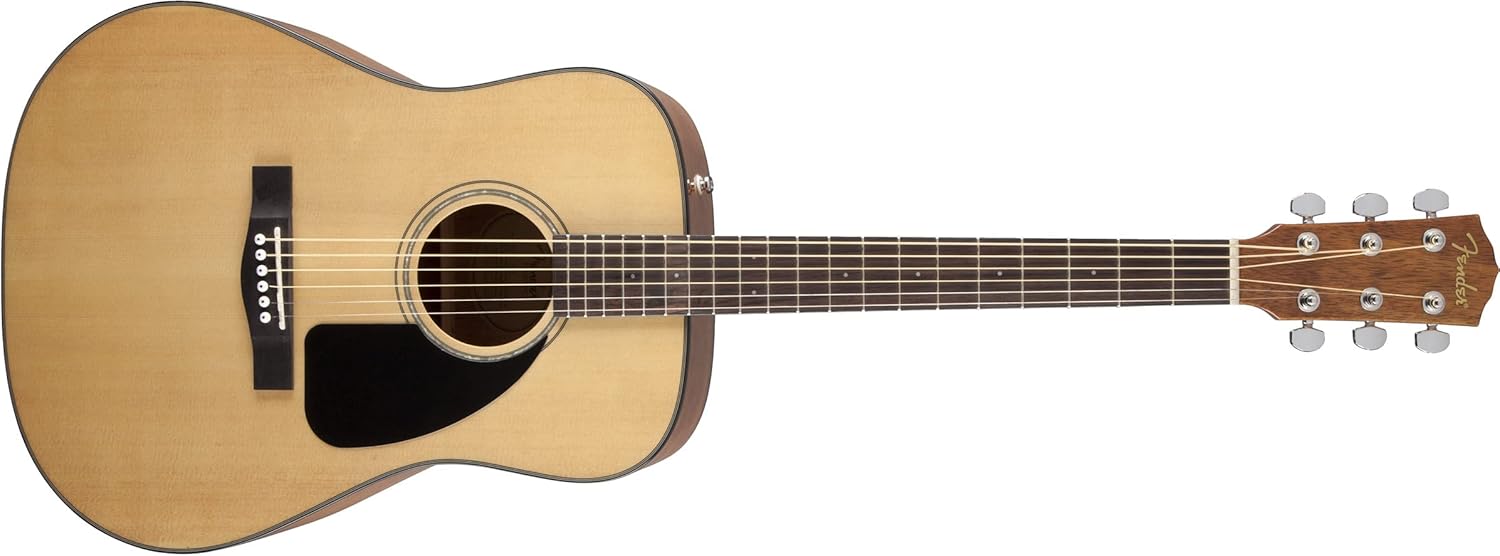
The Fender CD-60 V3 Dreadnought Acoustic Guitar keeps things deliberately straightforward. It is a full-size steel-string acoustic built around the familiar dreadnought shape, with a natural finish, laminated spruce top and laminated mahogany back and sides.
There are no onboard electronics, unusual controls or complicated features to distract from the basic purpose of the instrument. This is an acoustic guitar intended to be picked up and played, whether that means learning chords, practising at home, accompanying vocals or simply keeping a dependable acoustic around for everyday use.
Why the dreadnought shape works
The dreadnought has remained one of the most common acoustic-guitar body shapes for good reason.
Its broad shoulders, deep body and generous internal air volume give it a substantial physical presence. Compared with a smaller concert-style guitar, a dreadnought generally feels bigger against the chest and produces a fuller acoustic response when strummed firmly.
That makes the CD-60 V3 particularly natural for rhythm playing.
Open chords, folk-style accompaniment and straightforward singer-songwriter material all suit this kind of body. There is enough space inside the instrument for the guitar to feel lively without relying on amplification.
The trade-off is physical size. A dreadnought does not disappear into your lap like a compact acoustic, and that is something we will come back to in the drawbacks.
What it feels like to play
Fender uses a 25.3-inch scale length, giving the CD-60 V3 a fairly conventional steel-string acoustic feel.
The neck is mahogany with Fender’s comfortable C-shaped profile, paired with a walnut fingerboard and 20 frets.
The neck shape is important because a beginner acoustic guitar can quickly become frustrating if it feels excessively bulky in the hand. The CD-60 V3 keeps the profile familiar rather than trying to recreate a particularly thick vintage neck.
The fingerboard has rolled edges, which helps soften the transition between the fretboard and the sides of the neck. It is a small detail, but it can make the neck feel less abrupt in the hand.
The strings will still feel firmer than those on most electric guitars. That is simply part of playing a steel-string acoustic. Someone moving across from an electric may notice the extra resistance immediately, especially when forming full chords or bending notes.
Laminated spruce and mahogany construction
One specification worth getting right is the top.
The CD-60 V3 uses a laminated spruce top, not a solid spruce top.
That distinction matters.
Spruce is widely used on acoustic guitars because it offers a useful balance of clarity and strength, but laminated construction behaves differently from a solid piece of tonewood.
The back and sides are laminated mahogany, giving the instrument a warm visual appearance when viewed from the side or rear.
For a guitar intended for regular everyday use, laminated construction has practical advantages. It is generally less sensitive to environmental changes than an all-solid acoustic and can be reassuring for someone who does not want to worry constantly about small changes in temperature and humidity.
That said, players specifically looking for the tonal development and construction of an all-solid instrument should understand that this is not one.
Scalloped X-bracing
Inside the body, Fender uses scalloped X-bracing.
The bracing underneath an acoustic top has a major influence on how freely the top can vibrate while still remaining structurally strong enough to cope with string tension.
You cannot see most of it during normal use, but it is doing important work.
Scalloped bracing removes material from selected areas of the braces, allowing parts of the top to move more freely than they would with heavier unscalloped bracing.
For the player, the important point is not the technical language itself. It is that Fender has not treated the inside of the guitar as an afterthought simply because this is a relatively straightforward acoustic.
A simple guitar without electronics
The CD-60 V3 is a purely acoustic instrument.
There is no built-in pickup or preamp system.
For home practice, lessons, songwriting or informal playing, that may not matter at all. In fact, there is something refreshingly uncluttered about an acoustic guitar with no battery compartment, control panel or output jack to worry about.
If you intend to perform through a PA or acoustic amplifier, however, you will need an external microphone or an aftermarket pickup system.
That is an important distinction from electro-acoustic models that are ready to plug in straight from the box.
Whether that is a drawback depends entirely on how you plan to use the guitar.
The feel of the natural finish
The Natural version has a traditional appearance.
The pale spruce-coloured top is offset by the darker fingerboard and black pickguard, giving the guitar the kind of familiar look that is unlikely to feel dated quickly.
There is nothing particularly flashy about it.
That restraint can be appealing. A simple natural dreadnought looks at home in a bedroom, studio, rehearsal space or sitting on a stand in the living room.
The body has a gloss finish, so the surface feels smooth and polished rather than open-grained or satin.
Gloss also means fingerprints and marks can become visible, particularly around the area where the picking arm rests against the body.
A useful guitar for learning
The CD-60 V3 makes sense for someone learning acoustic guitar because there are very few distractions.
There is no pickup system to understand, no unusual tuning arrangement and no complicated hardware.
The player can concentrate on the things that actually matter at the beginning: fretting notes cleanly, changing chords, controlling the pick and developing rhythm.
The dreadnought body also gives a satisfying amount of acoustic sound without needing an amplifier.
That simplicity is useful beyond beginners too.
Experienced players often appreciate having one straightforward acoustic available for writing, casual practice or leaving on a stand ready to pick up.
The drawbacks
The most obvious drawback is the size of the dreadnought body.
This is a full-sized acoustic guitar, and it feels like one.
Smaller players, children or anyone with limited shoulder movement may find the broad lower bout tiring during longer sessions. The picking arm has to reach over a fairly substantial body, particularly when sitting down.
A smaller concert, parlour or auditorium-style guitar can feel noticeably more comfortable in that situation.
The dreadnought shape is therefore not automatically the right choice simply because it is common.
The second drawback is the laminated construction.
The spruce top is laminated, as are the mahogany back and sides.
For everyday durability and stability, that can be perfectly sensible. But someone specifically shopping for a solid spruce top or an all-solid acoustic will need to look elsewhere.
Solid-top guitars can offer a different level of responsiveness and may change more noticeably as the wood ages and is played.
The CD-60 V3 should instead be viewed as a practical laminated acoustic, not as a substitute for a higher-specification all-solid instrument.
There are also no onboard electronics.
If you later decide to perform live, connect to an acoustic amplifier or record directly into an audio interface, you will need to add a pickup or use a microphone.
For someone who already knows they will be performing regularly, buying an electro-acoustic from the start may make more sense.
Adding a pickup later can work perfectly well, but it introduces another purchase and, depending on the system, possibly professional installation.
The lack of a cutaway is another limitation.
The traditional dreadnought body runs continuously into the neck joint rather than curving away beneath the higher frets.
For ordinary chord playing this is irrelevant.
For a guitarist who regularly plays melodies or lead parts high up the neck, upper-fret access is more restricted than on a cutaway acoustic.
A beginner may never notice this. A more adventurous player eventually might.
The full-scale steel-string setup also requires a little hand strength.
Anyone coming from an electric guitar with light strings may initially find acoustic strings firmer and less forgiving.
That is normal, but it can make the first few weeks of acoustic playing tougher on the fingertips.
A sensible setup can make a significant difference here.
Action that is unnecessarily high will make any acoustic harder to play than it needs to be. Even a new production guitar can benefit from having the neck relief, nut slots and saddle height checked by someone who knows what they are doing.
The CD-60 V3 should not be judged solely on how one particular example feels straight out of a shipping box.
There is also no gig bag or hard case included with the standard guitar.
That is easy to overlook when buying online.
If the guitar is going to lessons, rehearsals or another house regularly, some form of protection will be needed.
A padded gig bag may be enough for light local transport. More demanding travel may justify a hard case.
The gloss finish has its own small compromises.
It looks clean and traditional, but polished surfaces tend to show fingerprints, light marks and picking wear more readily than a matte finish.
That may not bother someone who likes a guitar to show signs of use. A player who wants the instrument to remain immaculate may find themselves wiping it down frequently.
Another limitation is simply that the CD-60 V3 is deliberately uncomplicated.
Someone already several years into playing may eventually want more character, more responsive solid woods, a different neck feel or onboard electronics.
That does not make the Fender unsuitable. It simply means the specification is focused on straightforward usability rather than giving an experienced player every premium feature they may want.
The dreadnought voice can also be more than some players need.
If most of your playing is delicate fingerstyle at low volume, a smaller-bodied guitar may respond in a way you find more intimate and comfortable.
The CD-60 V3 naturally makes sense for strumming and general-purpose acoustic playing, but body shape remains a very personal choice.
Finally, buying any acoustic guitar online means you do not get to feel the exact instrument beforehand.
Wooden instruments vary slightly, even within the same model.
Neck relief, action and general setup can also shift during transport and with changes in temperature or humidity.
A new guitar arriving safely does not necessarily mean it will arrive adjusted exactly to your personal preference.
None of these drawbacks makes the CD-60 V3 a poor guitar.
They simply define what it is: a traditional, full-sized, laminated dreadnought designed around simple acoustic playing rather than premium construction or stage-ready electronics.
Who it suits best
The Fender CD-60 V3 is particularly well suited to someone looking for a straightforward full-size acoustic guitar.
It makes sense for beginners who want to concentrate on learning rather than dealing with unnecessary features.
It also works for returning players who simply want a dependable acoustic around the house for chords, songwriting and casual playing.
Singer-songwriters who mainly play acoustically may appreciate the dreadnought body and uncomplicated layout.
It is less suitable for players who need built-in electronics, prefer a smaller body, want easy upper-fret access or specifically want a solid-top acoustic.
Is it worth the acoustic guitar space?
The Fender CD-60 V3 does not need to be complicated to make sense.
Its full-sized dreadnought body, laminated spruce top, laminated mahogany back and sides, scalloped X-bracing, comfortable C-shaped neck and straightforward acoustic design give it a clear purpose.
The drawbacks are just as clear.
It is physically large, the construction is laminated rather than solid, there is no pickup system, no cutaway and no included case.
For someone who understands those limitations and simply wants a traditional acoustic guitar for regular everyday playing, however, the CD-60 V3 offers an uncomplicated place to start — and potentially a useful guitar to keep long after the first chords have become familiar.
For more acoustic guitars with different body styles and playing characteristics, explore our Acoustic Guitars guides on AIGuitars.
As an Amazon Associate I earn from qualifying purchases.