
Fender Classic Series Hardshell Case
As an Amazon Associate I earn from qualifying purchases.
A good guitar case has a fairly simple job: protect the instrument without making every journey feel awkward. The Fender Classic Series Hardshell Case takes the traditional route, using a rigid wooden shell, fitted interior and proper metal hardware rather than trying to compete with the lighter feel of a padded gig bag.
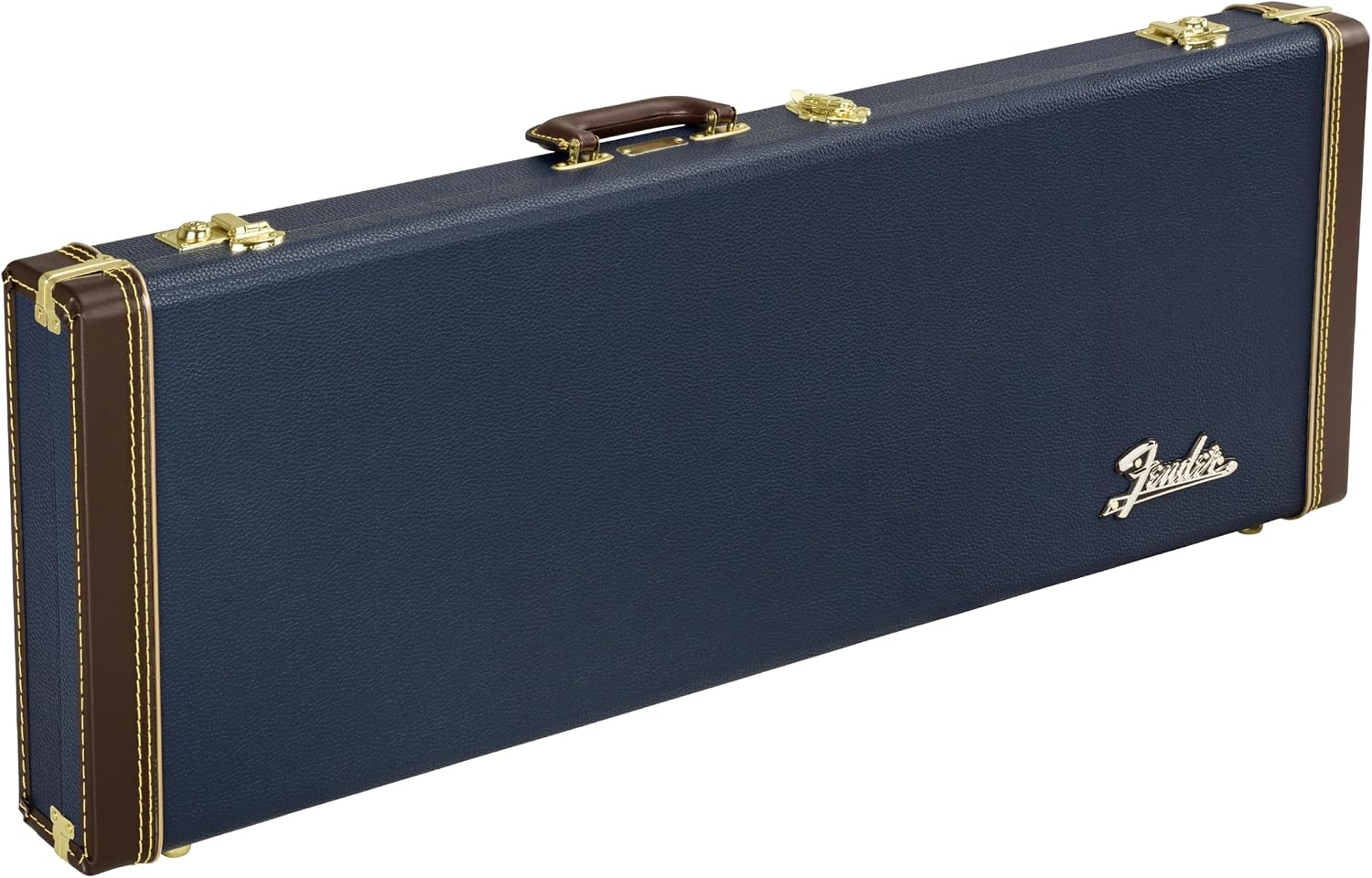
This Navy Blue version has quite a distinctive appearance. The dark textured vinyl exterior has an old-school luggage feel, while opening the lid reveals a contrasting orange plush interior. It is unmistakably a guitar case rather than a generic equipment bag, and that traditional styling suits a Stratocaster or Telecaster particularly well.
More importantly, there is real structure underneath the finish. The three-ply wooden shell has 8 mm sides with 5 mm top and bottom panels, giving the guitar a rigid barrier against knocks, pressure and the sort of accidental bumps that soft cases can only absorb to a limited degree.
Why it works for Stratocaster and Telecaster guitars
This case is designed around two of Fender’s most familiar body shapes.
Fender states that it fits most right-handed Stratocaster and Telecaster guitars, so the interior is shaped to support those instruments rather than leaving them floating around inside a large universal case.
That matters more than it might initially seem.
A guitar can be surrounded by thick padding and still move around too much if the case itself is badly shaped. A fitted case supports the body and neck in more predictable places, helping the instrument stay settled when the case is being carried or stored.
The soft crushed-acrylic plush lining gives the inside a warm, dense feel rather than the thin fabric found in cheaper cases. It provides a softer surface around the finish of the guitar while the rigid wood shell deals with impacts from outside.
For someone with a Stratocaster or Telecaster that spends time travelling between home, rehearsals, lessons or gigs, that combination is much more reassuring than relying entirely on layers of foam.
What it feels like to use
The Classic Series case feels deliberately traditional.
The textured vinyl exterior has a slightly grained, luggage-like surface, and the brown vinyl-wrapped steel-core handle gives you something substantial to hold rather than a thin fabric strap.
There is some weight and solidity to the whole thing. This is not the sort of case that collapses when the guitar is removed. Put it down, open the latches and lift the lid, and it behaves like a proper rigid case.
The steel draw latches reinforce that impression. One of the latches can also be locked using the supplied key set, which is useful for preventing the case from being casually opened.
That lock should not be mistaken for high-level security — someone determined to steal the guitar is hardly going to be defeated by carrying away the entire case — but it is still useful when the instrument is being transported or stored around other people.
Inside, the orange plush lining makes quite a contrast with the dark blue exterior. It feels softer and more luxurious than bare foam, and it helps prevent the hard inner structure of the case from sitting directly against the guitar.
Useful storage inside the case
A large covered accessory compartment sits inside the case.
That gives you somewhere sensible for the smaller things that tend to accompany a guitar: spare strings, picks, a tuner, capo, small tools and similar accessories.
Keeping those items in their own compartment is preferable to having them loose beside the instrument. A metal tuner, string winder or set of cutters moving around against a guitar finish is exactly the sort of little risk a good case should avoid.
The compartment will not replace a separate equipment bag for someone carrying pedals, cables and a large collection of accessories, but that is not really its purpose.
It is there for the essentials you want to keep with the guitar.
Protection when storing a guitar at home
A hardshell case is not only useful for travelling.
For a guitar that spends long periods at home, the rigid shell keeps the instrument covered and protected from everyday knocks, dust and objects being placed against it.
That can make particular sense when there are children, pets or a busy household around the instrument.
A guitar stand is wonderfully convenient when you play every day, but it also leaves the instrument exposed. The Fender case takes more effort to open, yet provides considerably more physical protection when the guitar is not required.
It also stacks and stores more predictably than a soft gig bag because the shell keeps its shape.
The drawbacks
The biggest disadvantage is weight and bulk.
A three-ply wooden case is always going to feel more substantial than a padded gig bag. The rigid construction that gives the guitar better protection also means you have a large fixed object to carry even when the case is empty.
If you regularly walk a long distance with your guitar or rely on public transport, a good backpack-style gig bag may simply be more comfortable.
There are no shoulder straps here. Carrying is done using the traditional side handle, so all the weight is in one hand. For a short journey between the house and the car that is unlikely to be a problem, but it can become tiring over longer distances.
The fixed dimensions create another practical issue.
A soft gig bag can often be squeezed into a narrow cupboard or folded flatter when empty. A wooden hardshell case occupies essentially the same amount of space whether a guitar is inside it or not.
That makes storage worth thinking about before buying one, particularly in a small room or apartment.
Compatibility also deserves attention.
Fender says the case fits most right-handed Stratocasters and Telecasters. The word “most” matters.
Not every Strat-shaped or Tele-shaped guitar from every manufacturer uses identical body dimensions, neck angles, bridge designs or control layouts. Modified instruments can also introduce their own differences.
I would therefore avoid assuming that any vaguely Strat-style electric guitar will automatically fit properly. If you are buying the case for a non-Fender instrument or an unusual Fender model, checking dimensions and compatibility first is sensible.
The traditional draw latches are sturdy and straightforward, but they also project slightly from the exterior. As with most cases of this style, they can catch against clothing, upholstery or other equipment if the case is handled carelessly.
The plush lining also needs a little common sense.
It is soft against the guitar, but loose picks, strings, screws or dirt can still find their way into the lining. Keeping the interior clean is worthwhile, especially before placing a guitar with a highly polished finish inside.
The accessory compartment is useful, though it is not enormous. Someone who likes to keep several packs of strings, tools, multiple tuners, cables and other equipment with the guitar may quickly run out of room.
There is also the locking latch.
It is a handy feature for preventing casual access, but I would not treat the case as a secure safe. The real value of the lock is convenience and privacy rather than serious theft protection.
And finally, there is the simple question of whether you actually need this much case.
If the guitar rarely leaves the house and lives safely on a stand in a dedicated music room, a full wooden case may spend most of its life taking up floor or cupboard space.
Likewise, a player who only travels occasionally and values low weight above everything else might get more day-to-day use from a well-padded gig bag.
The Fender case makes most sense when the extra rigidity is genuinely useful rather than simply because a hardshell case looks more substantial.
Who it suits best
The Fender Classic Series Hardshell Case is best suited to Stratocaster and Telecaster owners who want traditional rigid protection rather than the lightest possible carrying solution.
It makes particular sense for musicians transporting a guitar by car, storing an instrument around other equipment, travelling to rehearsals or simply wanting better physical protection at home.
It is also a natural match for players who appreciate traditional Fender styling. The Navy Blue vinyl exterior, brown handle and orange plush interior have far more character than a plain black moulded case.
For musicians frequently walking long distances with a guitar, however, a lighter shoulder or backpack-style case may make more sense.
Is it worth the guitar space?
For the right Stratocaster or Telecaster, the Fender Classic Series Hardshell Case offers exactly what a traditional guitar case should: a rigid wooden structure, soft fitted interior, dependable hardware and useful accessory storage.
It feels substantial because it is substantial.
That inevitably means accepting more weight and considerably more bulk than a soft case, but those compromises are closely connected to the reason for buying it in the first place.
If you want the lightest possible way to carry a guitar, this is probably not it.
If you want a fitted case that surrounds a compatible Stratocaster or Telecaster with a proper rigid shell and has the unmistakable feel of traditional Fender equipment, it makes considerably more sense.
For more practical cases, accessories and equipment, explore our Guitar Gear articles.
As an Amazon Associate I earn from qualifying purchases.