
Finding Your Sound in a Small Room
Amazon Associate Disclaimer: As an Amazon Associate, we may earn from qualifying purchases. This comes at no extra cost to you and helps support our website.
Where Tone Actually Begins
Most guitar tone isn’t discovered on a stage. It happens in smaller rooms, at odd hours, with the door half-closed and an idea that won’t leave you alone until you plug in and chase it. A practice amp is where that chasing happens, and the shape it gives your sound will color every riff you write before anyone else ever hears it.
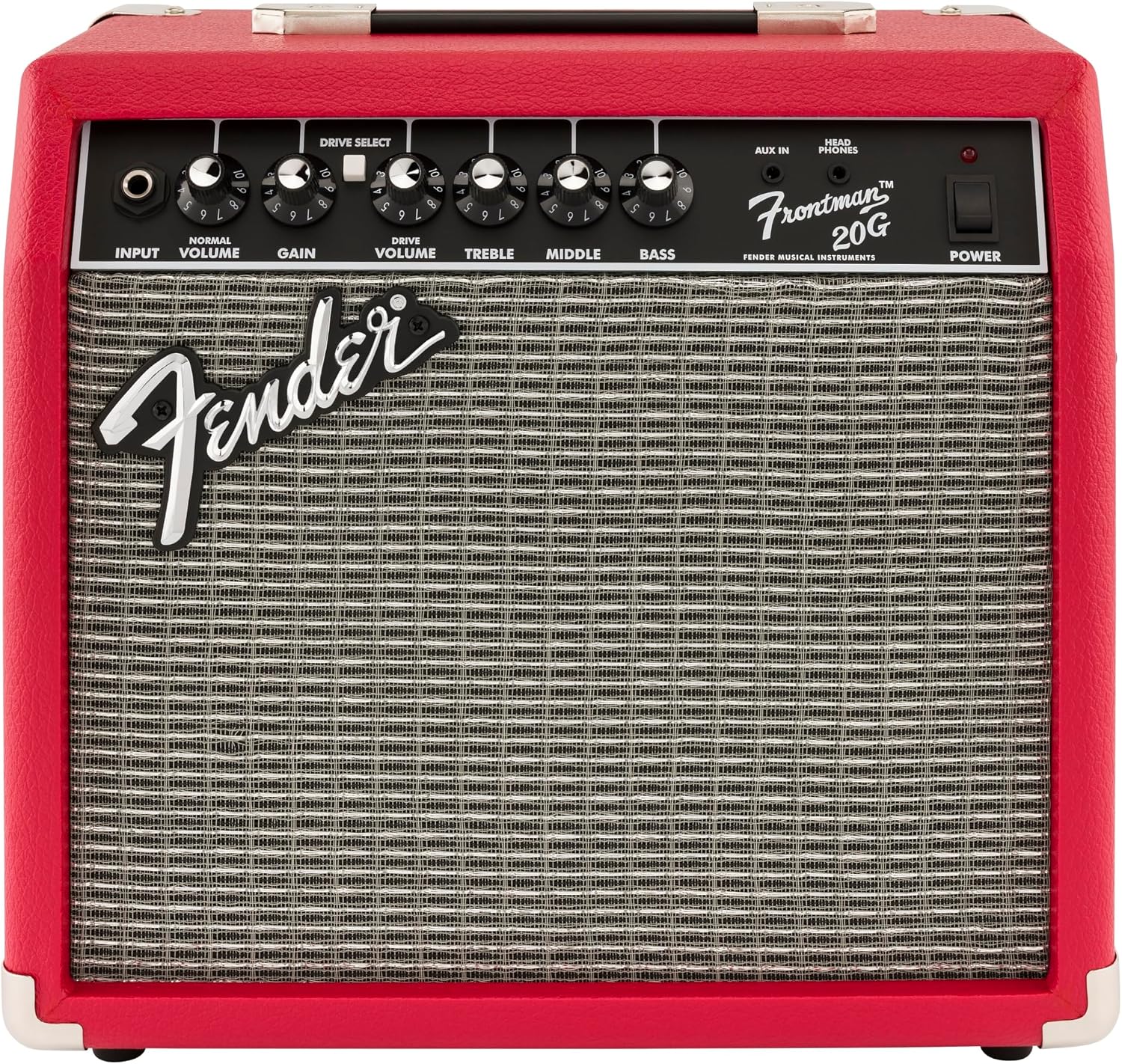
The Fender Frontman 20G sits squarely in that world. It’s a 20-watt combo built around a 6-inch Fender speaker, small enough to live on a desk or the corner of a bedroom, but voiced with the kind of clarity that makes an hour of noodling feel worthwhile. Red, familiar-looking, and unmistakably Fender in its layout, it’s the sort of amp that disappears into the background of your routine instead of demanding attention for its own sake.
A Clean Channel That Leaves Room to Think
The clean channel is where most practice sessions start, and it’s built with a single volume knob alongside three EQ controls for bass, mid, and treble. That’s enough range to shape a tone that suits whatever you’re working on, whether it’s picking through a chord progression slowly enough to hear every note ring out, or running scales with a metronome ticking somewhere in the background.
There’s something clarifying about a clean tone that doesn’t get in your way. When the signal is uncolored, mistakes are easier to hear, which means they’re easier to fix. A lot of technical growth happens in that unglamorous space between “close enough” and “actually clean,” and an amp that lets you hear the difference is doing quiet, important work.
Switching Into Drive When the Mood Shifts
Practice isn’t only about precision, though. Some evenings call for volume knobs turned past the polite range, for chords that break up just slightly at the edges. The Frontman 20G’s separate Drive channel, with its own independent volume control, exists for exactly that shift in mood.
Flipping between the two channels mid-session mirrors how songwriting actually moves. A verse might live in that clean, controlled space, while the chorus wants something rougher underneath it. Having both textures available on one amp, switchable without stopping to adjust pedals or settings, keeps that creative momentum intact instead of interrupting it every time the idea changes direction.
Practicing Alongside the Songs You Actually Listen To
The 1/8-inch auxiliary input turns the amp into something closer to a listening companion than a standalone box. Plugging in a phone or a music player means you can sit down with a favorite record and play along in real time, matching phrasing, working out a solo by ear, or just locking into a groove alongside a rhythm section that isn’t your own.
This kind of playing teaches things that scales and exercises don’t always reach: timing, feel, the space between notes. It’s less structured than formal practice, but for a lot of guitarists, it’s where the instrument starts to feel less like a task and more like a conversation.
Late Sessions, Zero Compromise
Not every good idea arrives at a convenient hour. The built-in headphone jack means the amp can go quiet for everyone else in the house while staying just as present for the player. That’s a meaningful shift in how often you actually pick the guitar up. When plugging in doesn’t require negotiating with the rest of the household about volume, a fifteen-minute idea at eleven at night becomes possible instead of something you talk yourself out of.
There’s also a subtler benefit here. Headphone practice tends to sharpen your ear, since small imperfections in tone or timing are harder to hide when they’re right up against your ears instead of filling a room. Musicians who split their time between headphones and open-air playing often notice their overall listening gets more precise as a result.
Familiar Controls, Straightforward Layout
Part of what makes an amp easy to live with day after day is not having to relearn it every time you sit down. The Frontman 20G’s front panel keeps things intuitive: volume and EQ on the clean side, a dedicated volume for Drive, and nothing buried in menus or secondary functions. That simplicity matters more than it might seem to at first. An instrument you don’t have to think about operating is one you’re more likely to reach for on a whim, rather than saving for sessions when you have the patience to relearn a control layout.
For anyone building a home setup, that ease of use also means the amp integrates smoothly alongside other gear. It doesn’t demand a dedicated corner of a pedalboard workflow or specialized cables. It just sits there, ready, with the immediacy that a good practice tool should have.
Built With the Long Term in Mind
An amp that’s part of your daily routine needs to hold up to daily use, and the construction here reflects that. Fender backs the Frontman 20G with a two-year limited warranty, the kind of detail that speaks to how the amp is meant to be used: regularly, not occasionally. At 15.8 pounds and measuring roughly 10 by 16 by 16 inches, it’s substantial enough to feel solid on a stand or shelf, while still being easy to move between rooms if your practice space shifts with the seasons or your schedule.
That portability opens up small but meaningful possibilities, too. Carrying it to a friend’s place for an informal jam, setting it up in a different room to change your creative environment, or packing it along on a trip where a full-sized rig isn’t practical all become simple rather than complicated.
Where This Fits Into Everyday Playing
None of this requires a stage or an audience to matter. A practice amp like this one is really about the in-between moments: the ten minutes before dinner, the after-work wind-down, the late-night idea that needs somewhere to go before it’s forgotten. Two channels give you room to move between focused technical work and looser, more expressive playing. The aux input turns practice into something closer to musical conversation. The headphone jack keeps the door open at hours when a full amp stack wouldn’t be welcome.
Different players will lean on different parts of it. Someone working through a beginner’s method book might live mostly on the clean channel, dialing in EQ until chords ring clearly. Someone chasing a specific tone for a song they’re writing might spend more time flipping into Drive, listening for the exact point where the sound starts to break up. Both are valid ways to use the same amp, and that flexibility is really the point. A good practice setup doesn’t dictate how you play. It just stays out of the way while you figure that out for yourself, one session at a time.
As an Amazon Associate I earn from qualifying purchases.
Take a closer look