
Gretsch Jim Dandy Parlor Acoustic Guitar
As an Amazon Associate I earn from qualifying purchases.
The Gretsch Jim Dandy Parlor Acoustic Guitar takes its inspiration from an era when a guitar was often a simple companion rather than an elaborate piece of equipment.
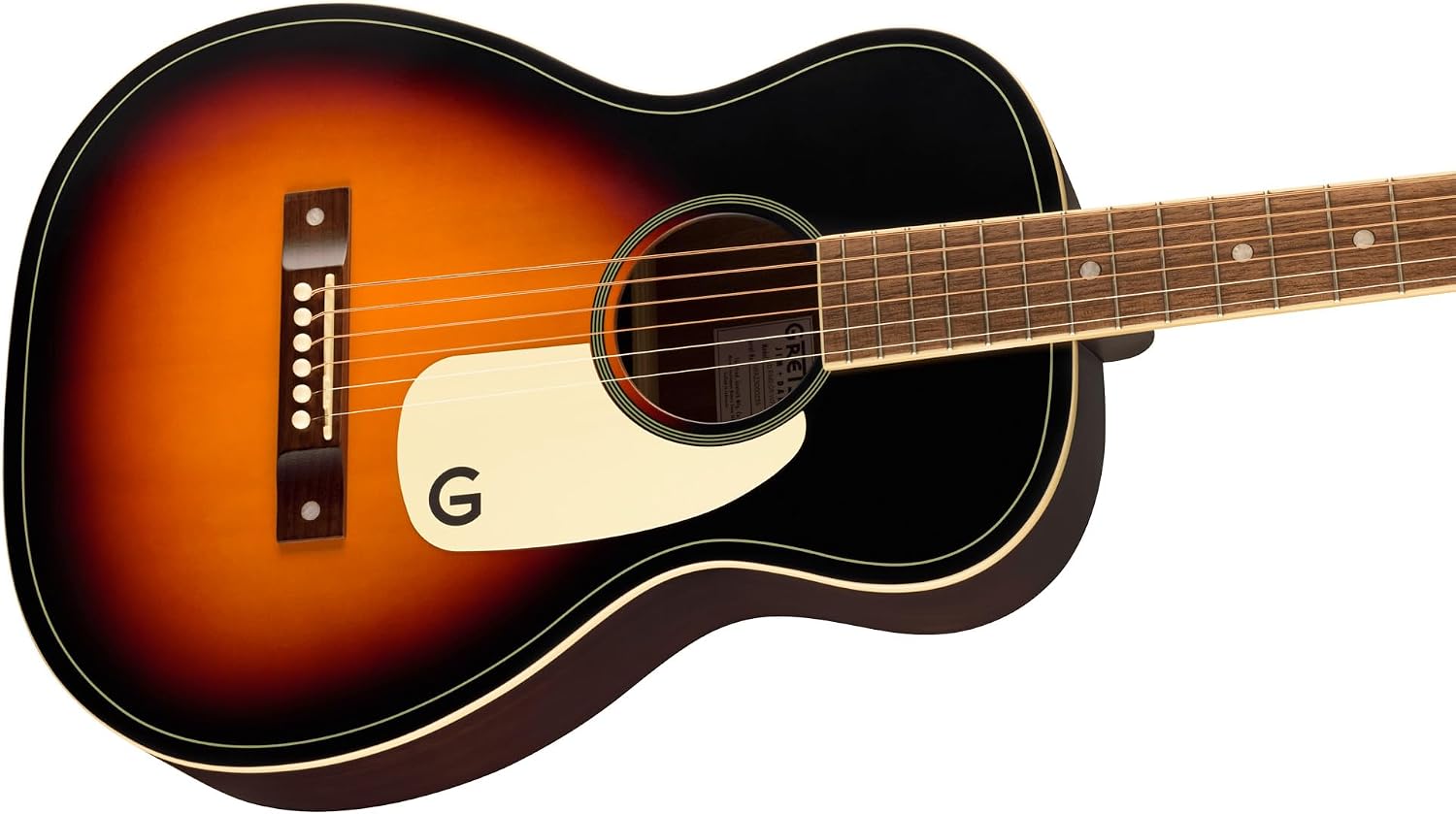
Its small parlor body, short 24-inch scale and understated Rex Burst finish deliberately recall the affordable Gretsch Rex guitars sold through mail-order catalogues during the 1930s, ’40s and ’50s. The modern Jim Dandy keeps that old-fashioned character while adding practical features such as X-bracing and an adjustable truss rod.
This is not an acoustic designed to imitate a large dreadnought. Its appeal is almost the opposite: compact dimensions, easy handling and a direct acoustic voice that makes it particularly inviting for relaxed playing, songwriting and keeping close at hand around the house.
Why the parlor body works
The first thing you notice about the Jim Dandy is how little guitar there is surrounding you.
Gretsch lists the body at approximately 17.8 inches long and 3.75 inches deep. That makes it noticeably more compact than a full-size dreadnought and easier to hold when sitting on a sofa or chair.
For some players, that physical comfort matters enormously.
A large acoustic can sound wonderful, but it also places a substantial body beneath the picking arm and against the chest. If you find bigger acoustics cumbersome, particularly during long practice sessions, the Jim Dandy’s shallower parlor body can feel much less intrusive.
The neck joins the body at the 12th fret, another traditional feature associated with smaller acoustic designs.
That means the guitar is not really aimed at players who spend their time reaching for very high frets. Instead, its proportions naturally favour chords, fingerstyle patterns, blues lines and the sort of playing that lives primarily in the first half of the neck.
What the 24-inch scale feels like
The Jim Dandy uses a 24-inch scale length.
That is shorter than many full-size steel-string acoustics, and the difference can be felt.
With the same string gauge and tuning, a shorter scale generally requires a little less tension. That can make fretting chords and bending notes feel slightly more forgiving, which is one reason compact acoustics can be enjoyable for relaxed playing.
Gretsch supplies the guitar with D’Addario EJ16 phosphor-bronze .012–.053 strings, so this is still very much a conventional steel-string acoustic rather than a lightly strung miniature guitar.
The important point is that the guitar feels compact without reducing everything to toy-like proportions.
Its 1.69-inch nut width is close to what many players will recognise from other steel-string acoustics, while the 12-inch fingerboard radius keeps the playing surface comfortably familiar.
A simple C-shaped nato neck
The neck is made from nato and uses a traditional C shape with a semi-gloss finish.
There are 18 vintage-size frets, with 12 frets clear of the body, on a walnut fingerboard. Large white pearloid dot markers help maintain the uncomplicated vintage appearance.
Nothing about the neck specification suggests that Gretsch was trying to turn the Jim Dandy into a modern performance acoustic.
It is straightforward and traditional.
That suits the character of the guitar.
You pick it up, tune it and play rather than spending time thinking about sophisticated electronics, multiple controls or complicated hardware.
For someone learning chords or practising fingerstyle patterns, that simplicity can be refreshing.
Experienced players may appreciate it for exactly the same reason.
Laminated basswood construction
The current Rex Burst Jim Dandy Parlor uses laminated basswood for the top, back and sides, supported by X-bracing.
That is worth stating clearly because the attractive vintage appearance could easily lead someone to assume the guitar uses solid tonewoods.
It does not.
Gretsch specifically describes the body as being built from lightweight laminated tonewoods, with the intention of balancing vintage-style acoustic character with durability.
Laminated construction can be a sensible choice for a guitar intended to travel and be used casually.
It is generally less sensitive to environmental changes than thin solid wood and helps make an instrument that can be picked up frequently without feeling overly precious.
The body is also X-braced rather than being built as a purely decorative reproduction of an old catalogue guitar.
Gretsch describes the result as having the tonal clarity and pronounced midrange associated with parlor acoustics.
A different sound from a dreadnought
It is important to approach the Jim Dandy for what it is.
A small parlor body will not behave like a large dreadnought.
Big acoustics have more internal air volume and are often chosen for their deeper bass response, broad projection and ability to support heavy strumming.
The Jim Dandy puts more emphasis on the middle of the guitar’s voice.
Notes can feel immediate and well defined, which suits blues, folk, old-time music, fingerpicking and songwriting particularly well.
A smaller guitar can also make individual notes easier to hear when playing quieter passages.
That does not mean the Jim Dandy is restricted to fingerstyle.
Gretsch specifically positions the model for both picked and fingerstyle playing.
Strumming works perfectly well; it simply produces the character of a compact parlor guitar rather than trying to imitate a much larger instrument.
Vintage styling without unnecessary decoration
The Rex Burst finish is a major part of the Jim Dandy’s personality.
The body has a semi-gloss finish, aged-white binding, white-and-black rosette rings and painted pinstripe purfling.
A white single-ply pickguard carries Gretsch’s large “G” graphic, while oversized dot markers and nickel hardware reinforce the old catalogue-guitar appearance.
At the headstock are open-gear die-cast tuning machines arranged three per side.
These details give the guitar enough visual character without making it ornate.
It looks intentionally old-fashioned rather than artificially distressed.
That is an important distinction.
Gretsch has not tried to make the Jim Dandy look like an expensive vintage collector’s instrument. It looks more like the kind of straightforward guitar someone might once have ordered from a catalogue and simply played for years.
A pinned walnut bridge
The current Jim Dandy Parlor uses a walnut bridge with a compensated saddle and a conventional pinned-string arrangement.
That makes restringing familiar to anyone who has owned a conventional acoustic.
The nut is synthetic bone, as is typical on many modern guitars in this type of construction.
Again, nothing is unnecessarily complicated.
There is no tremolo, pickup battery, onboard tuner or control panel to maintain.
For somebody who simply wants an acoustic guitar they can leave nearby and play whenever the mood strikes, that lack of complication is part of the appeal.
Good for songwriting and casual practice
I think this is where the Jim Dandy makes particularly good sense.
A guitar that is comfortable and easy to reach tends to get played.
Its compact dimensions make it easier to keep beside a chair, take into another room or put in a vehicle than a large acoustic.
For songwriting, that can be ideal.
You do not necessarily need enormous projection or a complicated pickup system when you are working out chord changes, melodies or lyrics.
You need a guitar that feels inviting enough to pick up repeatedly.
The shorter scale can also suit evening practice sessions when you simply want to sit and play without wrestling with a large instrument.
Gretsch itself describes the Jim Dandy Parlor as suited to both newer and experienced players, which makes sense given how uncomplicated the overall design is.
A practical travel companion
The Jim Dandy is not marketed as a dedicated folding or headless travel guitar, but its parlor dimensions naturally make it easier to transport than many full-size acoustics.
The short body and 24-inch scale reduce the overall footprint while still giving you a conventional steel-string instrument.
That makes it appealing for holidays, weekends away, camper trips or simply taking a guitar somewhere you might hesitate to carry a larger and more delicate instrument.
However, there is an important point here:
Gretsch does not include a case or gig bag with the current Jim Dandy Parlor.
If you intend to travel with it regularly, you will need appropriate protection separately.
That becomes particularly important if the guitar will spend time in cars, public transport or aircraft.
No electronics keeps things simple
The standard Jim Dandy Parlor is a purely acoustic guitar.
There is no factory pickup or onboard preamp listed for this model.
For home playing, songwriting and informal sessions, that may be exactly what you want.
There are no batteries, cables or controls to think about.
If you eventually want amplification, however, you will need to add an external microphone, soundhole pickup or another suitable acoustic pickup system.
Gretsch also offers other small acoustics with built-in pickups, but this particular Jim Dandy keeps the concept deliberately uncomplicated.
The drawbacks
The Jim Dandy’s greatest strength — its compact parlor body — is also its biggest limitation.
If you want a large acoustic sound with strong bass, broad projection and plenty of physical volume, this is probably not the Gretsch to choose.
A 3.75-inch-deep parlor body simply cannot move air in the same way as a large dreadnought.
That does not make the Jim Dandy inferior.
It means the guitar has a different purpose.
Its smaller body focuses more naturally on clarity and midrange character than on producing huge low-end weight.
Heavy strummers may therefore prefer a larger acoustic, particularly if they need to compete acoustically with other instruments.
The 24-inch scale will not suit everybody either.
The slightly softer feel can be comfortable, but a player who has spent years on longer-scale acoustics may initially notice the shorter spacing and different string response.
Some people adapt immediately.
Others simply prefer the firmer feel of a longer scale.
The guitar also has only 18 frets, with the body joining at the 12th.
For blues, chords and fingerstyle this may never matter.
For a player who regularly ventures high up the neck, it becomes a real limitation.
There is no cutaway, so reaching the highest frets is not what this body design was created for.
The laminated construction also needs to be understood.
The top, back and sides are laminated basswood rather than solid wood.
Players specifically searching for a solid spruce or solid mahogany top will need to look elsewhere.
Solid woods and laminates each have practical advantages, but they should not be confused.
The Jim Dandy’s laminated body contributes to its sturdy, uncomplicated nature, while a player specifically chasing the response and ageing characteristics associated with solid tonewoods may want a different instrument.
There are no electronics.
That keeps the guitar beautifully straightforward at home but means it cannot simply be connected to an amplifier or PA system.
Anyone planning regular performances will either need to microphone it or install a suitable pickup.
That adds another component and potentially another job.
There is also no case or gig bag included.
For a guitar whose compact dimensions make it naturally appealing for travel, that is worth remembering.
You will need to find a case or bag that fits the parlor body rather than assuming one arrives with the instrument.
The open-gear tuners contribute to the vintage appearance, but they are visually and mechanically more traditional than modern sealed machines.
Some players enjoy that exposed simplicity.
Others prefer enclosed tuners that offer a more contemporary feel and keep the gearing protected.
The semi-gloss finish is another matter of preference.
It fits the understated old-fashioned styling well, but somebody looking for the deep, mirror-like finish found on more elaborate acoustics may find the Jim Dandy intentionally plain.
The body dimensions can also be deceptive in another way.
Because it is small, people sometimes assume a parlor guitar is automatically a child’s instrument.
The Jim Dandy is not designed simply as a scaled-down beginner guitar.
Its 1.69-inch nut and conventional steel-string setup remain perfectly usable for an adult player.
That means very young beginners may still find the neck wider than they expect if they are comparing it with a purpose-built children’s guitar.
Likewise, the short scale should not be mistaken for extremely low string tension.
The supplied strings are conventional .012–.053 light-gauge acoustic strings, so your fingertips still know they are playing a steel-string guitar.
And while laminated construction can be reassuring for casual use and travel, the guitar still needs normal acoustic-guitar care.
Leaving any wooden instrument in a very hot car, beside a radiator or in severe changes of humidity is asking for trouble.
Compact does not mean indestructible.
Finally, the Jim Dandy has a very definite personality.
Its appearance and construction intentionally reference inexpensive vintage catalogue guitars.
If you want an acoustic that looks contemporary, has elaborate inlays, a cutaway, onboard electronics and a large polished body, virtually everything about this design points in another direction.
That is not a weakness when you like what Gretsch is trying to achieve.
But this is not a neutral, do-everything acoustic.
Its character is a large part of the reason to choose it.
Who it suits best
The Gretsch Jim Dandy Parlor is particularly appealing for players who value comfort, character and simplicity.
It makes sense as a home guitar that can remain within easy reach rather than living permanently inside a large hard case.
Songwriters may enjoy its compact size and direct acoustic voice.
Blues and fingerstyle players should find the parlor proportions naturally suited to more intimate playing.
Experienced guitarists who already own larger acoustics may appreciate the Jim Dandy precisely because it offers a different experience rather than trying to replace them.
It can also make an approachable acoustic for a newer player who finds a full-size dreadnought physically uncomfortable, provided they are happy with a traditional steel-string setup.
And for travelling by car, camper or on weekends away, its smaller dimensions make it considerably easier to take along than many full-size acoustics.
Is it worth the guitar space?
The Gretsch Jim Dandy Parlor earns its place by being the sort of guitar that encourages you to pick it up.
Its 24-inch scale, shallow parlor body, C-shaped nato neck and uncomplicated acoustic construction make it easy to live with, while the Rex Burst finish and period-inspired details give it far more personality than a completely anonymous practice guitar.
It will not produce the huge bass and projection of a large dreadnought.
It does not have a solid top, onboard electronics, a cutaway or an included gig bag.
Those are genuine compromises rather than details to hide.
But that is also why the Jim Dandy makes sense.
It is not trying to be every acoustic guitar at once.
It tells a simpler story: a compact steel-string instrument inspired by the straightforward Gretsch catalogue guitars of decades past, designed to sit nearby, travel easily and make you want to play a few more songs before putting it down.
Explore more acoustic guitars in our Acoustic Guitars section.
As an Amazon Associate I earn from qualifying purchases.