
Fender Mustang LT25 Guitar Amplifier
As an Amazon Associate I earn from qualifying purchases.
The Fender Mustang LT25 Guitar Amplifier brings an extensive selection of amplifier sounds and built-in effects into a compact 25-watt combo designed primarily for home practice.
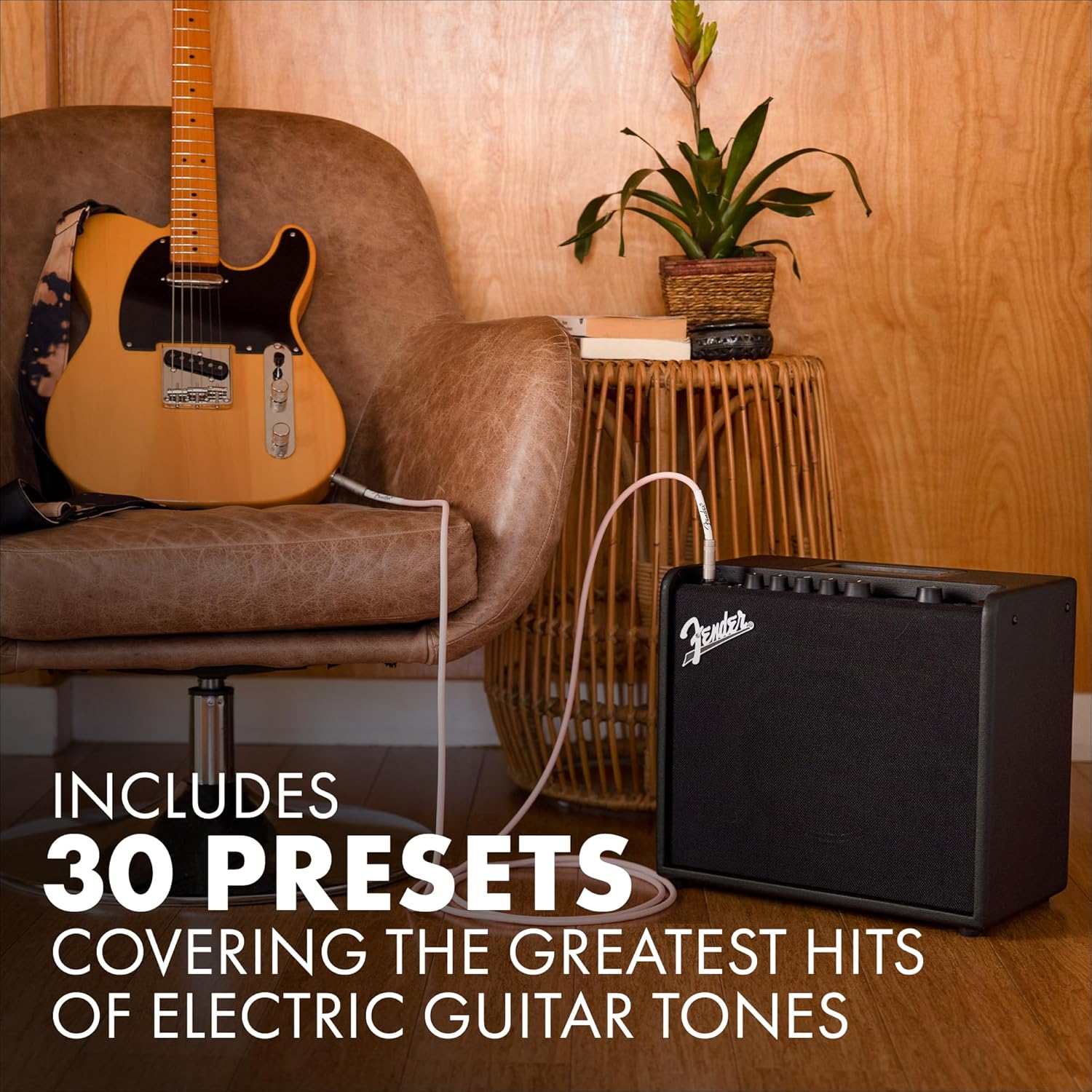
With 20 amplifier models, 25 effects and 30 factory presets, it gives guitarists an opportunity to explore different playing styles without immediately investing in a collection of separate pedals.
Its 8-inch Fender Special Design speaker, straightforward controls and small colour display make it particularly appealing to beginners and home guitarists who want useful tonal flexibility without a complicated setup.
The LT25 also supports headphone practice, USB recording and computer-based editing through Fender Tone Desktop.
However, it is important to understand what this amplifier does and does not provide. Despite its extensive digital features, it has no Bluetooth connectivity, and its compact speaker is better suited to home playing than demanding live performances.
For guitarists who enjoy experimenting with different sounds while keeping their equipment manageable, the Mustang LT25 is an interesting option.
Why It Works for Home Guitar Practice
A useful practice amplifier needs to provide satisfying guitar sounds at sensible volume levels.
It should also make it easy to move between different styles without requiring a complicated collection of effects pedals.
The Fender Mustang LT25 addresses these requirements through digital amplifier modelling.
Instead of relying on one fixed amplifier character, it offers sounds inspired by different types of guitar amplification.
Players can explore clean tones, blues-inspired overdrive, classic rock distortion and heavier modern sounds.
The 25-watt output and single 8-inch speaker make it practical for bedrooms, home studios and dedicated practice areas.
Because the amplifier produces its different tones through digital modelling, a guitarist can explore overdriven sounds without needing to drive a traditional valve amplifier at excessive volume.
The headphone connection provides another useful option for quieter sessions.
For someone learning guitar or practising regularly at home, this combination of flexible sounds and manageable dimensions is particularly attractive.
What It Feels Like to Use
The Mustang LT25 retains the familiar appearance of a conventional Fender combo amplifier.
Its black textured vinyl covering, dark grille and compact wooden cabinet create a straightforward, understated design.
Measuring approximately 36.8cm wide, 32.4cm high and 21cm deep, it can sit comfortably in a small practice area without occupying the space required by a larger stage amplifier.
At approximately 5.7kg, it is manageable to move between rooms.
The controls include Gain, Volume, Treble, Bass and Master, alongside buttons for navigating and saving sounds.
A 1.8-inch colour display shows the selected preset and provides access to further editing functions.
This is an important distinction from more complicated modelling amplifiers.
The LT25 allows basic adjustments directly from familiar knobs, while the display handles more detailed changes.
A beginner can start with a factory preset and play immediately.
More experienced guitarists can explore amplifier models, effects and individual settings to develop their preferred sounds.
The control arrangement strikes a reasonable balance between simplicity and flexibility, although some functions still require navigating menus.
Fender Mustang LT25 Effects List
One of the questions people frequently ask is which effects the Mustang LT25 actually includes.
Fender officially specifies 25 onboard effects, arranged into four main categories.
These are designed to cover common guitar sounds without requiring external pedals.
Stompbox Effects
The stompbox section includes overdrive, distortion, fuzz, compression and related sound-shaping options.
Examples include Overdrive, Blues Drive, Myth Drive, Rock Dirt, Fuzz, Big Fuzz, Octobot and Compressor.
These allow guitarists to experiment with everything from relatively mild drive to more heavily processed sounds.
For beginners, having these options already available makes it easier to discover which types of guitar effects they enjoy.
Modulation Effects
The modulation section includes sounds such as Chorus, Flanger, Vibratone, Tremolo, Phaser, Step Filter and Touch Wah.
These effects introduce movement and variation into the guitar signal.
Chorus can add width to clean passages, while tremolo creates rhythmic volume changes.
Phaser and flanger provide more pronounced movement, making them useful for experimental playing and classic rock sounds.
Delay Effects
The amplifier includes conventional Delay, Reverse and Echo effects.
Delay can add space to lead guitar passages or create repeating rhythmic patterns.
The Tap Tempo control makes it possible to adjust delay timing without manually entering every setting.
Reverb Effects
Reverb options include Small Room, Large Hall, Spring 65, Plate and Arena.
These simulate different acoustic spaces and traditional reverb characteristics.
A modest spring reverb can complement clean blues or country playing, while a longer hall-style setting provides greater atmosphere.
Together, the effects offer a useful introduction to guitar sound shaping.
The important point is that the LT25 provides different categories of effects rather than simply offering numerous variations of one basic sound.
How Many Presets Does the Fender Mustang LT25 Have?
The Mustang LT25 includes 30 factory presets covering different amplifier and effects combinations.
These provide a convenient starting point for guitarists who do not want to create every sound manually.
Factory sounds include Fender Clean, Vintage Tremolo, Country Picking, Jazz Amp, Phaser Swirl and Acoustic Sim, among others.
Additional presets can also be accessed, although Fender’s published documentation differs on the total number.
Its expanded owner’s manual describes 30 initial presets plus 20 additional selections accessed through the Replace function. Some current Fender promotional material describes 30 additional presets.
The available preset selection should therefore be checked against the amplifier’s installed firmware and current Fender documentation.
Can You Save Your Own Sounds?
Yes.
Guitarists can edit amplifier models, adjust effect parameters and save their preferred combinations.
This is particularly convenient when developing sounds for particular songs or playing styles.
For example, a player could prepare one clean sound with reverb and another featuring a British-style amplifier model with overdrive and delay.
Rather than adjusting everything during each practice session, the saved sounds can be recalled when needed.
The preset system is one of the LT25’s strongest features, provided the player is prepared to learn the basic editing process.
Does the Fender Mustang LT25 Have Bluetooth?
No. The Fender Mustang LT25 does not have built-in Bluetooth connectivity.
This is worth making clear because some other Mustang amplifiers support Bluetooth audio or wireless app-based features.
The LT25 uses a wired USB connection for computer-based recording, firmware updates and communication with Fender Tone Desktop.
It also includes a 3.5mm auxiliary input for connecting a compatible external audio source.
That allows players to practise alongside music or backing tracks using a wired connection.
However, the LT25 cannot directly stream backing tracks from a smartphone over Bluetooth.
It also does not offer wireless editing through the Fender Tone mobile app.
For guitarists who specifically want Bluetooth audio and rechargeable portability, our BOSS Katana-Mini X Compact Guitar Amp article explores a different approach to home practice.
The distinction is important because buyers should not assume that every modern digital amplifier includes the same wireless features.
USB Recording and Fender Tone Desktop
The USB connection gives the Mustang LT25 useful recording capabilities.
A compatible computer can receive the amplifier’s processed guitar signal, allowing players to record ideas without placing a microphone in front of the speaker.
This is useful when creating simple demos, recording practice sessions or experimenting with guitar arrangements.
The amplifier also works with Fender Tone Desktop for supported Windows and Mac computers.
This software provides additional ways to manage presets and edit amplifier sounds.
However, the USB interface is relatively straightforward compared with a dedicated professional recording interface.
Musicians who need several simultaneous recording inputs, microphone preamps or complex monitoring arrangements may still require separate recording equipment.
For individual guitar recording, though, the built-in connection provides a convenient starting point.
Is the Mustang LT25 Suitable for Different Guitar Styles?
The amplifier’s modelling system allows it to cover a broad selection of musical styles.
Clean Fender-inspired sounds can suit country, jazz and general rhythm playing.
Blues guitarists may appreciate the moderate overdrive options, particularly when combined with spring reverb.
Classic rock players can explore British-style amplifier models, while heavier distortion settings provide additional options for modern rock and metal.
The effects allow these basic amplifier sounds to be developed further.
For example, a clean preset with chorus and delay creates a very different atmosphere from a high-gain sound with additional compression.
The LT25 is particularly useful for guitarists still discovering their musical preferences.
Rather than committing to one amplifier sound, they can explore several approaches and begin to understand which tones suit their playing.
The Drawbacks
The Fender Mustang LT25 offers useful flexibility, but its compact design and digital features introduce several limitations.
These deserve careful consideration, particularly for guitarists deciding whether the LT25 will remain a practice amplifier or become their main piece of amplification equipment.
The 8-Inch Speaker Has Physical Limitations
The LT25 uses a single 8-inch speaker.
This is a sensible choice for a compact home amplifier, but it cannot reproduce the same physical scale as a larger combo with a 12-inch speaker.
Guitarists accustomed to larger cabinets may notice less low-frequency weight and a different sense of projection.
This becomes particularly relevant when playing heavily distorted sounds that benefit from a fuller speaker response.
The LT25 is intended primarily for practice and everyday playing rather than reproducing the physical impact of a substantial stage amplifier.
Not Ideal for Loud Band Rehearsals
Although the amplifier provides 25 watts of output, wattage alone does not determine whether an amplifier can compete with a loud drummer.
Speaker size, efficiency, cabinet design and the surrounding environment also matter.
The Mustang LT25 is better suited to home practice than consistently demanding rehearsals or live performances.
It may work for informal playing in quieter circumstances, but musicians requiring dependable performance volume should consider a larger amplifier.
Those interested in a more substantial clean-sounding combo may find our Roland JC-40 Jazz Chorus Amplifier article useful when exploring alternatives.
No Bluetooth Connectivity
The absence of Bluetooth is a genuine limitation for players accustomed to wireless devices.
Backing tracks require a wired connection through the auxiliary input or an appropriate computer-based arrangement.
Fender Tone editing also requires a compatible computer and USB connection.
Anyone expecting wireless smartphone control may find this inconvenient.
The LT25 remains perfectly usable without wireless features, but buyers should understand that its connectivity is more limited than that of some newer smart amplifiers.
The Preset System Takes Some Learning
The factory presets make it easy to begin playing, but creating more detailed sounds introduces additional complexity.
Some adjustments are made through the display and encoder rather than dedicated physical knobs.
This can become distracting for guitarists who prefer traditional amplifier controls.
Understanding how different amplifier models and effects interact also takes time.
Beginners may find themselves spending longer experimenting with presets than practising their instrument.
The variety is useful, but it rewards a little patience.
Factory Presets Will Not Suit Everyone
A broad selection of factory sounds is helpful, but not every preset will suit every guitar or playing style.
Some heavily processed sounds may feel excessive for ordinary rhythm playing.
Distortion, modulation and reverb can also interact differently depending on the guitar’s pickups and playing technique.
A preset that initially sounds impressive may be less convincing when used for an entire song.
The ability to edit the sounds is therefore important.
Players should expect to make adjustments rather than assume every factory preset will be ideal immediately.
Digital Modelling Feels Different From a Valve Amplifier
The LT25 recreates amplifier characteristics through digital processing.
This provides flexibility, but it is not identical to the experience of playing through a traditional valve amplifier.
Some guitarists particularly value the dynamic interaction between the instrument, amplifier circuitry and loudspeaker.
A small modelling combo cannot reproduce every physical characteristic of a larger valve amplifier.
The LT25 is better understood as a convenient and versatile practice tool rather than a direct replacement for every classic amplifier it models.
Limited Expansion Connections
The LT25 does not include a conventional effects loop or dedicated external speaker output.
Its connections are focused on ordinary guitar input, headphones, auxiliary audio and USB.
This is sufficient for many home guitarists.
However, players building complicated pedalboards or using external recording and amplification systems may find the available connections restrictive.
It is not designed as the central component of a large professional guitar rig.
Footswitch Control Is Basic
The LT25 supports an optional single-button footswitch for switching between selected presets.
However, it does not provide the extensive foot control found on larger multi-effects processors.
Players needing immediate access to numerous sounds during a performance may find the switching arrangement limited.
For everyday home practice, selecting presets directly from the amplifier is usually manageable.
For more complicated live arrangements, a different amplifier or processor may be appropriate.
USB Recording Is Not a Complete Studio Solution
Although USB recording is convenient, the LT25 does not replace a dedicated audio interface for every recording application.
It lacks multiple microphone inputs and the wider routing facilities required for more elaborate home recording arrangements.
A guitarist wanting to record vocals, acoustic guitar microphones and electric guitar simultaneously will need additional equipment.
The LT25 is useful for recording individual guitar ideas, but it should not be mistaken for a complete recording studio.
Who It Suits Best
The Fender Mustang LT25 is particularly well suited to beginners, students and home guitarists who want to explore a variety of sounds without buying numerous separate effects pedals.
Its compact size makes it practical for bedrooms and home practice spaces.
The 30 factory presets provide an approachable starting point, while the additional editing functions allow players to develop their own sounds.
It also suits guitarists interested in experimenting with blues, rock, country, jazz and heavier styles.
However, musicians who mainly need a loud rehearsal amplifier or prefer traditional valve amplification should consider other equipment.
The LT25 is most convincing when its primary purpose is regular practice, learning and musical experimentation.
Is the Fender Mustang LT25 Worth the Space?
The Fender Mustang LT25 combines useful digital technology with the familiar design of a compact guitar combo.
Its 20 amplifier models, 25 effects, factory presets and straightforward controls create plenty of opportunities for exploring different guitar sounds.
The USB connection and headphone output add practical flexibility, particularly for home musicians.
Its limitations are equally important.
The small speaker, lack of Bluetooth and basic footswitch options mean it will not satisfy every guitarist.
Nevertheless, for someone wanting a manageable practice amplifier with a broad selection of sounds and enough features to encourage continued learning, the Mustang LT25 remains a sensible option.
Its greatest strength is giving guitarists room to experiment without requiring an elaborate collection of equipment.
Explore more carefully selected practice and performance amplifiers in our Amplifiers collection.
As an Amazon Associate I earn from qualifying purchases.