
Ortega OSWS100 Wireless Acoustic Guitar Pickup
As an Amazon Associate I earn from qualifying purchases.
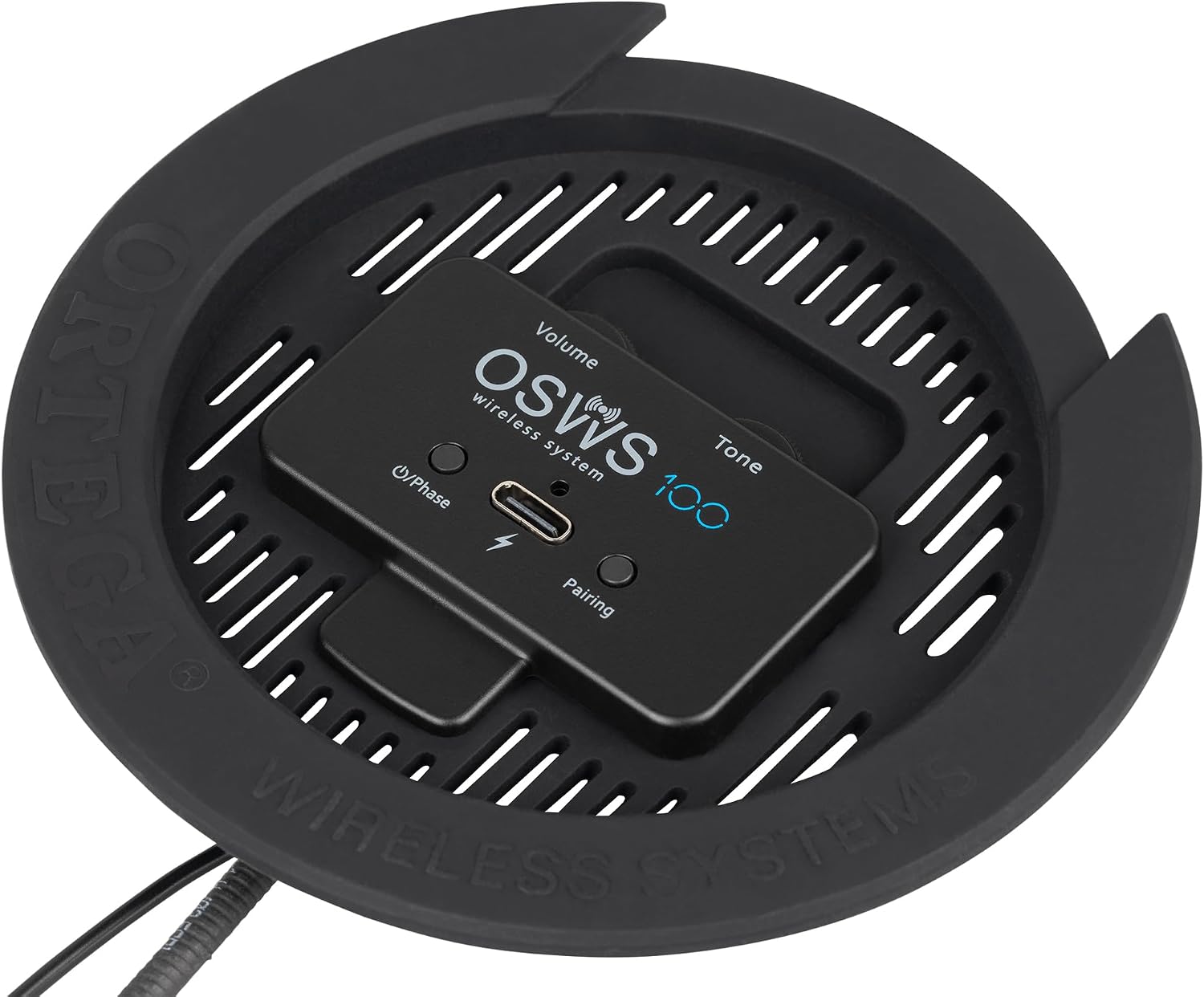
The Ortega OSWS100 Wireless Acoustic Guitar Pickup is designed for players who want to amplify an acoustic guitar without cutting into the instrument, installing a permanent pickup or running a cable from the guitar to the amplifier.
Rather than using a conventional magnetic soundhole pickup, Ortega builds the OSWS100 around an adjustable gooseneck microphone and wireless transmitter housed in a unit that fits into a 100 mm acoustic-guitar soundhole. Ortega describes the installation as similar to fitting a soundhole cover, with no tools or permanent modification required.
That makes it particularly interesting for an acoustic guitar that was never fitted with onboard electronics in the first place.
Why the wireless design is useful
The obvious attraction is freedom from a conventional instrument cable.
The OSWS100 uses a four-channel UHF wireless system, allowing the guitar signal to be sent to the supplied receiver without a cable running across the floor. Ortega specifies a maximum range of around 30 metres in open conditions.
For a player standing fairly still with an acoustic guitar, thirty metres may sound excessive. The real benefit is simpler than that: there is no cable hanging from the guitar, pulling at the output socket or trailing around the player’s feet.
That can feel especially tidy for small performances, rehearsals, church playing, open-mic nights or any situation where an acoustic guitarist wants a little more movement.
The system has four available UHF channels, which also gives some flexibility when wireless equipment is already being used nearby.
What it feels like to use
The OSWS100 is quite different physically from a normal clip-on or under-saddle pickup.
The circular housing sits in the guitar’s soundhole, while the small gooseneck microphone extends towards the inside of the instrument. Because the microphone position can be adjusted, the player has some control over where the guitar’s internal sound is being captured.
There is something pleasantly simple about the idea. Instead of modifying the saddle, fitting an endpin jack or attaching electronics permanently inside the guitar, the system occupies the soundhole as a removable piece of hardware.
Ortega specifically designed it for guitars without a factory-installed pickup, so the emphasis is on adding amplification while leaving the basic guitar intact.
That should appeal to someone who likes their acoustic exactly as it is and does not want to start drilling holes into it simply to play through an amplifier occasionally.
No permanent modification
This is probably the strongest practical argument for the OSWS100.
Permanent acoustic-guitar pickup installation can involve removing or modifying the saddle, drilling for wiring, replacing the endpin or mounting controls inside the body.
None of those things is necessarily a problem when done correctly, but they are permanent changes.
The Ortega system is designed to avoid that. The company says installation requires no tools, with the unit fitting into the soundhole without complex modifications that could alter or damage the guitar.
That gives the pickup a useful temporary character.
You could use it on an acoustic that mainly lives at home but occasionally needs amplification, or remove it again when the guitar is being played entirely acoustically.
It also makes the concept attractive for someone who owns a guitar they would rather not alter permanently.
Rechargeable rather than disposable batteries
Both convenience and physical clutter matter with wireless equipment.
Ortega uses a rechargeable system, with USB charging rather than relying on disposable batteries. The manufacturer specifies approximately four hours for a full charge and up to eight hours of playing time.
For occasional performance use, eight hours is quite generous.
The important part is developing the habit of charging it. A normal passive acoustic guitar does not care whether you remembered to plug it in the night before; a wireless system obviously does.
The supplied system includes the transmitter, receiver and USB-C charging cable, so the basic wireless chain is part of the package rather than something that has to be assembled from unrelated components.
The adjustable microphone approach
The microphone is what separates the OSWS100 from the familiar magnetic pickups that sit underneath the strings.
A magnetic pickup responds primarily to the movement of steel strings. A microphone can capture more of the guitar body and the air moving inside the instrument.
That can make the amplified sound feel more connected to the acoustic character of the guitar, although it also introduces different practical considerations.
Ortega describes the OSWS as using high-sensitivity microphones and an optimised audio processor, with the system designed to provide clear sound while helping control feedback.
The adjustable gooseneck is important because microphone position affects what is captured.
Moving it can change the balance between warmth, attack and body resonance, so a little experimentation is sensible rather than assuming there is one perfect position for every guitar.
The 100 mm fit is critical
This is one specification that should not be treated casually.
The OSWS100 is designed for acoustic guitars with a 100 mm soundhole. Ortega also makes the separate OSWS86for classical guitars with approximately 86 mm soundholes.
That means this is not a universal soundhole pickup.
Before buying, the guitar’s soundhole should actually be measured rather than judged by eye.
A difference of several millimetres matters when the product is intended to sit physically inside the opening. If your guitar has a substantially smaller or larger soundhole, this particular model may simply be unsuitable.
That sounds obvious, but it is probably the single most important compatibility check with the OSWS100.
The drawbacks
The fixed 100 mm fit is the first and most important drawback.
Unlike a pickup with broadly adjustable clamps, the OSWS100 is designed around a specific soundhole size. If your guitar does not match that size closely enough, the rest of the specification becomes irrelevant. Ortega’s separate OSWS86 exists precisely because classical guitars commonly use a smaller opening.
So this is one product where measuring before buying is essential.
The second drawback is that the unit occupies the soundhole.
That is necessary for the design to work, but some players may dislike having a fairly visible black circular unit sitting in the centre of the guitar. On a plain stage guitar this may not matter at all; on an acoustic with an attractive rosette or carefully chosen top wood, the visual change is much more obvious.
It also changes the physical relationship between the open soundhole and the room.
Because the system covers much of the opening, the guitar may not feel or project exactly the same acoustically while the OSWS100 is fitted as it does with an unrestricted soundhole. Players who care strongly about the unplugged experience may prefer to remove the unit when amplification is not required.
Then there is the microphone itself.
Microphones can capture a more natural sense of the instrument than some pickup systems, but they can also be more sensitive to stage volume, monitor position and feedback.
Ortega says the OSWS uses an optimised processor intended to help prevent feedback, but no acoustic-microphone system can make stage positioning irrelevant.
If the guitar is standing directly in front of a loud monitor or being used beside a drummer and high stage volume, the working conditions become more demanding.
A magnetic soundhole pickup or under-saddle piezo may be easier to control in a very loud environment because those systems are less dependent on capturing air movement inside the guitar.
The gooseneck microphone also adds another variable.
Its adjustability is useful, but it means there is some setup involved. Moving the microphone can alter the sound, so the first position you try may not be the one you ultimately prefer.
Someone wanting a completely fit-and-forget solution may find that small amount of experimentation unnecessary.
Wireless operation introduces its own compromises as well.
The absence of a cable is convenient, but now there are two powered pieces of equipment in the signal chain: the soundhole unit and the receiver. They need charging and need to be switched on and paired correctly.
The specified eight-hour operating time is plenty for many situations, but it is still finite. Forgetting to recharge the system before a performance is a problem that simply does not exist with a passive wired pickup.
Wireless transmission can also be affected by the environment.
Ortega’s quoted 30-metre range applies in open conditions. In a real venue there may be walls, people, metal structures and other wireless equipment between the transmitter and receiver.
Most acoustic players are unlikely to wander thirty metres from their amplifier anyway, so I would treat that figure as a maximum specification rather than an expectation of guaranteed real-world stage range.
The four-channel UHF system gives some flexibility, but it still requires sensible channel choice where several wireless systems are operating nearby.
Another drawback is that this is not a permanent professional installation.
For some players that is exactly the point. But if you gig every week and want one acoustic guitar permanently ready to plug in, an internal pickup system with an endpin output may ultimately be tidier.
With the Ortega, you still have a removable unit to install, charge, carry and look after.
The OSWS100 also will not suit players who specifically want the feel and response of an under-saddle piezo or magnetic soundhole pickup.
Its microphone-based approach has a different character. That is part of what makes it interesting, but it also means the sound may not behave exactly as expected through every acoustic amplifier, PA or effects setup.
There is also no reason to buy wireless just because wireless sounds more advanced.
If you normally sit two metres from an acoustic amplifier at home, a good cable is extremely simple, reliable and requires no charging. The OSWS100 starts to make more sense when cable-free movement, temporary installation or avoiding modification to the guitar actually solves a problem.
Finally, the product’s removable nature means it is another small piece of equipment to keep track of.
Receiver, charging cable and soundhole unit all need to stay together. A permanently installed pickup is always in the guitar; this system can be left at home accidentally.
None of these problems makes the OSWS100 a poor idea. They simply show that its strongest advantages — removable installation and wireless operation — also create most of its compromises.
Who it suits best
The Ortega OSWS100 makes most sense for someone who owns an acoustic guitar without built-in electronics and does not want to modify it permanently.
It is particularly appealing for occasional performers who need amplification for rehearsals, small gigs, church, open-mic nights or similar situations but still want the guitar to remain fundamentally unchanged.
It may also suit someone who owns a particularly valued acoustic and feels uncomfortable drilling or altering the instrument simply to add amplification.
The wireless aspect is useful for players who like a cleaner stage area or who move around while performing.
It is less suited to someone whose guitar does not have a 100 mm soundhole, someone working regularly on very loud stages, or a player who wants a permanently installed system that is always ready without charging.
Is it worth the guitar space?
The Ortega OSWS100 solves a very specific problem rather neatly.
It gives a non-electro acoustic guitar a rechargeable wireless amplification system without drilling, wiring or permanent modification. The adjustable microphone, four-channel UHF transmission, USB charging and quoted 30-metre open-condition range make it considerably more sophisticated than a basic removable soundhole pickup.
The limitations are just as important.
Your guitar needs the correct 100 mm soundhole, the unit visibly occupies that opening, microphone-based amplification needs sensible feedback management, and the wireless system has to be kept charged.
For someone who performs regularly enough to want amplification but not regularly enough to justify permanently altering a favourite acoustic, though, that combination of reversibility and wireless freedom is exactly what makes the OSWS100 interesting.
For more useful accessories and equipment for guitarists, explore our Guitar Gear guides on AIGuitars.
As an Amazon Associate I earn from qualifying purchases.