
Traveler Guitar EG-3 Travel Electric Guitar
As an Amazon Associate I earn from qualifying purchases.
The Traveler Guitar EG-3 Travel Electric Guitar tackles one of the awkward truths about travelling with a guitar: the instrument itself may not feel particularly large when you are playing it, but once it is inside a case, carrying it through airports, hotels, trains and cars can become a nuisance.
The EG-3 reduces that bulk without shortening the part that matters most to the playing feel.
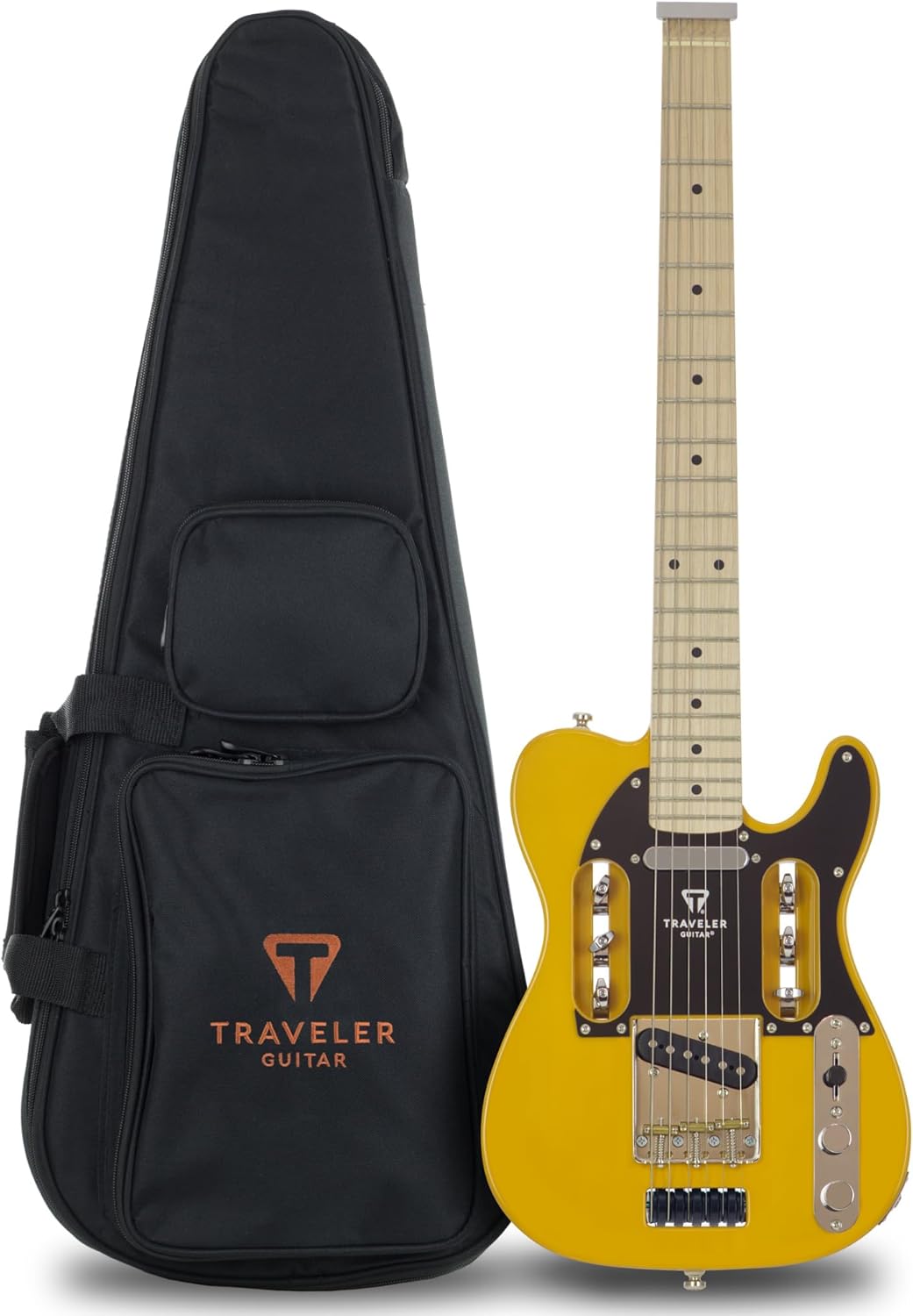
It uses a full 25.5-inch scale length, so the distance between the nut and bridge is comparable with many familiar full-size electric guitars. The clever part is everything surrounding that scale. By using Traveler Guitar’s in-body tuning system and eliminating the conventional headstock, the complete guitar measures only 30 inches long.
That makes the EG-3 a genuine travel guitar without turning it into a miniature instrument.
Why a full-size scale matters
Travel guitars often achieve their compact dimensions by shortening the scale.
That certainly makes an instrument smaller, but it also changes the way the strings feel under the fingers. Fret spacing becomes tighter, string tension changes and the guitar can feel noticeably different from the instrument you normally play at home.
The EG-3 takes another route.
Its 25.5-inch scale means the fretting hand still encounters familiar spacing from one end of the fingerboard to the other.
If you normally play a full-scale electric guitar, that can make switching to the Traveler considerably more natural.
This is particularly useful if the guitar is being taken away for practice.
You are not spending a week learning chord shapes, scales and bends on a dramatically shortened neck and then having to readjust when you return to your main guitar.
The EG-3 is compact because the unused length has been removed from around the playing area, not because the fretboard itself has been squeezed.
What it feels like to play
The EG-3 uses a bolt-on maple neck with a maple fingerboard and 22 jumbo frets.
Traveler Guitar specifies a 15.75-inch fingerboard radius and a nut width of approximately 1.65 inches.
That relatively flat radius suits the modern feel of the instrument and gives plenty of room for string bending.
The jumbo frets also make sense on a guitar intended to be played as a proper electric rather than simply carried around as an emergency practice instrument.
At 5 lb 7 oz, the EG-3 is noticeably lighter than many traditional solid-body electric guitars, but it still has enough substance to feel like a real instrument in the hands.
The body is about 10 inches wide and 1.75 inches thick, so visually and physically it is much smaller than a conventional full-bodied electric.
That compact body will take a little adjustment.
Your picking arm does not rest against as much wood, and when sitting down there is less body beneath the guitar than you may be accustomed to.
But the neck, strings and fret spacing remain full size, which is arguably the more important part once you start playing.
The in-body tuning system
The unusual appearance of the EG-3 comes largely from Traveler Guitar’s tuning system.
Instead of placing the tuners on a conventional headstock, the tuning hardware is incorporated into the body.
That removes several inches from the overall length while still allowing the guitar to use standard strings and standard tuning machines.
You are therefore not tied to an obscure set of specialist travel-guitar strings.
Traveler Guitar currently ships the EG-3 with D’Addario EXL110 strings, but the system is designed around conventional guitar strings.
For someone actually travelling with the instrument, that matters.
A broken string should not turn into a search for a proprietary replacement that nobody nearby stocks.
There is a short adjustment period to tuning from the body rather than reaching automatically towards a headstock, but the trade-off is a guitar that becomes dramatically shorter without sacrificing scale length.
Two pickups keep it versatile
The EG-3 has two pickups rather than relying on a single travel-guitar pickup.
At the neck is a chrome lipstick pickup, while the bridge uses a conventional single-coil pickup. A three-way selector allows either pickup to be used individually or both together.
The neck pickup gives the guitar a smoother, rounder character.
Move to the bridge and the sound becomes more direct, bright and cutting.
The middle position combines the two.
That gives the EG-3 enough range for practice, songwriting, recording and straightforward live use without covering the compact body with excessive controls.
There is a master Volume and Tone control, keeping the layout familiar and uncomplicated.
You plug the guitar into an amplifier, pedalboard, audio interface or headphone amp through a standard quarter-inch output jack, just as you would with a conventional electric guitar.
A travel guitar that still needs an amplifier
One point worth understanding is that the EG-3 does not contain its own headphone amplifier.
It is a passive electric guitar with a conventional output.
If you want silent practice in a hotel room, you will need something else to provide the amplified sound.
That could be a small headphone amp, compact modelling device, audio interface or portable amplifier.
For players who already own something such as a headphone amp or small modeller, that may not matter at all.
In fact, separating the guitar from the amplification system means you can choose whatever practice or recording solution you prefer rather than being tied to electronics permanently built into the instrument.
But someone expecting to plug headphones directly into the EG-3 itself should know that this is not how the guitar is designed.
Built around travelling
The complete EG-3 is only 30 inches long, and Traveler Guitar supplies a custom gig bag measuring about 31.5 x 12 x 2.75 inches. The guitar weighs approximately 7 lb in its bag.
That is where the design begins to make real sense.
A conventional electric guitar case is long, awkward and often one of the most inconvenient pieces of luggage you can carry.
The EG-3 package is considerably shorter and lighter.
Traveler Guitar states that the design is intended to fit into airline overhead compartments, although airline baggage policies and available cabin space vary, so I would always check the individual carrier’s rules before travelling.
Even when flying is not involved, the smaller dimensions help.
It takes up less room in a car, hotel room, camper, train compartment or crowded home.
For somebody who spends a lot of time travelling for work, that can be the difference between taking a guitar and deciding it is simply too much trouble.
Poplar body and maple construction
The EG-3 uses a poplar body with a bolt-on maple neck and maple fingerboard.
The body is finished in Butterscotch Blonde, giving the guitar a familiar vintage-inspired appearance despite the unconventional travel design.
Chrome hardware and the contrasting lipstick pickup continue that look.
It is an interesting combination.
From a distance there are obvious references to classic electric guitars, but remove the traditional headstock and most of the body mass and the result looks distinctly modern.
The compact shape is functional first.
There is simply less wood where it is not needed for the full-scale playing surface.
For a travel instrument, that is more useful than trying to reproduce the dimensions of a traditional guitar and then calling it portable because it happens to come with a gig bag.
Useful beyond holidays
The EG-3 does not need to be reserved only for flights and holidays.
It could make a very practical guitar for somebody who regularly travels for work.
A guitar that lives conveniently in a vehicle or travels easily between temporary accommodation gives you far more opportunities to practise than an instrument that stays at home because carrying it is inconvenient.
It could also make sense as a second guitar for a caravan, camper or holiday property.
Home recording is another possibility.
The standard output means the EG-3 can feed the same pedals, amplifiers and recording interfaces as another electric guitar.
Its compact size does not prevent it from being recorded like a conventional passive electric.
And because it retains the full 25.5-inch scale, it can be used to practise material intended for a regular electric without dramatically changing the physical dimensions under your fingers.
The drawbacks
The compact body is both the EG-3’s biggest advantage and the first thing that may take time to get used to.
It simply does not give your body the same physical reference points as a conventional electric guitar.
If you have spent decades playing a larger instrument, your picking arm may initially feel as though part of the guitar has disappeared.
That is essentially what Traveler Guitar has done to make it portable.
The important playing geometry remains, but much of the surrounding body has been removed.
For some players that will feel liberating.
Others may always prefer the balance and substantial feel of a traditional solid-body guitar.
The 5 lb 7 oz weight is light compared with many electrics, but it is also worth putting it into perspective.
This is not a featherweight two- or three-pound skeletal travel instrument.
The EG-3 retains a fairly substantial body, two pickups and full-size hardware.
That added weight arguably contributes to it feeling more like a conventional electric, but someone looking for the absolute smallest and lightest possible travel guitar can find more extreme designs.
The tuning system also takes adjustment.
Most guitarists have spent years reaching automatically towards the headstock when a string needs tuning.
With the EG-3, your hand goes to the body instead.
There is nothing particularly difficult about it, but muscle memory does not disappear the moment you buy a travel guitar.
The lack of onboard headphone amplification is another limitation.
Some travel guitars are designed as self-contained practice instruments.
The EG-3 is not.
To hear a proper amplified electric-guitar sound through headphones, you need a separate device.
That means adding another small piece of equipment to your luggage.
For somebody already carrying a compact headphone amp or modeller this is hardly a problem, but a traveller seeking a completely standalone solution may prefer a guitar with amplification built in.
The pickup configuration is useful but fairly straightforward.
You have a lipstick neck pickup, single-coil bridge pickup and three-way switching.
There are no humbuckers, coil splits or large switching systems.
Players who rely heavily on thick high-output humbucker tones may therefore want to consider whether this particular pickup arrangement suits their music.
Single-coil-style pickups can also be more susceptible to electrical hum than humbuckers in some environments.
That becomes relevant when travelling because hotel rooms, rehearsal spaces and temporary venues do not always have the cleanest electrical environment.
There is no tremolo system listed on the EG-3 either.
Players who regularly use a vibrato arm will need to adjust their playing or choose a different instrument.
The gig bag is useful and keeps the package compact, but it is still a soft bag rather than a hard flight case.
For normal carrying and careful overhead storage that keeps everything convenient.
If the guitar is going into checked baggage or travelling where other heavy luggage could be stacked on top of it, I would want more substantial protection.
And despite Traveler Guitar designing the instrument around airline travel, no manufacturer can guarantee that every airline will allow a particular bag into every overhead compartment.
Aircraft types, baggage rules and how full the flight happens to be can all affect what is accepted.
Always check before travelling rather than assuming the words “travel guitar” override an airline’s baggage policy.
The highly compact appearance can also create expectations that the EG-3 will feel like a miniature guitar.
It does not.
That is actually one of its strengths, but it means somebody specifically wanting very close fret spacing for small hands will not gain that from this model.
The 25.5-inch scale is full size.
Finally, portability only has value if you genuinely need it.
If the guitar will spend its entire life on a stand in the same room, a conventional electric gives you far more choice of body shapes, pickup configurations and hardware.
The EG-3 earns its unusual design by solving a particular problem: carrying a proper electric guitar without carrying the bulk of a proper electric guitar.
If that problem does not exist for you, much of what makes it special becomes unnecessary.
Who it suits best
The Traveler Guitar EG-3 makes most sense for guitarists who want to continue practising while away from home without moving to a short-scale miniature instrument.
Touring musicians, people who travel regularly for work, caravan and camper owners, and anyone frequently moving between locations should immediately understand the appeal.
It can also suit electric players who simply want a compact second instrument that can remain ready for travel.
The full scale makes it particularly attractive to somebody who wants practice time on the road to translate naturally back to their main guitar.
And for players who already own a compact headphone amp, modelling pedal or portable interface, the lack of built-in amplification may be no disadvantage at all.
Is it worth the guitar space?
The Traveler Guitar EG-3 succeeds because it does not try to make the playing part of the guitar miniature.
The 25.5-inch scale, 22 jumbo frets, maple neck, two pickups and familiar volume, tone and three-way controls give you the fundamentals of a proper electric guitar.
Traveler Guitar then reduces the unnecessary length and body bulk around those fundamentals.
At only 30 inches overall, the EG-3 occupies dramatically less luggage space while still accepting standard strings and plugging into normal guitar equipment.
There are compromises.
The smaller body feels different, tuning from the body takes adjustment, there is no built-in headphone amplifier, and the supplied gig bag cannot offer the protection of a substantial hard case.
But those are understandable trade-offs for a guitar specifically designed to go places a traditional electric can be inconvenient to take.
For somebody who has repeatedly left their guitar at home because travelling with it was simply too much trouble, the EG-3 offers a particularly appealing solution: a genuinely compact guitar that still feels full size where your hands actually play it.
Explore more electric guitars in our Electric Guitars section.
As an Amazon Associate I earn from qualifying purchases.