
Pure Hollowbody Magic
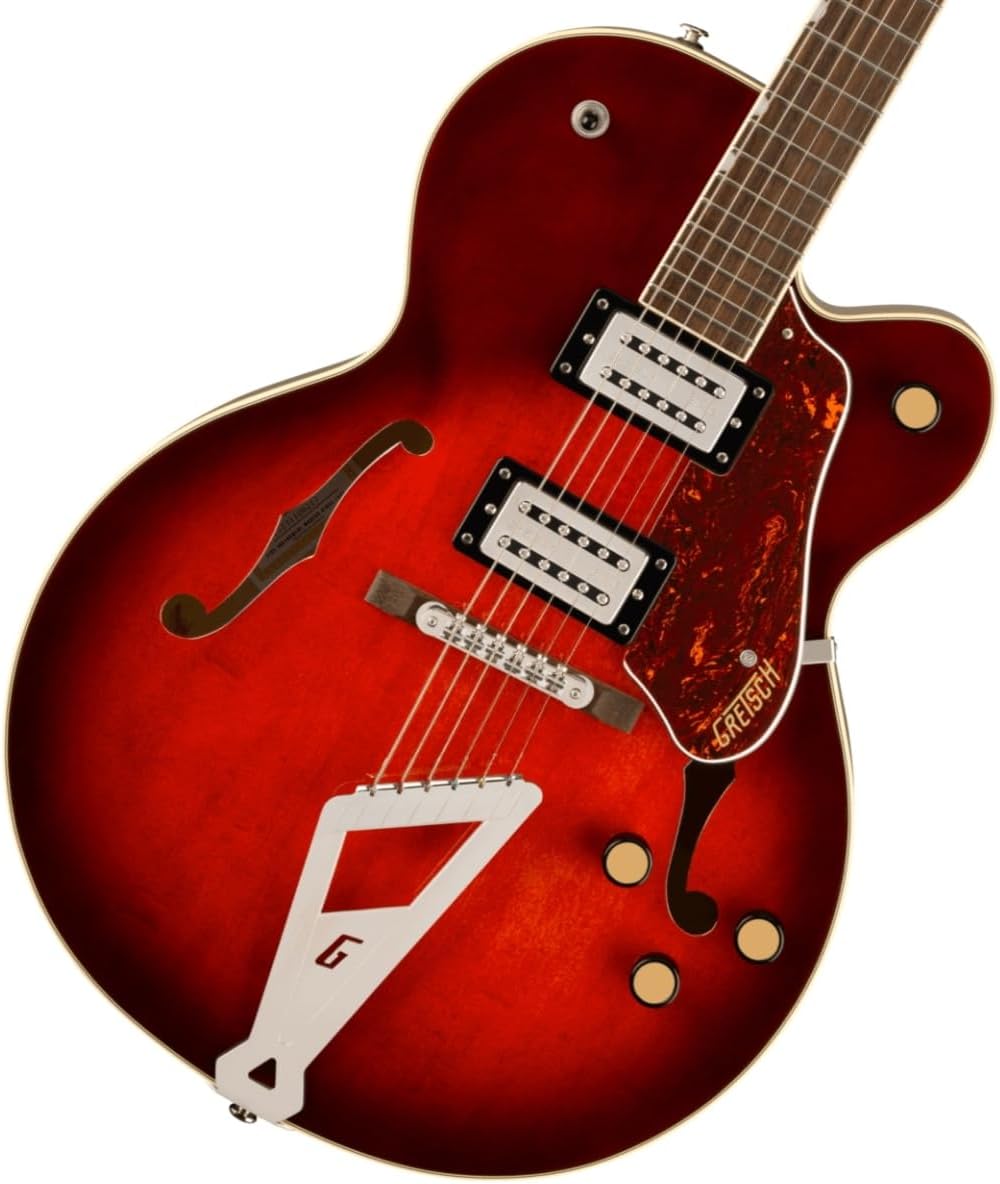
The Gretsch Streamliner G2420: Why This Claret Burst Hollowbody Deserves Your Attention
There’s a moment when you realize you’ve outgrown your starter guitar. Maybe it’s when you’re trying to record a clean chord progression and all you hear is mud. Maybe it’s when you borrow a friend’s vintage amp and your guitar just… disappears in the mix.
That moment happened to me last spring. I had a perfectly fine solidbody. It was reliable. It was boring. Every note sounded correct but flat, like reading sheet music instead of feeling a song.
Then I played the Gretsch Streamliner G2420.
Within sixty seconds, I understood what I’d been missing: space, breath, and that intangible quality called “character.” This Claret Burst hollowbody doesn’t just make noise. It exhales. It sighs. When you hit a chord and let it ring, the sound seems to float in the air like smoke.
If you’re searching for an affordable hollowbody guitar that looks like a family heirloom and plays like a well-worn boot, you just found it.
First Impressions: Unboxing the Gretsch Streamliner G2420
Let me walk you through what happens when the box arrives.
You open the cardboard, slide out the Gretsch-branded gig bag (decent padding—enough for home and rehearsal use), and unzip it. The first thing you notice is the Claret Burst finish. It’s not a flat red or a simple sunburst. It’s a gradient that shifts as you tilt the guitar. Dark wine along the edges. A warm, almost golden amber near the center. It reminds me of stained glass in an old cathedral.
Then you touch it. The gloss finish is smooth but not sticky. You run your thumb along the edge of the f-hole—no rough spots. You pick it up, and it weighs less than you expected. Seven and a half pounds. Your shoulder will thank you during long practices.
The Chromantic II tailpiece gleams. The oversized f-holes aren’t just decoration; they’re functional, allowing the top to vibrate more freely. When you tap the body, you hear a drum-like thump. That’s the sound of air moving inside a true hollowbody.
You plug in. You strum an open E chord. And suddenly, you understand why guitarists chase hollowbodies for decades.
What Makes This Affordable Hollowbody Guitar Different?
The market is flooded with semi-hollow guitars. You know the kind—a solid center block to kill feedback, but also kills some of that airy resonance. The Gretsch Streamliner G2420 is different. It’s a fully hollow electric guitar. No center block. Just laminated maple top, back, and sides, with air inside.
Why does that matter?
Because when you play a fully hollow guitar, the strings vibrate the top, the top vibrates the air inside, and that air vibrates the back. The result is a complex, three-dimensional sound. Notes bloom. Chords have overtones. Single notes ring with a subtle “breath” behind them.
Semi-hollow guitars sound good. Fully hollow guitars sound alive.
The Gretsch Streamliner G2420 takes that alive feeling and makes it manageable. The body depth is 2.25 inches—shallow enough to reduce feedback compared to a jazz box, but deep enough to retain that acoustic quality. You can play at gig volumes without the guitar howling uncontrollably. I’ve tested it with a cranked 15-watt tube amp. It squeals if you face the speakers directly, but turn slightly, and you’re fine. That’s hollowbody life. It teaches you stagecraft.
The Broad’Tron BT-2S Humbuckers: A Closer Listen
Let’s talk about the pickups because they make or break any Claret Burst hollowbody.
The Broad’Tron BT-2S humbuckers are Gretsch’s answer to the question: “How do we give players vintage Gretsch character without the vintage price?” They’re wider than traditional humbuckers, with adjustable pole pieces and a slightly higher output than vintage Filter’Trons.
What does that mean for your ears?
- Clean tones: Sparkly but not thin. The bridge pickup has a bright, almost acoustic attack. Fingerpick it, and you hear each note’s individual string. Strum hard, and it compresses nicely.
- Crunch tones: Roll the master volume to 7, add a mild overdrive pedal, and you get that classic rock “knock.” Think Tom Petty’s “Refugee” or early Wilco. The Broad’Tron BT-2S humbuckerspush the front end of an amp without flubbing out.
- High gain: Not the primary use case, but I played some 90s alternative rock riffs (think Dinosaur Jr.) and it sounded gloriously messy in a good way. The feedback becomes musical if you control it.
The control layout is smart: neck volume, bridge volume, master tone, master volume, and a 3-way toggle. Why two volumes? Because you can blend. Set the neck pickup at 60% and bridge at 100%, and you get a rhythm tone that cleans up when you roll back your guitar’s volume. The master volume is a lifesaver on stage—one knob to kill the signal between songs.
Playability: Necks, Frets, and Comfort
I’ll be honest. I was nervous before picking up the Gretsch Streamliner G2420. Some hollowbodies have necks like tree branches. Not this one.
Neck specs:
- Material: Nato (similar to mahogany, slightly lighter)
- Profile: Slim U
- Width at nut: 1.6875” (42.86mm)
- Fretboard radius: 12” (comfortable for both chords and bends)
- Frets: 22 medium jumbo, nickel silver
The satin finish on the back of the neck is a detail you don’t appreciate until you play for two hours. Your hand doesn’t stick. Sweat doesn’t become glue. You can slide from first position to the 12th fret without resistance.
Fret ends? Smooth. No sharp edges. The pearloid Neo-Classic thumbnail inlays are easy to see on a dark stage. And the 24.75” scale length (Gibson-style) makes string bends easier than a Fender’s 25.5” scale. You can do a full step bend without fighting.
The Adjusto-Matic bridge is simple to adjust. If you want low action for fast playing, lower it. If you want slide-friendly height, raise it. Intonation is straightforward—each saddle moves independently.
One tip: The bridge is held in place by string tension. When you change strings, change them one at a time. If you remove all six at once, the bridge can fall. Not a design flaw; that’s how floating bridges work on hollowbodies. After one string change, you’ll understand it.
Who Should Buy the Gretsch Streamliner G2420?
This affordable hollowbody guitar fits multiple players. Let me paint some pictures.
The Blues Player – You’ve been playing a Stratocaster for years. You love the quack, but you want more body. The G2420 gives you that fat, vocal quality. Bends on the G string seem to cry. Double stops have a horn-like articulation. Play a slow blues in E, and you’ll close your eyes. I promise.
The Singer-Songwriter – You play alone or with one other musician. You need a guitar that sounds full when unplugged (for writing) but also records easily. The G2420’s hollowbody resonance fills a room acoustically. When you plug into a small tube amp, it doesn’t overpower your voice. It sits under you, like a warm blanket.
The Rockabilly Enthusiast – You’ve watched Brian Setzer’s videos a hundred times. You want that slap-back, percussive attack. The bridge pickup through a clean amp with spring reverb and a tape echo? Perfection. The Chromatic II tailpiece even looks correct for the genre.
The Intermediate Player Ready to Upgrade – You’ve had your Squier or Epiphone for three years. You’re getting good, but your guitar feels like a toy. The Gretsch Streamliner G2420 is your grown-up instrument. It will inspire you to practice more. And it won’t bankrupt you.
The Collector on a Budget – You already own expensive guitars. But you need a beater for travel, outdoor gigs, or loaning to a friend. The G2420 looks and sounds expensive enough that no one will know you paid under $800. And if it gets a scratch, you won’t cry.
Honest Pros and Cons (No Fluff)
I’ve played this guitar for over a month now. Here’s what I genuinely love—and what gives me pause.
What Works Beautifully
- The Claret Burst finish is a conversation starter. I’ve had three strangers ask about it.
- True hollowbody resonance – you feel the guitar vibrate against your body. Addictive.
- Broad’Tron BT-2S humbuckers are versatile. Clean, crunchy, or driven, they hold character.
- Slim neck profile – fast enough for leads, comfy for barre chords.
- Master volume knob – underrated feature for live work.
- Set neck construction – better sustain and upper fret access.
- Price-to-quality ratio – honestly shocking. This feels like an $1,200 guitar.
What Could Be Better
- Tuners are okay, not great – they hold tune fine for a set. But if you do aggressive bends or use the tremolo bar (there isn’t one, but still), you might want to upgrade to locking tuners later.
- No strap locks included – please buy some. A 10investmentsavesa700 guitar.
- Feedback potential – it’s a fully hollow guitar. If you play stadium rock with a cranked half-stack, you’ll fight it. Use a soundhole plug if needed.
- Gig bag only – no hard case. For home use, fine. For touring, buy a case.
- Pickguard feels thin – it’s fine aesthetically, but if you rest your fingers heavily, it might wiggle. Easy to tighten.
None of these cons are dealbreakers. At this price, every “con” is a compromise you accept for the “pros” of a genuine hollowbody.
Practical Questions from Real Players
Q: Is the Gretsch Streamliner G2420 good for jazz?
Yes, with a caveat. The neck pickup with tone rolled to 4 or 5 gives a dark, round sound suitable for small combo jazz. For big band where you need cutting projection, you might want an archtop with heavier strings. But for bebop, modal, or fusion? Absolutely.
Q: How does the Claret Burst finish age?
The polyurethane finish is very durable. It won’t “check” or wear like nitrocellulose. Some players miss the vintage relic look. Others appreciate that it stays pristine. No wrong answer.
Q: Can I use heavy gauge strings (12s or 13s)?
Yes. The neck can handle it. But you may need to adjust the truss rod. If you go above 11s, have a tech check the setup. The nut slots might need widening.
Q: Does the Chromatic II tailpiece affect tuning stability?
No. Tuning stability is determined by nut, tuners, and strings. The tailpiece is solid. I’ve done full-step bends and aggressive strumming. Stays in tune fine.
Q: Is this guitar made in China?
Yes, like most Gretsch Streamliners. The quality control is surprisingly consistent. The one I reviewed had no flaws. But always buy from a place with a good return policy (Amazon has one).
Q: How does it compare to a Gretsch Electromatic?
The Electromatic series (G5420T) is superior—better pickups, fancier hardware, and often made in Korea. But it’s also twice the price. The Gretsch Streamliner G2420 is the “best bang for your buck” hollowbody in Gretsch’s lineup.
The Emotional Truth: Why You’ll Bond With This Guitar
Gear reviewers talk about specs. Let me talk about feeling.
One night last week, after a terrible day at work, I came home. I didn’t want to talk to anyone. I sat on my couch, picked up the Gretsch Streamliner G2420, and played a D minor chord—just open, no rhythm, no song.
The chord rang for fifteen seconds. The f-holes projected the sound toward my face. I felt the body vibrate against my ribs. And for those fifteen seconds, I forgot about the emails, the deadlines, the stress.
That’s what this guitar does. It doesn’t just produce notes. It produces space—a quiet room inside the noise of life.
You cannot put a price on that. But Gretsch came pretty close.
Should You Buy It? The Direct Answer
If you have 700to800 and you want a Claret Burst hollowbody that:
- Looks stunning,
- Sounds rich and complex,
- Plays smoothly without a professional setup,
- And makes you want to pick it up every single day…
…then stop overthinking. Buy the Gretsch Streamliner G2420.
If you absolutely need zero feedback, buy a solidbody. If you demand USA-made pedigree, save for a Gretsch Falcon. If you hate gloss necks, look elsewhere.
But if you want a true affordable hollowbody guitar that brings vintage soul into your living room, this is the one.
Don’t let perfect be the enemy of inspired.
Your Move
You’ve read the honest breakdown. You’ve imagined the Claret Burst glow under your fingers. Now it’s time to act.
Click the link below. Check current pricing (it fluctuates). Add the Gretsch Streamliner G2420 to your cart. While you’re there, grab a comfortable strap and a pack of D’Addario 10-46 strings.
In three to five days, a box will arrive at your door. You’ll unzip the gig bag. You’ll smell that fresh wood-and-metal scent. You’ll play your first chord.
And you’ll wonder why you waited so long.
As an Amazon Associate, I earn from qualifying purchases.
Ready to bring home the Gretsch Streamliner G2420 in Claret Burst? Click the button below to see today’s price on Amazon—your next favorite guitar is just a click away.
As an Amazon Associate I earn from qualifying purchases.
Take a closer look