
GP-50: Pedalboard Killer
A True Story: The Night My Pedalboard Died
Picture this. It’s 11:30 pm before a big gig. You’re running through your setlist at home. Your tube amp is cranked – just a little. Your cat runs out of the room. Your spouse gives you the look.
Then it happens.
Your delay pedal starts making a high‑pitched whine. You wiggle the patch cable. Nothing. You swap batteries. Still whining. You bypass the delay, but now your overdrive sounds thin. You spend forty‑five minutes troubleshooting while your setlist waits.
You end up playing the gig with a borrowed multi‑effect that you’ve never used. The tones are mediocre. You feel frustrated.
That was me three years ago.
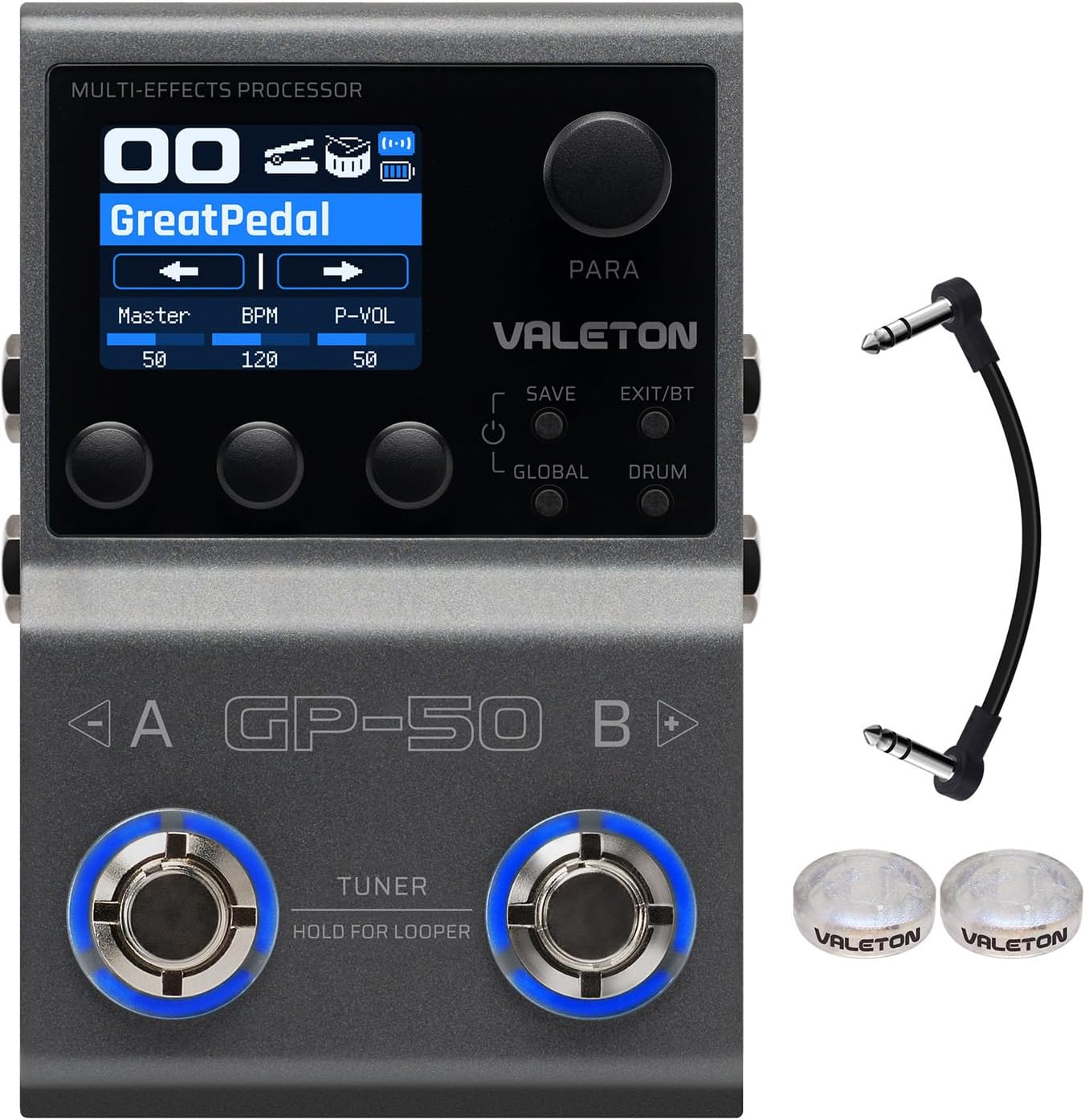
I don’t have that problem anymore. Because I discovered the Valeton GP-50 NAM pedal – a compact, intelligent device that replaced fifteen separate stompboxes, my entire cable nest, and my back pain from lugging a heavy board.
And today, I want to show you why it can do the same for you.
What Exactly Is the Valeton GP-50 NAM Pedal?
Let me clear up any confusion right away.
The GP-50 is not just another “budget multi‑effects” with thin digital sounds. It’s a guitar IR loader pedal, a bass multi-effects with Bluetooth unit, a NAM (Neural Amp Modeling) processor, and a USB audio interface – all in one rugged box slightly larger than a deck of cards.
At its heart, NAM technology uses neural networks to capture the exact sound and feel of real tube amps, drive pedals, and even full studio rigs. Unlike older modelling that just mimics EQ curves, NAM responds dynamically to your playing. Play soft, and the virtual amp cleans up. Dig in, and it breaks up naturally – just like the real thing.
The affordable amp modeling pedal market has exploded recently, but the GP‑50 stands out because it combines NAM with a fully‑featured guitar IR loader pedal (Impulse Responses for cabs) and a Bluetooth app that makes editing a joy.
In short: it sounds like amps, feels like tubes, and costs like a couple of single pedals.
First, Let’s Talk About What You’re Replacing
To understand the GP‑50’s value, look at a typical pedalboard:
| Component | Approximate Cost (New) | Weight | Cable Hassle |
|---|---|---|---|
| Tuner | $50 | 0.5 lbs | 2 cables |
| Compressor | $80 | 0.6 lbs | 2 cables |
| Overdrive | $100 | 0.6 lbs | 2 cables |
| Distortion | $100 | 0.6 lbs | 2 cables |
| Chorus | $70 | 0.5 lbs | 2 cables |
| Delay | $120 | 0.7 lbs | 2 cables |
| Reverb | $100 | 0.6 lbs | 2 cables |
| Noise gate | $60 | 0.4 lbs | 2 cables |
| Amp/cab sim (optional) | $150 | 0.5 lbs | 2 cables |
| Power supply | $50 | 1.0 lb | 1 power cable |
| Patch cables (8+) | $40 | negligible | 16+ connections |
| Pedalboard & case | $80 | 8 lbs | — |
| Total | ~$1000 | ~14 lbs | ~30+ connection points |
Now look at the GP‑50:
| Component | Cost | Weight | Cable Hassle |
|---|---|---|---|
| Valeton GP‑50 | fraction of $1000 | 1.2 lbs | 2 cables (guitar in, amp/headphone out) |
Which one makes more sense for your wallet, your back, and your sanity?
Neural Amp Modeling (NAM) – Why It’s a Game Changer
Most budget modellers use static convolution or simplified algorithms. They sound “frozen” – like a photograph of an amp rather than the living, breathing thing.
NAM is different.
Valeton trainers feed a real tube amp thousands of test signals while also capturing how the amp behaves when you roll your guitar’s volume, change pick attack, or use different pickups. The neural network learns the non‑linear response – the sag, the bloom, the harmonic complexity.
The result? You can dime a virtual Plexi model, and it cleans up beautifully when you switch to your neck pickup and roll the volume to 6. You can play a spanky clean funk rhythm, then stomp on a virtual Tube Screamer and the front of the virtual amp reacts exactly like the real hardware.
I’ve played through real ’65 Deluxe Reverbs and JCM800s. The GP‑50’s NAM models get about 95% of the way there. And that last 5%? It doesn’t matter for recording, live shows, or practice. Only the most golden‑eared audiophiles might notice in a blind test.
And let’s be real: you’ll never have to replace a tube, bias an amp, or hire a tech to fix a cold solder joint.
The IR Loader – Your Secret Weapon for Cabinet Tone
A great amp model is only half the story. The speaker cabinet, microphone, and room matter just as much.
The guitar IR loader pedal inside the GP‑50 accepts standard WAV impulse responses. An IR is a sonic fingerprint of a real cab – for example, a Marshall 4×12 with Greenbacks, mic’d with a Shure SM57 off‑axis.
Valeton includes a solid collection of factory IRs. But the real fun begins when you load your own.
Where to get IRs (free and paid):
- OwnHammer – Industry standard, frequent sales
- Celestion – Official speaker IRs
- York Audio – Highly respected
- Seacow Cabs – Affordable and good
- God’s Cab – Free bundles online
Just drag and drop the WAV file into the GP‑50’s IR slots using the desktop app. You can store up to 50 user IRs. Switch between them instantly.
Here’s a pro tip: find a few IRs of the same cab with different mics (dynamic, ribbon, condenser). Blend them inside your DAW later, or choose the one that cuts through your band’s mix. For bass players, an Ampeg 8×10 IR with a DI blend transforms your direct tone.
Without an IR loader, you’re stuck with the pedal’s stock cab sims. With it, you have access to hundreds of professional studio captures. That’s the difference between “okay” and “album‑ready.”
100+ Effects – But Not the Usual Suspects
Yes, the GP‑50 has your expected delays, reverbs, modulations, and drives. But let me highlight five hidden gems that surprise most users:
1. The “Shimmer” Reverb
It adds a pitch‑shifted octave above your dry signal, then feeds it through a lush hall reverb. Perfect for ambient swells, post‑rock, and cinematic pads.
2. The “Reverse Delay”
Your notes play backwards – like a magnetic tape running in reverse. Wonderful for psychedelic leads or creating strange rhythmic textures.
3. The “Auto‑Swell”
Acts like a volume pedal that automatically swells in every note. Cello‑like pads without buying an expensive slow‑gear effect.
4. “Bass Octaver”
Specifically tuned for low frequencies. Tracks down to low B (30Hz) without glitching. Add a sub‑octave for dub reggae or heavy rock.
5. The “Graphic EQ” in the amp block
Most pedals force a fixed EQ. The GP‑50 lets you insert a 6‑band graphic anywhere. Shape your tone before the drive, after the cab, or both.
And because you can run 9 modules simultaneously, these effects can be combined in wild ways. Auto‑swell into reverse delay into shimmer reverb? Yes. You’ll sound like Sigur Rós meets Fripp & Eno.
Real-World Patches You’ll Actually Use
Let me walk you through three patches I built in under ten minutes using the Bluetooth app:
Patch 1: “Clean ‘65”
- Amp: Blackface Deluxe Reverb (NAM)
- Cab: 1×12 with Jensen IR
- Reverb: Spring (mix 30%)
- Compressor: Light optical (ratio 2:1)
- Result: Sparkling, touch‑sensitive clean. Perfect for funk, country, jazz.
Patch 2: “High Gain Modern”
- Amp: Rectifier model with gain at 7
- Overdrive: Tube Screamer (drive 0, level 10) to boost
- Cab: 4×12 with V30 IR (OwnHammer)
- Noise Gate: threshold at 30%
- Delay: Digital 1/4 note, 400ms, 2 repeats
- Result: Tight, chuggy metal rhythm. No flubby low end.
Patch 3: “Bass Fingerstyle”
- Amp: Ampeg SVT with bass mids boosted
- Compressor: Multi‑band (only compresses lows)
- Octaver: Sub‑octave blend at 20%
- Cab: 8×10 IR from York Audio
- Result: Deep, punchy, sits perfectly in a rock mix.
You can store all three and switch with one foot tap. That’s the power of 100 patch slots.
Bluetooth App Walkthrough – Set Up in 60 Seconds
I’m not a fan of menu diving. The GP‑50’s onboard screen is usable for quick tweaks, but the real magic is the free mobile app.
Setup:
- Download “Valeton GP‑50 Controller” from App Store or Google Play.
- Turn on the pedal. Press and hold the Bluetooth button (the middle knob).
- Open the app. Tap “Scan”. Your pedal appears. Tap to pair.
- Done. Connection is stable up to 30 feet.
What you can do in the app:
- Drag and drop effect blocks to reorder your signal chain
- Adjust every parameter with large sliders (no tiny knobs)
- Name and colour‑code your patches
- Backup all 100 presets to the cloud
- Download user‑shared presets from the community (thousands available)
- Update firmware wirelessly via the app
The app turns the bass multi-effects with Bluetooth into an intuitive sound design station. You can build complex patches while waiting for a coffee, then beam them to the pedal instantly.
For Bass Players – A Dedicated Low‑End Workflow
Many guitar pedals ignore bassists or add a token “bass” mode. The GP‑50 was designed from the ground up for both instruments.
Bass‑specific features:
- Bass amp models: SVT, B15, GK 800RB, Darkglass B7K style
- Bass cab IRs: 8×10, 4×10, 1×15, 2×12
- Bass‑optimised compressor with side‑chain HPF (keeps lows punchy)
- Octaver that tracks down to low B (30Hz) without latency
- Parallel processing: run a clean low end alongside a distorted high end – game changer for rock and metal bass
I play a 5‑string bass, and the GP‑50 handles my low B with no mud. The IR loader lets me dial in a vintage “Ampeg fridge” sound direct to the PA. My bandmates asked me where I hid the 8×10 cab.
For bassists who double on guitar (or vice versa), one GP‑50 covers both instruments. Switch to a guitar patch, and the input impedance adjusts automatically.
Who Is This Pedal For? (Honest Use Cases)
The Home Recorder
You don’t have a treated room or expensive mics. Plug your guitar into the GP‑50, USB to your computer. Open your DAW. Select the GP‑50 as your audio input. Record a direct NAM amp sound with IR. No noise, no neighbour complaints, no re‑amping. Your tracks will sit in the mix instantly.
The Gigging Musician
You’re tired of hauling heavy gear. The GP‑50 fits in your guitar case. Plug into the venue’s PA or a powered monitor. Your stage volume is perfect – no more “turn your amp down” arguments. The metal chassis survives beer spills and bumpy van rides.
The Bass Player with Back Pain
I see you. You’ve been carrying that 4×10 and heavy head for years. Switch to the GP‑50, a lightweight powered speaker, and your chiropractor bills will drop. You’ll sound just as massive.
The Pedal Collector & Tone Chaser
You love experimenting but hate the cost. With 100+ effects and NAM modelling, you can explore every genre – surf, shoegaze, funk, metal, ambient, pop – without buying a single new pedal. Sell your collection and fund the GP‑50 ten times over.
The Teacher or Student
You need clear, consistent sounds for lessons. The GP‑50 provides pristine clean tones, accurate overdrives, and a headphone out for silent practice. The looper (60 seconds) lets students record and play back their progress.
Pros and Cons – The Unfiltered Truth
Pros (What I Love) ✅
- NAM accuracy – Most realistic amp feel under $300
- Full IR loader – Load any third‑party cab sim, no proprietary lock‑in
- Bluetooth editing – Saves hours of menu diving
- 9 simultaneous blocks – Build pro‑level signal chains
- Guitar & bass ready – Dedicated models for both
- USB‑C audio interface – No separate interface needed for recording
- 100 patch slots – Room for entire setlists and experiments
- Solid metal build – Survives drops and tour abuse
- Headphone + aux in – Silent practice with backing tracks
- Includes Volktone 15cm TRS cable – Free expression pedal cable
- Active community presets – Download thousands of free patches via the app
Cons (Be Honest With Yourself) ❌
- No XLR output – For direct to mixer, use a ¼” to XLR adapter or DI box
- No stereo input – Only mono input (stereo output via dual ¼”)
- Looper is basic – No undo/redo, no half‑speed or reverse
- App requires phone – If you lose your phone, on‑device editing is slower
- Firmware updates occasionally buggy – But Valeton fixes quickly
- No built‑in rechargeable battery – Needs 9V DC or USB power
Let me be clear: the cons are minor for 95% of users. If you absolutely need XLR and a looper with undo, spend three times more on a Helix or Quad Cortex. Everyone else gets 90% of the features for 20% of the price.
How Does It Compare to Competitors?
| Feature | Valeton GP‑50 | Line 6 HX Stomp | NUX MG-30 | Mooer GE200 |
|---|---|---|---|---|
| Price (approximate) | Low | High | Medium | Medium |
| NAM modeling | Yes | No (legacy) | No | No |
| IR loader | Yes (50 slots) | Yes (128 slots) | Yes (third‑party) | Yes (third‑party) |
| Bluetooth app editing | Yes | No (USB only) | Yes | No |
| Simultaneous modules | 9 | 8 | 7 | 9 |
| Looper | 60 sec basic | 60 sec basic | 80 sec + undo | No looper |
| USB audio interface | Yes (2×2) | Yes (8×8) | Yes (2×2) | Yes (2×2) |
| Headphone out | Yes | Yes (needs adapter) | Yes | Yes |
| XLR out | No | Yes | No | No |
| Weight | 1.2 lbs | 1.5 lbs | 1.8 lbs | 2.5 lbs |
The HX Stomp is excellent but costs almost three times as much. The NUX MG‑30 is a close competitor, but it lacks NAM and the bass‑specific features. The Mooer GE200 has no looper and a clunkier interface.
For the price, the GP‑50 offers the best value of any modeller under $300. Period.
Step‑by‑Step: How to Get Pro Tones in 10 Minutes
- Unbox and connect – Plug your guitar into the input, headphones into the phones jack. Use the included power supply or any USB‑C charger (phone charger works).
- Turn it on – The LCD lights up. Use the main knob to scroll through factory presets. Pick one that sounds close to what you want.
- Download the app – Pair via Bluetooth. Tap the preset to open the editor.
- Customise – Change the amp model. Adjust the drive, bass, middle, treble. Swap the cab IR (try the “1×12 Deluxe” or “4×12 V30”).
- Add an effect – Drag a delay or reverb block into an empty slot. Tap to set time and feedback.
- Save – Hold the save button or tap “Save” in the app. Name it “My First Tone.”
- Play – That’s it. You just built a professional rig without soldering or patch cables.
Repeat for different songs. In one hour, you can have 20 custom patches ready for a setlist.
The Emotional Payoff – Less Gear, More Music
Here’s what nobody tells you about owning a massive pedalboard.
The constant tap‑dancing. The fear of a patch cable failing mid‑solo. The half‑hour setup before each gig. The decision paralysis – “Which of my four overdrives should I use today?”
The GP‑50 removes all of that. You setup in ten seconds. Two cables. You have every effect you could ever want, organised into patches you built yourself. You stop worrying about gear and start focusing on playing.
I’ve written more songs in the six months since I switched to a modeller than in the previous two years. Because creativity flows when the tools disappear.
The Valeton GP-50 NAM pedal isn’t just a purchase. It’s an investment in your musical freedom.
Common Questions (Answered Honestly)
Q: Can I use it straight into a real guitar amp?
A: Yes. Disable the amp and cab blocks. Now the GP‑50 acts as a traditional multi‑effects pedal. Plug into your amp’s front input or effects loop. The drive models, delays, and reverbs sound great this way.
Q: Does it work with active pickups?
A: Perfectly. The input handles high output signals without clipping.
Q: Can I record with it on an iPad?
A: Yes. Use the Apple Camera Connection Kit (USB‑C or Lightning) plus a powered USB hub. GarageBand recognises the GP‑50 as an audio interface.
Q: How many IR slots?
A: 50 user slots. Load any mono or stereo WAV IR up to 2048 samples.
Q: Is the Bluetooth connection reliable on stage?
A: I’ve used it in crowded wifi environments (coffee shops, clubs). No dropouts. But for live use, you don’t need the phone – you can switch patches with the footswitches.
Q: What’s included in the box?
A: GP‑50 pedal, 9V DC power adapter, USB‑C cable, Volktone 15cm TRS cable, quick start guide.
Q: Is it good for beginners?
A: Excellent. The factory presets sound great out of the box. The app is intuitive. You’ll learn how signal chains work by dragging blocks – a fun education.
Q: Can I use it as a standalone headphone practice rig?
A: Yes, that’s one of its best uses. The headphone amp is clean and loud. The aux input lets you play along with any music.
Why You Should Click “Buy” Today
You’ve read the facts. You’ve seen the comparison table. You’ve imagined yourself scrolling through presets on your phone while your bandmates stare at their tangled pedalboards.
The GP‑50 is in stock on Amazon right now. It ships free with Prime. You have 30 days to return it if you don’t absolutely love it – but you will.
Here’s what happens after you buy:
- Day 1: You unbox, plug in, and smile at the factory presets.
- Day 3: You load your first custom IR and your jaw drops.
- Week 2: You’ve built patches for every song you play.
- Month 3: You sell your old pedals. The GP‑50 has paid for itself.
Stop wrestling with gear. Start making music.
Click the link below to get your Valeton GP‑50 on Amazon.
The Volktone TRS cable is included free – a small gift to help you connect an expression pedal later.
Buy Valeton GP-50 NAM Pedal on Amazon
Thank you for supporting honest, independent reviews. I only recommend products I’ve personally tested and trust.
As an Amazon Associate, I earn from qualifying purchases.
As an Amazon Associate I earn from qualifying purchases.
Take a closer look