
Upgrade Podcast Audio
Shure SM4 for Podcasting: Cleaner Voice Recording for Serious Creators
Disclosure: As an Amazon Associate, I earn from qualifying purchases.
Podcast audio does not need to sound like a radio studio to be effective.
But it does need to be clear.
Listeners will forgive a simple setup. They will forgive a modest room. They may even forgive the occasional background noise. What they usually will not tolerate for long is thin, harsh, distracting audio that makes your voice tiring to listen to.
That is why the Shure SM4 for podcasting is worth looking at if you are ready to move beyond basic microphones.
This is an XLR condenser microphone kit designed for home recording, vocals, instruments, podcasting, and creator audio. For podcasters, the main appeal is simple: it gives you a more controlled, studio-style way to capture your voice before editing begins.
It is not the easiest possible microphone. It is not USB plug-and-play. But for creators who care about improving their sound, it may be a practical upgrade.
Why Podcast Audio Matters More Than Many Beginners Think
A podcast is built on trust.
Your voice is the product.
If the audio sounds distant, noisy, boomy, or inconsistent, it weakens the listener’s confidence. Even good content can feel less professional when the recording quality gets in the way.
Cleaner podcast audio can help with:
- listener retention
- perceived authority
- interview quality
- brand credibility
- easier editing
- better repurposing for video clips
- a more enjoyable listening experience
The Shure SM4 microphone kit is aimed at creators who want that cleaner foundation.
What Makes the Shure SM4 Interesting for Podcasters?
The Shure SM4 includes several things podcasters may appreciate:
- XLR connectivity
- condenser microphone design
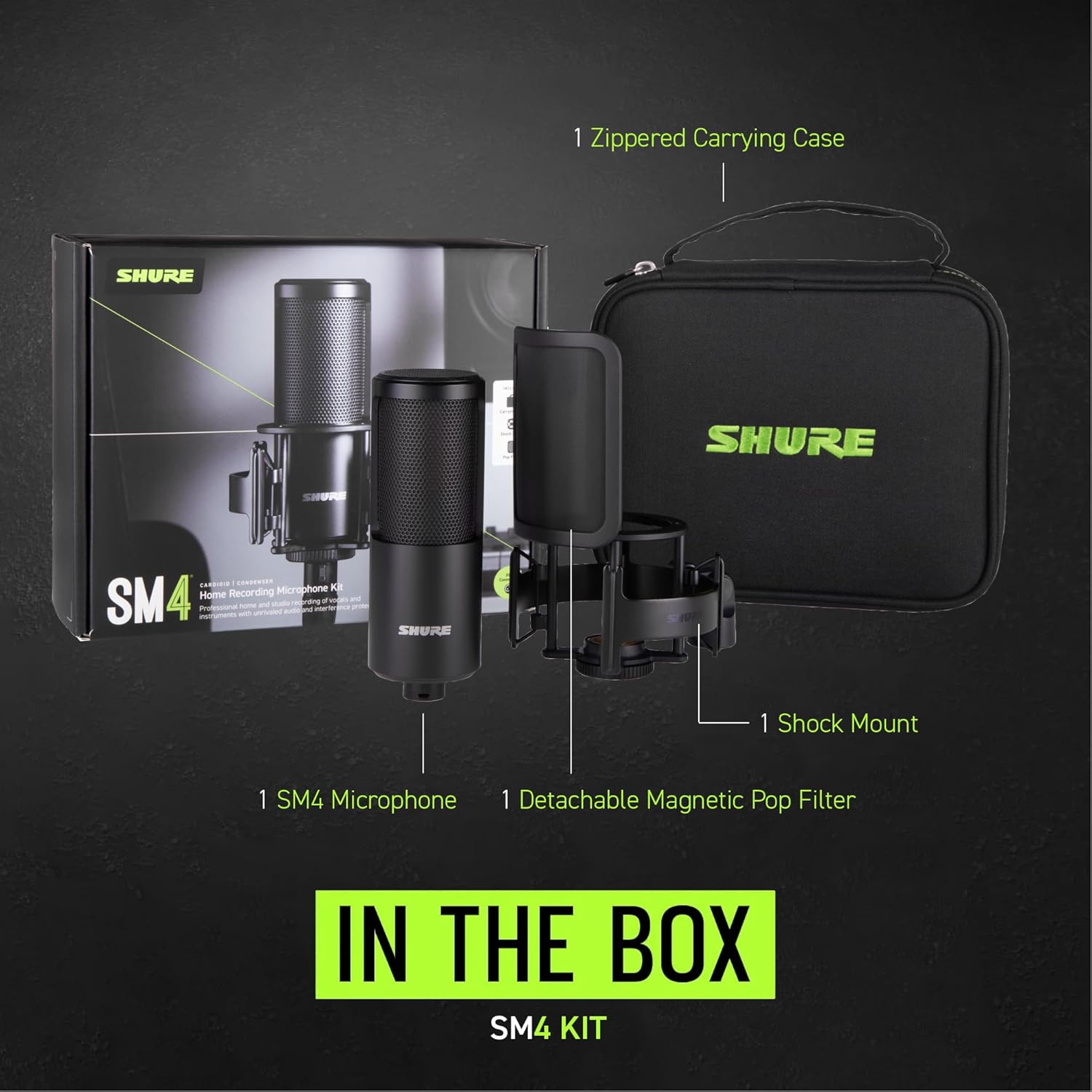
- detachable magnetic pop filter
- shock mount
- all-metal construction
- RF interference protection
- unidirectional polar pattern
- phantom power operation
The included pop filter and shock mount are especially useful for spoken-word recording.
Podcasting involves lots of close speech. That means plosives, mouth noise, desk vibrations, and small handling sounds can become a problem. Accessories like a pop filter and shock mount are not exciting, but they matter.
Designed for a Cleaner Vocal Starting Point
Editing software can improve podcast audio, but it cannot fully rescue a poor recording.
If your raw vocal track is full of interference, plosives, distortion, or room noise, you are already fighting uphill.
The Shure SM4 is designed to capture vocals with accuracy and low-frequency control. That may help spoken voices sound more stable and usable before compression, EQ, and noise reduction are applied.
For podcasters, this is important because a clean source recording usually makes the whole production workflow easier.
Useful for Solo Shows
If you record solo episodes, the Shure SM4 may suit your setup well.
Solo podcasters often need a microphone that can handle:
- long-form narration
- educational content
- opinion episodes
- scripted intros
- audio essays
- coaching-style episodes
- storytelling formats
Because the SM4 is designed for home studio recording, it may help your voice sound more focused and intentional.
It is especially useful if you record in the same position each time and can control your room reasonably well.
Good for Video Podcasts and Creator Setups
Many podcasters now record video as well as audio.
That changes the gear decision.
A microphone needs to sound good, but it also helps if it does not dominate the frame too much. The Shure SM4 has a sleek, low-profile design, which may appeal to creators who care about how their setup looks on camera.
This could matter if you create:
- YouTube podcasts
- livestream interviews
- online courses
- membership content
- webinar recordings
- creator clips for social media
A clean-looking microphone setup can make your recording space feel more intentional.
The XLR Factor
The Shure SM4 uses XLR, not USB.
That is both a strength and a limitation.
You will need:
- an audio interface
- phantom power
- an XLR cable
- recording software
- headphones
- a mic stand or boom arm
This makes the setup slightly more involved than a USB mic.
But it also gives you a better upgrade path.
With XLR, you can improve your interface later, add more microphones, use better monitoring, and build a more flexible podcast recording setup.
For serious podcasters, that matters.
Why Interference Protection Matters in Podcasting
Modern podcast setups are full of electronics.
You may record near:
- laptops
- smartphones
- Wi-Fi routers
- monitors
- chargers
- tablets
- lighting equipment
- cameras
The Shure SM4 includes interference shielding technology designed to reduce unwanted RF noise from wireless devices.
That does not mean every room problem disappears.
But it is a useful feature for home podcasters, especially if your recording space is also your office, bedroom, or desk setup.
Small noise problems can become annoying during long editing sessions. Anything that helps reduce those issues at the source is worth noticing.
Who the Shure SM4 Is Best For
The Shure SM4 microphone kit may be a good fit for podcasters who:
- want cleaner voice recordings
- are upgrading from a basic USB microphone
- already use or plan to buy an audio interface
- record at a desk or small home studio
- want a microphone with included podcast-friendly accessories
- care about long-term audio quality
- want an XLR setup from a trusted audio brand
It is best for creators who are ready to take audio a bit more seriously.
Who May Prefer Something Else?
This microphone may not be ideal if:
- you want the simplest setup possible
- you do not own an audio interface
- you record in a very noisy space
- you need a travel microphone
- you mostly record casual calls
- you want USB connection only
Some podcasters may also prefer a dynamic microphone if they record in untreated rooms with lots of background noise.
That is not a criticism of the SM4. It is just an honest buying consideration.
Condenser vs Dynamic for Podcasting
This is where buyers need to slow down.
A condenser microphone like the Shure SM4 can capture detail, clarity, and vocal nuance. That can be excellent for polished podcast recordings.
A dynamic microphone often rejects more room sound and can be easier in noisy or untreated spaces.
So the question is not simply, “Which is better?”
The better question is:
What kind of room are you recording in?
Consider the Shure SM4 if:
- your room is fairly quiet
- you want vocal detail
- you record close to the mic
- you are willing to adjust placement
- you want a more studio-style sound
Consider a dynamic mic if:
- your room has lots of echo
- your household is noisy
- you record near fans or traffic
- you want a more forgiving microphone
Practical Podcast Setup Tips
To get better podcast results with the Shure SM4:
- use the included pop filter
- keep your mouth a consistent distance from the microphone
- avoid recording directly beside hard walls
- lower room echo where possible
- monitor through headphones
- set gain carefully
- record a short test before every episode
- keep your phone slightly away from the recording chain
- use a stable stand or boom arm
Do not overcomplicate this.
A good podcast sound usually comes from clean habits repeated consistently.
Pros and Cons
Pros
- Strong fit for voice recording
- XLR connection supports a serious podcast setup
- Includes pop filter and shock mount
- Useful interference protection
- All-metal construction
- Low-profile design works well for creator desks
- Good upgrade from basic USB microphones
Cons
- Requires audio interface
- Needs phantom power
- Not ideal for people wanting USB simplicity
- May capture room sound in untreated spaces
- Extra setup knowledge required
Shure SM4 vs Entry-Level USB Podcast Mics
USB microphones are popular because they are simple.
For beginners, that simplicity can be useful.
But as your podcast grows, USB microphones may feel limiting. You may want better gain control, better monitoring, improved vocal tone, or a more expandable setup.
The Shure SM4 makes more sense if you are thinking beyond the first few episodes.
It is not just about recording today. It is about building a setup that can grow with your show.
Is the Shure SM4 Good for Interview Podcasts?
It depends on how you record.
For remote interviews, the SM4 can be excellent for capturing your side of the conversation clearly.
For in-person interviews, you would usually need one microphone per speaker for best results. One condenser microphone in the middle of a table is rarely ideal.
So if you run a solo podcast or remote interview show, the SM4 may be very useful.
If you regularly record multiple people in the same room, think carefully about your full setup.
Is It Good for Beginners?
Yes, but only the right kind of beginner.
If you want the fastest possible setup, a USB microphone may be easier.
But if you are a beginner who wants to learn proper recording habits, the Shure SM4 can be a strong first serious microphone.
You will need to understand:
- phantom power
- gain setting
- mic distance
- audio interface setup
- basic room control
None of this is impossible. It just requires a little patience.
Best Use Cases
The Shure SM4 may suit:
- solo podcasting
- educational shows
- creator commentary
- narration
- remote interviews
- video podcasting
- course recording
- voice-led content
- membership audio
- branded content
It is especially useful where vocal clarity and consistency matter.
Final Buying Thoughts
The Shure SM4 for podcasting is not a casual microphone for people who want the easiest possible route.
It is better suited to creators who want cleaner voice recordings, a more professional XLR workflow, and a microphone kit that includes useful accessories from the start.
Its pop filter, shock mount, interference protection, and condenser design make it a practical option for home podcast creators who care about sound quality.
If your podcast is becoming more serious, and you are ready to build around an audio interface, the Shure SM4 microphone kit is worth considering.
As an Amazon Associate, I earn from qualifying purchases. Thank you for supporting our work.
As an Amazon Associate I earn from qualifying purchases.
Take a closer look