
Simplicity Is The Secret
Why the Fender Frontman 10G Beats Complicated Modeling Amps Every Time
Let me tell you a story that might sound familiar.
You just bought your first electric guitar. You’re excited. You’ve waited years for this. You rip open the box, tune up, and then you look at the amplifier that came with your starter pack.
And your heart sinks.
Because that little black box has more buttons than a spaceship. There are 20 preset buttons labeled “Metal,” “Blues,” “Fusion,” “Surf,” “Crunch,” “Lead,” “Acoustic Sim” – whatever that means. There’s a digital screen. There’s a knob labeled “Amp Model” with 15 options. There’s another knob for “Effects” with reverb, delay, chorus, flanger, phaser, tremolo, and six others you’ve never heard of.
You have no idea where to start.
So you turn it on, press a few buttons randomly, and it sounds… not good. Thin. Digital. Fake. You twist knobs frantically, trying to find that classic rock tone you hear in your head, but you just make it worse.
Twenty minutes later, you put the guitar down. You feel stupid. You wonder if you made a mistake buying this thing.
Here’s the truth: it’s not you. It’s the amp.
The guitar industry has convinced beginners that they need “versatility” and “features” and “modeling technology” to sound good. But what a beginner actually needs is the exact opposite.
You need a simple guitar amplifier for beginners. An amp with no menus, no screens, no presets, and no confusion. An amp that sounds good the moment you plug in, with just a few knobs you can understand in five seconds.
That amp exists. It’s called the Fender Frontman 10G. And it might be the most honest, beginner-friendly amplifier ever made.
The Overwhelm Epidemic: Why Modeling Amps Hurt Beginners
Let me be blunt: modeling amps are amazing tools for experienced players.
If you’ve been playing for ten years and you know exactly what a “Tweed Deluxe” sounds like versus a “British Crunch,” then having 50 amp models at your fingertips is a dream. You can dial in a specific tone for a specific song in seconds.
But for a beginner? Those same features are a nightmare.
Here’s what happens when you hand a modeling amp to someone who’s been playing for three months:
Problem one: You don’t know what “good tone” sounds like yet. So when you scroll through presets, you can’t tell if “California Clean” is supposed to sound fizzy or if you did something wrong. You have no reference point.
Problem two: There are too many variables. If your tone is bad, is it the amp model? The gain setting? The EQ? The effects? The cabinet simulation? You change five things at once and have no idea what fixed it – or what broke it.
Problem three: You spend more time learning the amp than learning the guitar. The manual is 40 pages. There are YouTube tutorials. You need to understand signal chains and effect order and preset saving. That’s time you could have spent practicing your chord changes.
Problem four: The default presets often sound terrible. Manufacturers stuff modeling amps with extreme effects to show off. So preset 1 is “Clean” (okay), preset 2 is “Crunch” (fine), and preset 3 is “Metal with Delay and Flanger” (unusable for a beginner). You get lost in bad sounds.
A Fender Frontman 10G beginner amp solves all of these problems by simply not having them.
No menus. No presets. No modeling. No effects. No screen. No confusion.
Just a real amplifier that does one thing: makes your electric guitar sound like an electric guitar.
What You Actually Get: The Anti-Complication Manifesto
Let me walk you through the Fender Frontman 10G from the perspective of someone who just wants to play.
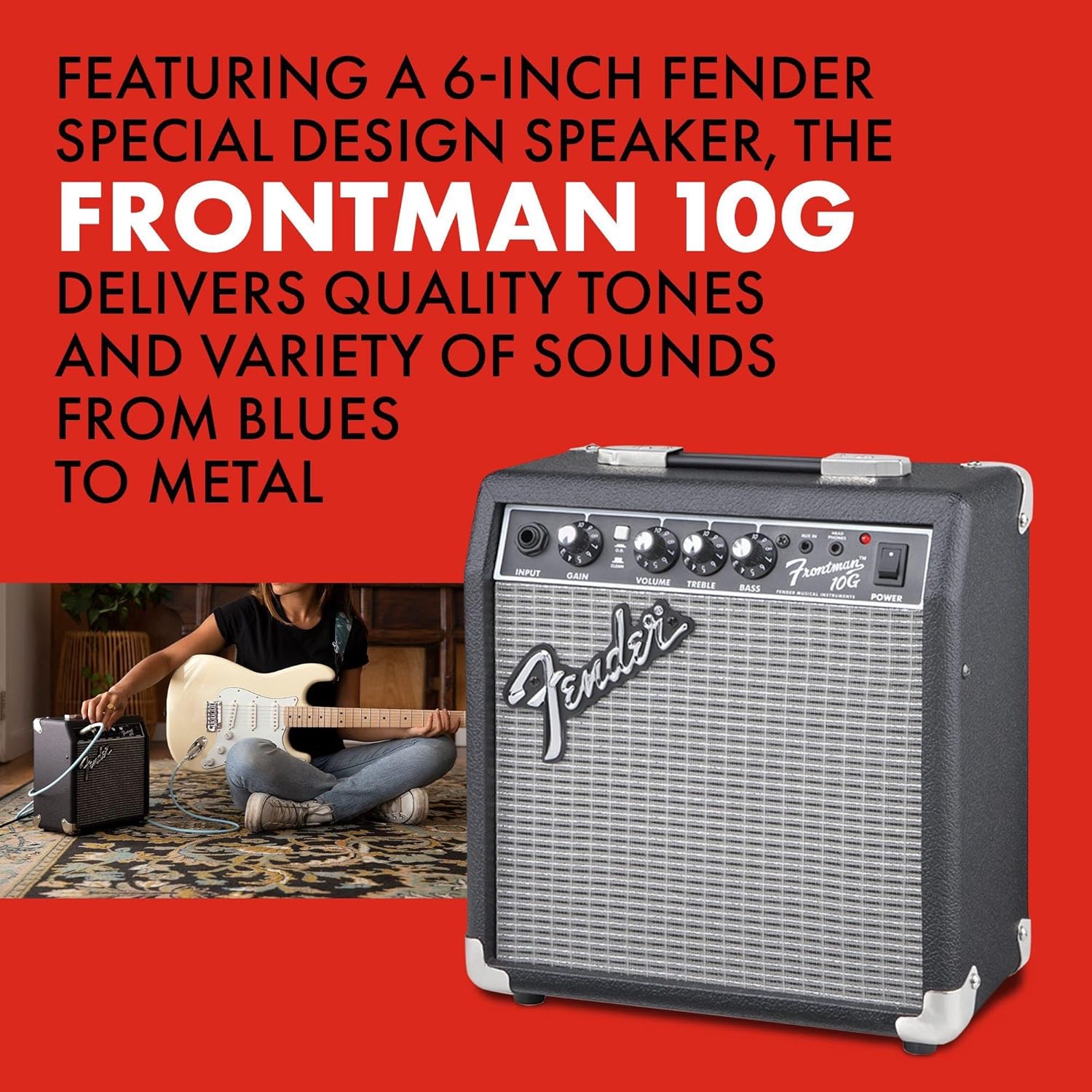
The Control Panel: Five Knobs, One Switch
When you look at the front of this easy to use practice amplifier, here’s exactly what you see:
- Input Jack – Plug your guitar cable in here. That’s it.
- Overdrive Select Switch – A small push-button. Up = clean channel. Down = overdrive channel.
- Gain – Turn this up for more distortion. Turn it down for cleaner sound.
- Volume – Turn this up for more loudness.
- Treble – Turn this up for more high frequencies (brightness, sparkle). Turn it down for smoother, darker tone.
- Bass – Turn this up for more low frequencies (thump, warmth). Turn it down for tighter, leaner sound.
That’s the entire amp.
Here’s how you learn it in 60 seconds:
- Set the Overdrive Select switch to the up position (clean channel).
- Set Gain to 3, Volume to 3, Treble to 5, Bass to 5.
- Play your guitar. It will sound clean and pleasant.
- Turn Gain up slowly. Listen as the sound gets dirtier and more aggressive.
- Flip the Overdrive switch down. Now the Gain knob does even more.
- Twist Treble and Bass. Hear how they change the character.
That’s it. You now understand 100% of what this amp can do. There is no hidden menu. There is no secret setting. There is no “advanced” mode that requires a PhD.
This is a no-fuss electric guitar combo designed for humans, not engineers.
The Speaker: 6 Inches of Honest Tone
The 6-inch Fender Special Design speaker is not trying to impress you with specs. It’s not a 12-inch Celestion. It’s not a high-wattage monster.
But here’s the thing: it sounds good.
Good in a way that teaches you what a real guitar should sound like. The mids are present. The highs are smooth, not piercing. The lows are round, not flabby. When you play a clean chord, it rings. When you dig in, it responds.
For a simple guitar amplifier, this speaker is perfectly matched to the circuit. It doesn’t exaggerate anything. It doesn’t hide anything. If you play sloppy, you’ll hear it. If you play well, you’ll hear that too. That’s exactly what a beginner needs: honest feedback.
The Power: 10 Watts of Friendly Volume
Ten watts through a 6-inch speaker is not loud enough to bother the neighbors (unless you really crank it). But it is loud enough to fill a bedroom, a dorm room, or a small living room.
More importantly, the volume control works like you’d expect. Turn it a little, it gets a little louder. Turn it a lot, it gets a lot louder. There’s no weird jump where volume goes from “silent” to “deafening” in one millimeter of rotation.
That predictability matters when you’re learning. You can trust the amp to behave.
The Hidden Benefits of Simplicity (That Nobody Talks About)
When people recommend the Frontman 10G, they usually talk about sound quality and price. But there are deeper benefits to a simple guitar amplifier for beginners that go way beyond tone.
Benefit One: You Learn What Knobs Actually Do
On a modeling amp, twisting a knob might do different things depending on which preset you’re in. On the Frontman 10G, the knobs always do exactly the same thing.
That means you can actually learn what gain does. You can experiment with treble and bass and immediately hear the results. You build an intuitive understanding of tone shaping that will serve you for your entire guitar journey.
Years from now, when you buy a tube amp or a high-end modeler, you’ll already know how to dial in a good sound because you learned on this little Fender.
Benefit Two: You Focus on Playing, Not Tinkering
I’ve watched friends spend 20 minutes tweaking their modeling amp before playing a single note. Then they play for five minutes, decide the tone isn’t right, and spend another 15 minutes tweaking.
That’s not practice. That’s procrastination disguised as tone-chasing.
With the Frontman 10G, you plug in, you set the knobs to a sensible place (noon on everything is a great start), and you play. The amp gets out of your way. You spend your limited practice time actually practicing.
Benefit Three: It’s Forgiving of Mistakes
On a hyper-accurate digital modeler, every tiny mistake sounds magnified. That can be demoralizing for a beginner.
The Frontman 10G is solid-state analog. It’s slightly forgiving. It smooths out the rough edges without hiding your mistakes. You still hear when you flub a note, but you don’t feel like the amp is judging you.
That psychological safety is huge when you’re building confidence.
Benefit Four: It’s Nearly Impossible to Break
No screen to crack. No digital processor to freeze. No firmware updates. No USB port to snap off.
The Frontman 10G is a tank. It’s a simple circuit board, a transformer, a speaker, and a wooden box wrapped in black vinyl. You could drop it down a flight of stairs (please don’t) and it would probably still work.
For a beginner who might be rough on gear, or for a parent buying for a child, that durability is pure gold.
Three Kinds of People Who Need This Simplicity
The Absolute Beginner (Any Age)
You’ve never owned an amp before. You don’t know the difference between preamp gain and power amp distortion. You don’t care. You just want to learn “Smoke on the Water” and feel like a rock star.
The Fender Frontman 10G is your perfect first amp. It’s simple enough that you’ll be playing in under a minute. It sounds good enough that you’ll be excited to play every day. And it’s cheap enough that you won’t feel guilty if you upgrade later.
The Frustrated Modeler Owner
You already bought a modeling amp. And you hate it. You spend more time reading forums about “patch settings” than actually playing. You feel like the amp is fighting you.
Sell that modeling amp. Buy a Frontman 10G. Rediscover why you wanted to play guitar in the first place. Simplicity isn’t a limitation – it’s freedom.
The Parent Shopping for a Child
You don’t play guitar yourself, but your 10-year-old wants to start. You’re overwhelmed by the amplifier options. You just want something safe, durable, easy to use, and not insanely loud.
This is your amp. The Frontman 10G has no complicated features that will confuse your child. It’s built tough. It’s affordable. And it comes with a 2-year warranty. Buy with confidence.
Sound Deep Dive: What It Actually Sounds Like (No Hype)
Let me describe the tones you’ll get from this easy to use guitar amp in plain English.
Clean Channel (Overdrive Switch Up)
With Gain set low (1-3): Sparkling, clear, slightly warm. Think early Beatles, surf rock, country, jazz. Great for practicing chords, scales, and fingerpicking.
With Gain set medium (4-6): Pushed clean. Slight hair on the notes when you hit hard. Perfect for blues, classic rock rhythm, and anything that needs a little attitude without full distortion.
With Gain set high (7-10): Actually starts to break up into mild overdrive. This is where the Frontman 10G surprises people. It’s not a metal tone, but it’s a satisfying, gritty crunch. Think The Black Keys or early White Stripes.
Overdrive Channel (Overdrive Switch Down)
With Gain low (1-3): Light, touch-sensitive breakup. Responds to your pick attack. Great for blues leads and classic rock riffs.
With Gain medium (4-7): Thick, saturated rock crunch. Perfect for Green Day, Foo Fighters, Tom Petty, and anything in that neighborhood.
With Gain high (8-10): Heavier but still articulate. Not modern metal – think 70s hard rock, early Van Halen (brown sound lite), and punk rock.
EQ Tips for Beginners
- Too bright/harsh? Turn Treble down to 3 or 4.
- Too muddy/dark? Turn Treble up to 7 or 8.
- Too thin/weak? Turn Bass up to 7 or 8.
- Too boomy/flabby? Turn Bass down to 3 or 4.
- For classic rock: Gain 6 (clean channel) or Gain 4 (overdrive channel), Treble 6, Bass 5, Volume to taste.
- For clean jazz: Gain 2 (clean channel), Treble 4, Bass 6, Volume to taste.
- For crunchy blues: Gain 7 (clean channel), Treble 6, Bass 7, Volume to taste.
You don’t have to memorize any of this. Just twist knobs until you like what you hear. That’s the beauty of simplicity.
Pros and Cons (Simplicity Edition)
Pros ✅
- Zero learning curve – Anyone can use it immediately
- No menus, no screens, no apps – Just knobs that do one thing each
- Teaches you what amp controls actually do – Builds foundational knowledge
- Honest, unforgiving in a good way – You hear your playing clearly
- Durable and simple inside – Nothing to break or glitch
- Great clean tone for practice – Encouraging, not exhausting
- Surprisingly good overdrive – Classic rock crunch, not digital fizz
- Takes pedals well – When you’re ready to experiment, it works
- 2-year warranty – Fender stands behind it
- Very affordable – Leaves budget for a better guitar or lessons
- Compact size – Fits on any desk or shelf
- Works with any electric guitar – Truly universal
Cons ❌
- No effects built in – You’ll want a reverb or delay pedal eventually
- Not for metal – Doesn’t have the gain or low-end thump for modern heavy styles
- No line out for recording – Can’t plug directly into a computer
- Speaker is only 6 inches – Won’t sound huge (but it’s honest)
- No battery option – Must be plugged in
- Not loud enough for jamming with a drummer – Strictly a practice amp
- Experienced players might find it limiting – This is for beginners, not pros
Questions from Real Beginners (And Honest Answers)
Q: I’m 50 years old and just starting. Is this amp too “kiddie” for me?
A: Not at all. Age doesn’t matter. The Frontman 10G is a serious tool for anyone who wants a no-nonsense practice amp. Many experienced players keep one around for quick practice sessions.
Q: My friend has a 100-watt amp. Is mine going to sound tiny compared to his?
A: Yes, if you’re in the same room and he’s cranked. But you’re not competing. You’re practicing. His amp is too loud for home use anyway. Your amp is perfect for where you are right now.
Q: Will I outgrow this amp quickly?
A: That depends. If you start playing in a band with a drummer in six months, yes – you’ll need something louder. But if you’re a home player, you might never outgrow it. Many intermediate and advanced players keep a small practice amp like this forever.
Q: Can I use this for acoustic-electric guitar?
A: Yes, absolutely. Set the gain low (1-2) and use the clean channel. It won’t sound as natural as an acoustic amp, but it’s fine for practice.
Q: Does it come with a cable?
A: No, you’ll need to buy a standard 1/4-inch instrument cable separately. Don’t forget that.
Q: I see cheaper amps on Amazon. Why should I pay more for the Fender?
A: Because those cheaper amps sound terrible. They’re made of plastic, the speakers buzz, and the tone is so bad you won’t want to practice. The Fender costs a little more because it’s a real instrument, not a toy. Your practice time is valuable. Don’t waste it on garbage.
Q: What if I want reverb?
A: Buy a cheap reverb pedal (like the Joyo or Behringer) for $30-40 and plug it between your guitar and the amp. Problem solved. And now you’ve learned how pedals work.
Q: Is the 2-year warranty worth registering?
A: Yes. Do it immediately. It takes two minutes on Fender’s website. You’ll thank yourself if anything goes wrong (it probably won’t, but still).
A Letter to the Beginner (Read This)
I remember my first amp.
It was a tiny, no-name piece of garbage that came with my first guitar. It buzzed constantly. The overdrive sounded like a mosquito in a jar. The clean tone was thin and lifeless. I hated it, but I didn’t know any better. I thought all small amps were that bad.
I was wrong.
I just hadn’t met the Fender Frontman 10G yet.
This little amp won’t make you a better guitarist overnight. It won’t teach you chords or scales. It won’t fix your sloppy timing.
But it will do something more important: it will get out of your way.
It will let you focus on the music. It will reward your good playing and honestly show you your mistakes. It will sound good enough that you’ll look forward to plugging in, not dread it.
And when you finally play that first song all the way through – clean chords, a simple solo, a satisfying ending – you’ll realize that the amp didn’t matter nearly as much as your own persistence.
But the amp helped. It didn’t fight you. It just worked.
That’s the gift of simplicity. And that’s what the Fender Frontman 10G offers.
You don’t need a spaceship. You need a friend. A reliable, straightforward, good-sounding friend that sits on your desk and waits for you to play.
This is that friend.
Your Move: Stop Overthinking and Start Playing
You’ve read the article. You’ve seen the pros and cons. You know this is the simple guitar amplifier for beginners that cuts through the noise – literally and figuratively.
You could spend another week watching video reviews. You could read forum arguments about whether the Boss Katana Mini is “better.” You could drive yourself crazy comparing specs that don’t matter for where you are right now.
Or you could click the button below, order the Frontman 10G, and spend that week actually playing guitar.
The choice seems pretty clear to me.
Ready to Simplify Your Life?
Click the link. Buy the amp. Plug in your guitar. Turn the knobs until you smile.
That’s it. That’s the whole process.
And in a world of endless complexity, that simplicity is the rarest thing of all.
[CLICK HERE TO GET YOUR FENDER FRONTMAN 10G ON AMAZON]
No menus. No confusion. Just music.
As an Amazon Associate, I earn from qualifying purchases.
As an Amazon Associate I earn from qualifying purchases.
Take a closer look